

The European Brazil. The best team to never win anything – then the best team never to exist. And the very definition of football being so much less than a matter of life and death. To think that a European country could fall asunder in such bloody violence; to think that slaughter occurred in what are now city-break destinations like Dubrovnik, in our lifetime; and to think that the men in the picture above – who made it to the quarter-finals of Italia 90, topped their group in the Euro 92 qualifiers ahead of eventual champions Denmark, and many of whom were European Champions in 1991 with Red Star Belgrade / Crvena Zvezda – would have their lives, and those of their families and friends, turned upside-down by war, is almost surreal to us today.
As in any society, however, the game of the masses gave expression to the divisions and tensions in the country. The serious rioting at the Maksimir stadium in Zagreb on the 13 May 1990 in a game between Red Star Belgrade (now in Serbia) and Dinamo Zagreb of separatist Croatia is regarded as a manifestation of the internal problems and a harbinger of things to come. Some even regarded it as the start of the war, as examined by Ivan Đorđević here . And while the scenes below don’t look unlike those we grew up seeing on BBC in the 70’s and the 80’s in English football, it’s the nationalist sentiment behind it which gives it meaning. No-one died in the riot. It could easily have been another Heysel. But the people of Yugoslavia would suffer enough soon.
To return to on-field footballing matters, Yugoslav history in the game is one of near-glories. Their only title came in the 1960 Olympic games. They were runners-up in 2 European Championships in 1960 and 1968, and semi-finalists in the 1962 World Cup. They assumed the epithet “Brazil of Europe”, seeing themselves as the representatives of samba football on the old continent. As Jonathan Wilson relates in his illuminating book on Eastern European football, ‘Behind the Curtain’, Red Star’s ground was known as the “Marakana” after Rio’s arena, and for Pele’s testimonial in 1971, it was the Yugoslavs chosen as Brazil’s opposition, rather than the more obvious European giants. But they never scaled the heights of their South American inspirations. And they should have. They really should have. Throughout the 1970’s and 1980’s they were a very strong side but never got beyond nearly men. Here they are beating World Champions Argentina in a friendly – back when they mattered somewhat – in 1979. That Susic lad looked alright.
At Italia 90, they finished 2nd in their group to West Germany, beating both the United Arab Emirates and Colombia. In the second round they beat the Spain of Butragueno, Michel and Zubizaretta 2-1 after extra time. Dragan Stojkovic scored twice. The second a wonderful free-kick, but the first epitomised absolute composure. Wonderful stuff.
In the quarter final, they lost out 3-2 on penalties to then World Champions and eventual finalists Argentina.
But it was the next tournament that would bring the end of Yugoslav football as we knew it. Their golden generation had won the World U-20 Championship in 1987, as described by Jonathan Wilson (again) here, and they were beginning to come of age. In qualifying for Euro 92, they won 7 out of 8 games. They scored 24 goals and conceded 4. They won every away match 2-0. Darko Pancev scored 10 goals, the top scorer in qualifying, and only France garnered more points.
They qualified on the 13th November 1991. Seven days later the massacre at Vukovar happened. Mass graves of 200 people were discovered there. 60 more went missing in the worst war crime since WWII. The siege of Dubrovnik started on October 1st 1991 where over 400 had died before the siege lifted on the 31st May 1992, 10 days before the Euros kicked off, and the day that what remained of Yugoslavia was kicked out of the competition.
Danish players were called in from their holidays and told they were back in as runners-up to Yugoslavia in qualifying. As you know, they won the tournament. In all of the “what-ifs” that dominate football conversations across the world, this is surely one of the biggest. And as the nations that made up Yugoslavia splintered in football into Croatia, Yugoslavia, Macedonia, Slovenia and Bosnia-Herzegovina in the 1990’s, and further into Serbia and Montenegro later on, even greater what-ifs emerged.
Yugoslavia had surely one of the best teams available to any nation in 1994, had that nation still existed and been allowed to enter the tournament. Instead they were suspended. Surely Croatia’s performances in Euro 96 and France 98 alone justify some hyperbole, battering the Danish champions 3-0 in Sheffield and then finishing 3rd in the World Cup in France, demolishing Germany 3-0 in the process, while the rump Yugoslavia team narrowly lost out to the Dutch in the second round.
Croatia could call upon Igor Stimac, Slaven Bilic, Robert Prosinecki, Davor Suker, and Zvonimir Boban. Yugoslavia fielded Predrag Mijatovic, the unforgettable (for many reasons) Sinisa Mihajlovic (below) and the genius Dragan Stojkovic. Together Christ knows what damage that team could have done at USA 94!
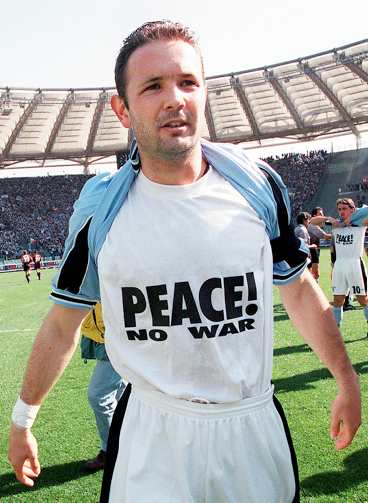
In Euro 2000 qualifying, both teams were drawn together, with Macedonia. And with Ireland. How good was that Irish team that we were seconds away from finishing top of that group. But for that desperate, desperate, late goal conceded in Macedonia. Yugoslavia won the group in the end. Croatia finished 3rd behind us. And we lost out to Turkey in the play offs. Unfortunately a 6-1 hammering by the Dutch in the quarter-final ended the Yugoslavian journey. For good.
The death of Yugoslavia took with it potential for one of the great European teams in the early and mid-90’s. As good as France in the late 90’s and Spain in the last decade. The new nations fielded some of the greatest European players of that decade. As a sign of their quality, it can be said that Former Yugoslavia countries have given European football many multiples of world class players than former Soviet republics, including Russia. People scoff when they see countries like Bosnia drawn out of the hat, until they realise Dzeko is up front. And how could a Yugoslavia team look today?
Begovic – Bosnia and Herzegovina (Chelsea)
Ivanovic – Serbia (Chelsea)
Kolarov – Serbia (Man City)
Lovren – Croatia (Liverpool)
Darijo Srna – Croatia (Shakhtar Donestsk)
Matic – Serbia (Chelsea)
Rakitic – Croatia (Barcelona)
Modric – Croatia (Real Madrid)
Pjanic – Bosnia (Roma)
Mandzukic – Croatia (Juventus)
Dzeko – Bosnia (Roma)
There is not a national team on the planet that these guys wouldn’t put it up to. And almost all would be torn asunder. Ireland lost out narrowly to Yugoslavia in Euro 2000 qualifying and finished ahead of Croatia. When you look at some of the Serbians and Croats listed above, and their clubs, it’s difficult to see how we could now. We were hammered 3-1 by Croatia in Poland and while we overcame Bosnia comfortably enough in the play-offs, we will be severely tested by Serbia in the next World Cup group.
Yugoslavia gave the world some magnificent footballers. Out of the ashes of war and genocide, 6 new countries emerged. And 6 new footballing nations. But the team that never played in Sweden in 1992 and the USA in 1994 will always be regarded as their best. Yugoslavia, and the nations that emerged, particularly Serbia and Croatia, are the epitome of great football cultures. Truly great players. Reliable players. Strong players. And some truly phenomenal teams.

 A Yard of Grass