

Against Switzerland on Friday, Good Friday, the Republic of Ireland national football team will wear a jersey emblazoned with the above image. It is certainly a uniquely nationalist sentiment being expressed officially by the Football Association of Ireland for my lifetime. The collective angst behind the national question, and its expression in this divided soccer island by the almost unique presence of two teams representing Ireland in the sport, is worth exploring. We know the reasons behind the split; a Belfast bias; political conflict; and the refusal to move a cup game etc. Decades of warming and cooling relations between the FAI and IFA have followed with talk of reunification on a few occasions throughout the 1970’s. But for people of my generation, the football split on this island is defined by that night in November 1993. The vitriolic hatred of the Windsor Park crowd as the Republic struggled to get to USA 94, and the sectarian rabble-rousing of Northern Ireland’s manager Billy Bingham as they led 1-0, has yet to fade. Thoughts of reunification since have been largely left to the academics and the what-if brigade.
Going back to the beginnings, Football first came to Ireland in the 1870’s with the British Army. And unlike Rugby and other sports, its headquarters were in Belfast. David Goldblatt’s monumental tome “The Ball is Round”, first published in 2006, puts this down primarily to geography and Belfast’s accessibility to the west of Scotland, as he calls it a “football hotbed” at the time. The IFA established the Irish Cup in 1881 and a league in 1890, as the Belfast and northern teams dominated. Bohemians were the first Dublin club to reach the final in 1895 where they lost 10-1 to Linfield. Finally, Shels beat Belfast Celtic 2-0 to win it in 1906, in only the 2nd final to be staged in Dublin.
If you can imagine, the footballing backdrop to the early 20th Century in Ireland was already volatile. You had a league run by mainly Protestant administrators in Belfast, with a number of teams in Dublin – Bohs, Shels and Sandymount’s brilliantly named Freebooters FC – challenging their dominance. Meanwhile the GAA was embedding itself into Irish nationalism, as part of the on-going Gaelic cultural revival. In a certain sense, a troika was formed within which every true Gael could wrap himself or herself – Nationalism, the Catholic Church and the GAA. As soon as the GAA was formed, it expanded its remit beyond merely promoting their games by expressly seeking the suppression of British Games, most notably through Rule 27, known as the Ban, and which stated that “Any member of the Association who plays or encourages in any way rugby, football, hockey or any imported game which is calculated to injuriously affect our National Pastimes, is suspended from the Association”. As in you play our games and you play no other, particularly British games. And Football was a British game – the garrison game. When Liam Brady was expelled from St. Aidan’s CBS for playing a sport at which he would go on to become a national and international icon, it was decisions made in the 1880’s that can be thanked.
And it was the GAA and Gaelic Football that thrived in the pre-Rising era, pre-Revolutionary Ireland. By the start of the 20th Century, All-Ireland finals were attracting the same crowds as the FA Cup Final in England as the national games were established as a cornerstone of our culture. And to be fair to the GAA, it should be borne in mind that Football indeed was essentially a British game and in my opinion, at that time it was probably both fair and reasonable for it to be viewed by the Gaelic revivalists as a rival to our own. It wasn’t a world game in the sense it is now. Had the GAA and the Irish Establishment known what nationalist aims and objectives would be met by the “garrison game” across the globe by many nations, old and new, including among England’s most bitter foes throughout the 20th Century, maybe they would have been happy to promote football and beat the Brits at their own game. Maybe that is naive, idealistic revisionist nonsense, but jaysus when else but this year will it be allowed!!!
Beating the Brits at their own game, however, is exactly what Ireland did in 1914, when they won the Home Championship. Captained by Catalan national hero Patrick O’Connell, or Don Patricio as he is known there, where he is regarded as the man who saved Barcelona FC during an era of desperate turmoil in Spain (His is one of Irish Football’s most incredible stories), Ireland beat Wales 2-1 in Wrexham, England 3-0 in Middlesbrough, and drew 1-1 with Scotland in Windsor Park.
Ireland 1914 Home Nations Champions

Then World War I happened. The Irish Cup continued but the league was suspended in 1915, as war efforts trumped almost everything. Ireland would remain champions for some time. Football continued, on a limited basis, in Dublin and Belfast. In The Origins and Development of Football in Ireland by Neal Garnham, it is said that over 20,000 attended games in Belfast. It was almost a boom time as this working-class game gave solace and escape from the war.
As for the GAA during the Great War, the same source relates stories of the Association as late as 1915 staging charity games for wounded servicemen – Irishmen serving in the British Army. They may not have had a firm policy on where to focus its political energies as the Volunteers began to organise, with several hundred GAA members among them, but a British inquiry into the Rising certainly concluded that the GAA was a subversive force within Ireland and central to the rebellion. The GAA strenuously denied this. According to Paul Rouse writing in the Irish Independent, 302 members from 53 clubs were involved from the 1,500 or so rebels. It was a significant contribution but they were far from hand in glove, and certainly not reflective of any official line. Far more members fought in Europe for the King, reflecting the general population as the Association always has. Later in 1916, the GAA even met with General Maxwell to discuss the entertainment tax issue, which could have had a serious adverse effect on sport in Ireland. He was the man put in charge in Easter Week by the British authorities and the man primarily responsible for killing the leaders of the Rising, after whom so many GAA clubs and grounds are now named. That very same organisation would also go on, many years later, to perpetrate the myth that Hill 16 was made from the rubble of the Rising. It was a total fabrication. Hill 60, as it was originally known, was named after a hill in Gallipoli where the Connaught Rangers suffered many casualties fighting for King and Country. Senior figures in the Association just decided to rename it in the 1930’s to distance itself from a British war and thought using the Easter Rising, and all the trappings of the rebellion, was a good idea.
However, no one seems to have asked how many football players were involved in the Rising. Dozens? Hundreds? Any collection of Dubliners, in particular, at that time would have had many footballers among their ranks, but there is seemingly no evidence to hand online (this is a blog not a PhD. Feel free to contact me if you have any info) of Bohs, Rovers or Shels players in the Volunteers or the Irish Citizen Army. The most famous link between our sport and the Rising would have to be Oscar Traynor. Many of you will have played in the Oscar Traynor Cup at some point in your schoolboy football life, named after the former President of the FAI and a Volunteer in the Easter Rising. I think I might’ve won it once with Portmarnock in the 80’s – I’ll check, but for now, Yes I did.
But perhaps the most public link between the Rising and football was from the 1966 FAI Cup Final, which was scheduled for the exact 50th anniversary of the rebellion, rather than Easter weekend – April 24th, in Dalymount. On that occasion, related on Come Here To Me, over 200 Volunteers paraded in front of and saluted fellow rebel, then President Eamon De Valera. The Irish Independent reported that the event “was a historic occasion with the freedom fighters of 1916 taking part beforehand in ceremonies which would have brought joy to the heart of the late president of the FAI, Oscar Traynor.” It was a terrible match in which Shamrock Rovers beat Limerick 2-0. In goal for Rovers that day was my Grandmother’s brother Mick Smyth, a man who was seemingly followed by league titles and FAI Cups wherever he played. I must ask him about that match one day. Raidio Éireann (now RTÉ) did not even bother to broadcast it. We would have to wait almost another 50 years before that particular institution realised we had a domestic game.
1916 Volunteer and FAI President Oscar Traynor

Going back to 1916, we all know what happened after Traynor and the Rising was defeated. The War of Independence, the Treaty and the Civil War all caused untold upheaval in all aspects of Irish life. And the island came out the other side divided. And Irish Football divided with it. To an outsider today, the latter would seem obvious. Why would 2 separate states have one football team? But back then, things were very different in that sense. International football had yet to bed down, with over a decade to go before the first World Cup, and FIFA just over a decade in existence. It was flexible, particularly in the old singular nation-state of Great Britain and Ireland, which had 4 “international” football teams. “Ireland” would still go on to refer to the entire Island. Both associations could pick players from each jurisdiction. And they did. Many players played for both, but the situation could not persist as international football became much more organised and much more important. As perhaps a sign of this increasing relevance, England competed in a World Cup for the first time in 1950.
Around the same time, FIFA decided it had enough of the IFA /FAI confusion, which had facilitated 4 southern players playing for both teams in the 1950 World Cup qualifying campaigns. By today’s standards, that seems ridiculous, but it happened. And in 1953, the name “Ireland” was removed from international football, replaced by the “Republic of Ireland” and “Northern Ireland”. Again, to an outsider, there appears to be nothing illogical. From a Rugby, Cricket, Hockey, Boxing etc. etc. perspective, it copper-fastened a partition that even the Irish Constitution accepted as merely a temporary arrangement. Seen from that perspective, the game of the masses legitimised division. But from another perspective, the Republic of Ireland National Football Team was the only sporting expression of the State, the new Republic, on an international stage. In other aspects of life – particularly economics and the new state enterprises, all that could be done to give expression to the new Republic was done. Could the football team have been regarded similarly? It stood under a tricolour with players who were therefore expressing some degree of loyalty to the Republic, either in its 26 County form, or in its 32 County form “pending re-integration of the national territory” as our own Constitution said up to 1999. They were not playing in and for Belfast but in and for Dublin. And it has been such ever since. Granny rule imports and those born north of the border all stood for Amhrán na bhFiann and there was to be no new accommodating anthems required. Whether you agree or not, in an Irish sporting context, it’s a perspective unique to football.
But as in any sport, it’s the results that really matter. Notwithstanding a good showing in the 1958 World Cup in Sweden where they were quarter-finalists in a 16-team tournament, going further than England or Hungary, success really came to Northern Ireland in the early 80’s and to the Republic from the late 80’s to the mid 90’s – the Charlton era – with several near-misses and heartbreaks under Mick McCarthy. 2 tournaments followed for the Republic in 2002 and 2012 – the former dominated by the absence of Roy Keane, the latter by the absence of the whole lot of them.
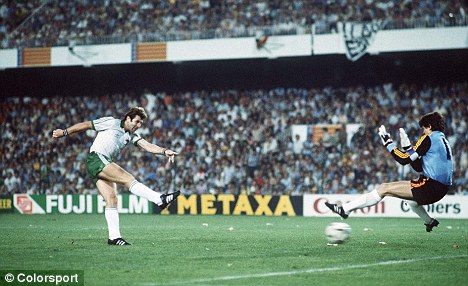
Spain 0 – 1 Northern Ireland in Valencia, World Cup 1982
Which brings us all the way up to 2016; 100 years after the seeds were sown in the freedom but eventual division of the Country and 102 years after Ireland beat England 3-0 away to become Home Champions. We look forward to an historic European Championships – the first time that this entire football island will compete in a major tournament. This fact is truly worth drinking in for a while. If you are a southerner, how will you watch Northern Ireland? Do you care? Do you hate their residual sectarianism? Do you regard them as much Brits as Irishmen? Or will you support them? Will you take pleasure if the Boys in the other shade of Green do well? If you’re a nationalist from Northern Ireland whose father and grandfather supported the Northern Irish team in the 1980’s World Cups, will you support them too? Maybe think about it now. Then reflect on those thoughts when they line up in June, particularly if Northern Ireland line up to a new anthem, as has been proposed, by virtue of England potentially dropping God Save the Queen (I have not heard any update on this proposal from January). The scars of November 1993 are still open, and there is certainly zero affection to this day for the “Free State” team in the stands of Windsor Park. But can this summer change things in that direction as well?
Michael O’Neill, manager of Northern Ireland, did more than most to put southern Irish domestic football on the international map. His back-to-back league titles with Shamrock Rovers and that unbelievable European run have yet to be matched 4 full seasons on. And of all the clubs, it was Shamrock Rovers he did it with – a club, some of whose fans were chanting “IRA” throughout a Setanta Cup game against Linfield a few years back, and who ripped up the odd seat in Windsor in the return tie. (As a Rovers fan, I like to think I’m in the better-behaved majority.) A Catholic former minor Gaelic footballer managing that same national team whose fans Billy Bingham whipped into a sectarian frenzy. And of course, the Republic managed by the other M. O’Neill. His father was a founding member of Padraig Pearse’s Kilrea GAA club. A Derryman. Both managers represented Northern Ireland with distinction. Martin captained them in the 1982 World Cup in which they beat the Spanish hosts and the pair have 95 caps between them.
Martin and Michael O’Neill
 A
A
To give a personal view, Yard of Grass is a one-man operation based in Harold’s Cross, Dublin. My background means I have no real interest in nationalism as it has been generally defined for several decades in Ireland. I know my history well enough but know and sing no rebel songs. I do not support Glasgow Celtic. I do not believe doing so is necessarily an “Irish” thing to do, or hating Glasgow Rangers for that matter. I do support Liverpool but also Shamrock Rovers. Like everyone around me in Tallaght that night I had no time for the IRA chants, and am glad they haven’t appeared in Lansdowne for a long time, as far as I’ve heard from the south stand. As a Dub, I have no true grasp of the descent of the Northern Irish football crowd into a sectarian outfit in the 90’s and 00’s. And I fully support James McClean in his stance on the poppy. Some of you will nod and accept the above. Some of you maybe screaming at the screen and preparing comments in your heads. But that’s the heart of the Irish National Football Question.
We grow up, most of us, supporting English teams and/or one Scottish team. We ignore, most of us, the league on our doorstep – y’know the one that Paul McGrath and Wes Hoolahan et al came from. We, most of us, are at least a little bit nationalist, and would see Irish reunification as something that could happen eventually. We like the Northern Irish, particularly Catholics who all support the Republic, but also nice decent Protestants. Ulster rugby fans are ok when it’s 6 nations or RWC time. Graeme McDowell and Alex Higgins too.
But the football team and their fans? This is a different story altogether. Perhaps, like any football crowd, including our own, gobshitery is inevitable, but from the small minority. Efforts to eradicate sectarianism are welcome and are working. Michael O’Neill is to be commended for his stance on trying to create a team for the whole community. And as the nascent “Northern Irish” identity grows – neither Irish nor British – perhaps nationalists will see that team as a viable and moreover desirable option once again. But it’s a long road from Neil Lennon being forced out by sectarianism to Catholic nationalists lining out to that anthem in large numbers again.
But looking to the bigger question. Can the IFA and FAI ever reunite and can we ever have one national football team and one league? Of course we can. If we want. I ask again that you consider the earlier point on how we will all feel in the Republic watching Northern Ireland in France, and I will revisit this in June. It would also be interesting to hear from moderate Northern Irish on both sides as they watch the Republic. The last time a team represented the whole island was in 1973 when playing as Shamrock Rovers XI, they lost 4-3 to Brazil in Lansdowne and according to the University of Ulster, 39% of Protestants now favour an all-Ireland team and 70% of Catholics. The growing cross-community appeal of the Northern Irish team was also noted in that research. These are not small figures. Imagine had the poll been carried out in Windsor Park in 1993.
Shamrock Rovers XI Reunited
Logistically and politically (with a small p), however, it could be a nightmare. As with the original split, politics with a big P would not be the driving force. European places, headquarters, venues, titles and roles, jobs for the boys etc. etc. would all be the sticking points. But we’re not talking about an overnight turnaround, and we’re not talking about a Platinum-One type new breakaway league either. There are steps that can be taken. For example, the Setanta Cup has never really caught on. Last season’s was cancelled and I don’t know about this year either. A Europa League place could be given to this. Even more useful would be the wholesale replacement of the second-tier League Cups with one cross-border League cup, call it what you will, which guarantees European football to the winners. No one cares about these trophies until the final, semi-finals at the earliest. Uniting them, and having Europe in sight, may give it a bit of something extra and we can do away with the existing Setanta Cup. Over time, a new Irish Cup could be instigated to replace the existing one and the FAI Cup. If UEFA allow some flexibility in the number of places on offer to a United Ireland league, particularly over a period of time, then there is no real obstacle for the reunification of the domestic game. Security issues will be a massive consideration, but we can’t let a hooligan minority dictate the future of the game. And there have been few incidents in the Setanta Cup in any case.
But it would only be worthwhile if it made things better. A united league would be more competitive and could be more marketable. There would be the added attractions of big games between the Belfast and Dublin clubs, and Cork City. Added bite to Dundalk, Derry and Finn Harps games without a doubt as well. Bigger crowds may turn out and bigger sponsors with them. Infrastructure would have to be improved then as well. More money and more full-time teams would improve the offer and may lead to the type of sustained relative success we saw in the early 2000’s in European football and with Shamrock Rovers in 2011. Then we may get the lumpen masses, the barstoolers, into the grounds and more TV cameras and mainstream journalists more often. It would no longer be a niche interest. But if attendances do not shift upwards, and subsequent European progress made, then what would be the point exactly. I can’t see your average Arsenal fan, be they from Shankill or the Shankill, being drawn to a half empty Tallaght or Windsor Park to watch a poor quality product any more than they would be now, just because a side from across the border is in town. It is worth thinking about nonetheless and the key point here is that there are steps that could be taken, from which we can turn back at any time.
In terms of the national side, the odd United Ireland friendly wouldn’t do any harm. International football is now festooned with meaningless friendlies and Dublin in particular has hosted enough of these in recent years to have rendered half of them irrelevant. If an All-Ireland XI was feasible at the height of the troubles in 1973, (476 were killed in 1972) surely it is now as well. The meeting of the 2 Irelands in friendlies and behind closed doors training sessions in recent years must have helped somewhat in bringing the associations closer together. So bring over the Germans, or the French or whoever, and have a go and see how we get on.
As things stand, however, there seems to be no appetite for such change. 2016 will come and go. On an exceptionally good day, both Irelands may get out of their groups but no further. Both associations will count the euros and pounds in the Autumn and will invest it as they see fit. Tumbleweed will continue to blow across the domestic grounds, with a few exceptions. And in a few years, people will ask the question again. But any change will have to come from the clubs. And the clubs should be looking for change now. An awful lot will need to be swallowed and a lot of history discarded as just history. This is a great football island when it wants to be and there is nothing to be gained from inertia. This summer could turn out to be a complete anomaly and normal service may resume in the Autumn, whereby the Republic qualify the odd time and the North struggle on.
1916 and the conflicts of the 1920’s and the 1960’s-1990’s have left indelible scars on Ireland and on Irish football. But through the worst of the politics, the greatest of footballers, George Best, the son of an Orangeman who carried the banners for his father’s lodge, was an advocate for a team that represented all of Ireland. We should all enjoy the fact that we are both there this June. I would not be unhappy if Northern Ireland played out of their skins and did something like we did in 1990. I would be ecstatic if the Republic of Ireland did. In this centenary year where all sorts of existential questions are being asked about Ireland, the hopes of the Proclamation and the type of country we got etc., let’s consider also the type of football we got. And how we can make it better.
Thanks for reading.
 A Yard of Grass