

The grand old team and a fundamental part of Irish football history, their story is one worthy of keeping alive, particularly in these days where folklore is written by rival tv stations, agents and advertisers. The people at the Belfast Celtic Society are doing their utmost in this very endeavour with a website which may be the most complete and comprehensive history of any football club anywhere. Reading more about this club and the affection in which it is still held has made this the most daunting of any post I’ve written! While dozens of Irish clubs have been in and out of business, Cork Hibs and Drumcondra being among the best known, it’s Celtic’s story which is most interesting and dramatic, suffused as it is with the political upheaval and violent sectarianism that shaped this island in the early 20th Century.
The story of Belfast Celtic is also the story of Ireland and Northern Ireland. A footballing microcosm of the troubles past and the troubles which followed their disappearance from League football in 1949. And from what I’ve gathered in researching this article, a club; a name; a family; and a way of life which is still held dear by many, many people. There’s a real passion evident in the esteem in which this club is held, and the nagging feeling that their absence may be a much bigger hole in Irish football than many may think.
Formed in 1891 they went on to play their home games at Celtic Park on the Donegall Road in West Belfast, they won the Irish League fourteen times and the Irish Cup eight times. Celtic Park, like its Glasgow namesake, is still called Paradise, even though it has been paved over for a fairly non-descript out-of-town shopping centre since.

You would imagine that a team with that name, in that city, through that period, would have been defined purely by one side of the divide and that side only. Belfast Celtic, however, showed no preference whatsoever for Catholic players and this ethos is carried on by the Belfast Celtic Society who state that “The Belfast Celtic Society is an inclusive, non-sectarian, anti-racist organisation in the spirit of the Belfast Celtic Football and Athletic Club. Membership of the Society is open to individuals irrespective of age, gender, ethnic identity, nationality, sexual orientation, race, religion or political opinion.” Their support was indeed Catholic but many of their players were Protestant. Sectarian hiring policies were for others.
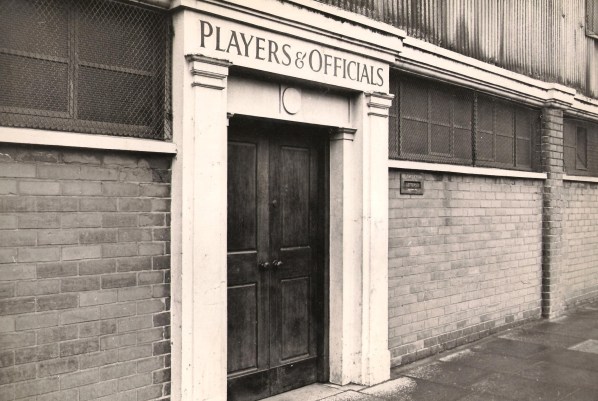
It’s no surprise to learn that the club modelled itself on their Glasgow counterparts, with the name and nickname of their home ground, as well as the green and white hooped jerseys. Not surprising either would be the fact that these colours transferred directly down to Shamrock Rovers, who first wore the Hoops around 1926, changing from the green and white vertical stripes. Belfast Celtic also provided the opposition for the opening game at Milltown in 1926, bringing 4,000 supporters to swell the attendance to 18,000. Celtic won 2-1 to claim the unofficial title of All-Ireland Champions.
While their story ultimately ended in sadness, Celtic were an innovative club. According to this Irish Echo piece, they were the first Irish Club to play on European soil, when they travelled to Czechoslovakia in 1912. Future 1916 rebel, and Minister for Justice, Defence and Posts & Telegraphs, as well as President of the FAI, Oscar Traynor was the goalkeeper on this tour.
But it was the nature of the club’s demise that has caused the sadness that seems to permeate the writing and the memories to this day. This club is commemorated in as much as it is celebrated, because they were beaten out of competition by violence not by sport. Having left the league temporarily in 1920 as the island fell further into warfare, their participation was permanently and savagely terminated on Boxing Day 1948, when Linfield fans poured over the barriers and attacked Celtic players after a 1-1 draw. Protestant Celtic player Jimmy Jones had his leg broken when he was chased or pushed over a wall. The RUC just looked on. Jones had annoyed the Linfield fans first by leaving them to join Celtic, then on the night in question he was held responsible, by no more than the PA announcer, for causing injury to Linfield’s Bob Bryson. The club had had enough.
While they dropped out of the Irish League then, they would go on to have one last, and historically significant, tour when they headed Stateside in May 1949 – thus becoming the first Irish team to cross the Atlantic. They played 10 matches including an incredible 2-0 victory over Scotland on May 29th. The Scots were Home International Champions – probably the best team in the world as far as the British and Irish press were concerned at the time, who had dubbed them the “wonder team of 1949”. The game was watched by 15,000 spectators at the Triboro stadium in New York. It’s not possible today to find a comparison to that result. A good club side would never come up against a great international side and actually compete with each other, plus these days the clubs are better in many cases. It is rightly regarded, however, as one of the finest performances by a club side ever.
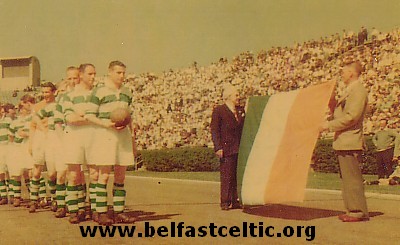
And so that was the end of the Belfast Celtic story. They have events to this day and there was a UTV documentary done in 1989 commemorating 40 years since the club’s greatest achievement and ultimate demise. The significance of their loss was perhaps not as keenly felt in its immediate aftermath, in that attendances at matches north and south remained healthy. But I do wonder as both leagues on the island continue to struggle to get attention in their native lands, and possibly with a view towards an All-Ireland league and national team one day (it’ll never go away. Accept that.), if the presence of a true footballing force for unity in Northern Ireland – more recent efforts by the IFA notwithstanding – could make a major contribution to that end.
I’ll leave with some words from society’s page, which neatly sums up the story as follows:
“The city of Belfast never recovered from its loss and neither did Irish football. The formation in 2003 of the Belfast Celtic Society is living proof that the Grand Old Team is not forgotten. We hope that these pages will be a forum for those interested in the history of the club and an inspiration to those who are currently campaigning for the reformation of Ireland’s greatest ever football team.”
 A Yard of Grass