
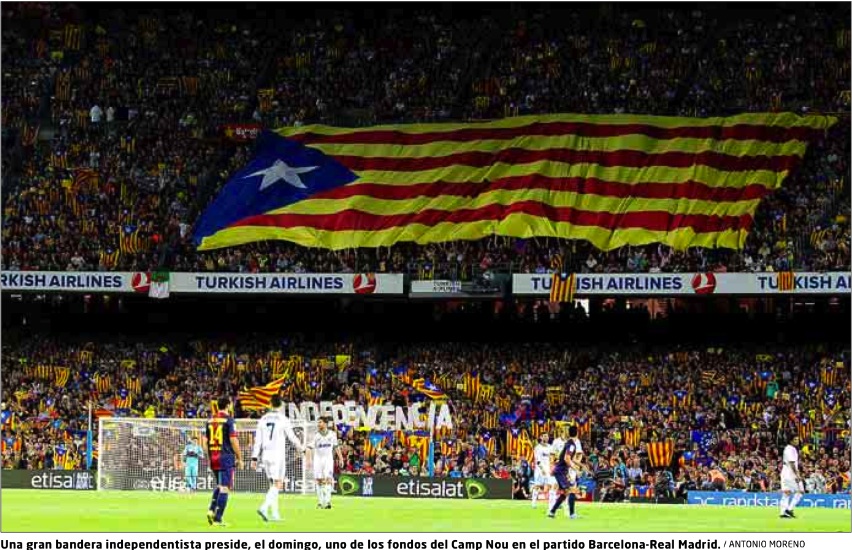
The scenes over the weekend from Barcelona and other towns across Catalonia have thrown the territorial integrity of Spain into sharp focus. Barcelona playing behind closed doors was another signal, albeit more symbolic, of the chaos which has gripped the region, and the nation-state. In recent decades, “Mes Que Un Club” has never meant more. Gerard Pique’s incredible interview after the unrest was another sign of the strength and depth of feeling within football in relation to this issue. Those who don’t see the relevance of sport in political and social matters understand nothing. And they understand even less about Spain and Catalonia. This post cannot even begin to fully address an issue to which tomes have been dedicated over many years, but an overview is not beyond me.
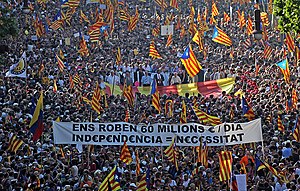
The history behind the secession movement is a complicated one. Walk the streets of Barcelona, Girona or Tarragona, and you would be forgiven for believing that the status quo has served Catalans well. Spain’s GDP per capita was €24,000 in 2016, Catalonia’s was just under €30,000. This is a case of the haves wanting to have a little bit more, or at least be compelled to give away a little less. One of the catch-crys of the movements is “They are Robbing Us”. This is not a case of an oppressed minority screaming for independence from their colonial masters. Catalonia is not Ireland 1845. It’s not even Scotland 2014, where GDP per capita is lower than the UK and England. I acknowledge it’s only one measure, and an economic measure at that, but it does give context.
(Banner translates as “They Rob €60 Million a Day From Us, Independence is Necessary”. It may be true, or it may be as true as the £350 Million a week slogan from Brexit)
What measures like that don’t do is explain the emotional aspect of this debate. After the Civil War, the actions of Franco’s regime in the oppression of Catalan culture in the early years of his rule is critical to understanding the movement. All Catalan activities were effectively banned for decades. The institutions of Catalonia’s government were abolished. This was true cultural repression, but well before the General’s death in 1976, the restrictions were starting to be lifted, if not fully.
To understand football and Barcelona’s link to Catalan nationalism, one can go back to what Jimmy Burns in his brilliant Barca calls, as a chapter title, “Death in the Afternoon”. It tells the story of Josep Sunyol i Garriga, President of the Club who was executed without trial on August 6th 1936 by a Francoist soldier after his arrest. His legacy was one of controversy with his status downplayed for decades by the club out of a fear that they would be linked to left-wing republican separatism in a fascist and extremely unitary Spain under General Franco. They finally recognised him in 1996, on the 60th anniversary of his death, after a hard-hitting campaign by his advocates.

It is extremely naive, however, to believe that Real Madrid was simply Franco’s team and Barcelona some kind of plucky underdog of oppressed Catalans. Neither Castilla nor Catalonia were, or are, homogenous political entities. The weekends referendum results are meaningless, not only due to the low turnout, but also about who turned up. Independence is not a universal objective of all Catalans. Just like in Scotland. The Madridistas may have no time for Catalan independence, but don’t for one minute believe that they all advocate the shameful actions of the Spanish police. On the other side, don’t presume that all 90,000 in the Camp Nou every second weekend would go so far as to wish to secede from Spain.
In footballing terms, independence would be absolutely fascinating, but more than likely a very bad thing for all concerned. While 4 of the 6 former Yugoslav states have qualified for tournaments, with Croatia finishing 3rd in the 1998 World Cup, you cannot but feel that that team would have gone better. Similarly, what sort of team would Ireland have had in the mid 1980’s if we had been united. Catalonia, with a population of 7.5 million, and one of the greatest footballing institutions on earth, would of course be a force to be reckoned with. But if that great institution has no Real Madrid, no Valencia, or no Athletico Madrid to battle with week in week out, they could soon have a lot more than political separatism in common with Scotland. And any national team would suffer as well.
You may have sensed some degree of anti-separatism in this piece, and I think you’d be right. I absolutely adore Spain and Spanish culture, including everything Catalonia has to offer. I’ve been to the country and its islands close to a dozen times and each time I fall further in love with the people, the food, the architecture and the landscape. From the spectacular mountains of northern Tenerife to the tranquility of Port Lligat in Catalonia itself, Spain is my favourite country in Europe apart from my own. I would be disappointed to see Catalonia break away, and upset if it triggered the full break-up of the country. What the Spanish Government and its security forces did over the weekend was unforgivable. All they had to do was to sit back and let them vote and then refuse to recognise it. What was a peaceful show of democracy turned into a shameful violent repression seen all over the world, but that bull-headed ignorance from the capital should not be seen as a representation of the Spanish people and Spanish society.
I hope I see a united Spain in Russia next summer. I hope Gerard Pique is playing. Spain has defined our footballing generation with some of the greatest performances of all time from its clubs and its national team. There are other routes to self-governance apart from independence. Politicians need to sit down and offer one of these routes to the Catalan people. Then, and only then, if the status quo becomes untenable, should Madrid offer a legal and binding referendum. And if we end up with Barcelona and Espanyol outside La Liga, so be it. “Mes Que un Club” may then have to be extended with the words ” Un País També”. More than a Club, A Country as Well.
 A Yard of Grass