
This time around on YoG we look at the role of women in football today and into the future. Do we foresee the level of coverage we see currently in the likes of Tennis, Athletics and Swimming, or will football, like most field sports and golf, keep women and the women’s game firmly in a very distant second place to the men’s game. I’m 41. No girl I ever knew as a kid even joined in in the kick-arounds with me and the lads, let alone played in a formal setting. Things have changed radically since then, but are we on the path to a world in which the striker for the Women’s Premier League Champions is as famous as Serena Williams, or where as many watch the Women’s World Cup Final as watch the Women’s 100m Final at the Olympics. It has been a long road for the women’s game up to now – but it wasn’t always this way – and it has been a long road also for women in the men’s game.
The Story So Far
Massive kudos to the incredible Football History Boys for their wide-ranging and brilliant recent series on the history of Women’s football from the late 19th Century. It finally inspired me to write the post I’ve been thinking of writing for a long time. The series was an absolute eye-opener for me, shocking to the extent that some parts even sounded fictional to a late 20th century product like myself, e.g. the following excerpt from Part Two:
“Perhaps the greatest example of the huge growth of women’s football comes from one match. At Everton’s Goodison Park, the Dick, Kerr’s Ladies took on local side St Helen’s Ladies in front of an estimated 53,000 spectators. According to Tim Tate a further 14,000 were turned away from the match and left outside the gates on a cold Boxing Day two years after the climax of the First World War.”
Clip from 1921 game in New Brighton, Merseyside between Dick, Kerr’s and Ellesmere Port Cement Works Team
Incredible stuff. So much so that the response of the Football Association was to ban women from using their grounds. Yes, while their game was flying in popularity, those in power banned half the population from playing it. The FA statement at the time read:
The Council feel impelled to express their strong opinion that the game of football is quite unsuitable for females, and ought not to be encouraged.
According to the Football History Boys, there was also an element to this which related to the re-assertion of the game’s masculinity; that if women could play it then men shouldn’t. Whatever the reasoning, it was a move that was “of its time” to be polite. Women’s football carried on under the radar and beyond the FA’s grounds. World War II came and went, as did the 50’s and all of its modesties and austerities. Then in 1969, unconnected to the FA, the Women’s Football Association was formed, with our very own Dundalk among the founding members, and the ban was overturned a few years later.
The women’s game grew and garnered greater and greater legitimacy from the mainstream game, culminating in the first FIFA World Cup in 1991, won by the United States. And in my experience, it was Stateside where the women’s game really centred from then until recently, and the likes of Brandi Chastain and Mia Hamm are well known by supporters of the men’s game across the world.
Today in Ireland, we are fortunate to have new media willing to give the women’s game some exposure, from Second Captains interviewing Emma Byrne on the Player’s Chair to the power of the viral social media propelling Stephanie Roche to 3rd place in the Ferenc Puskas award in 2015. RTÉ have also been willing to show a few games and since the Women’s National Team highlighted the inequalities they faced a few years back, the FAI have pushed a lot of content for the women’s team into my Inbox, and there’s not much of a patriarchy evident on their website, with WNT sitting right next to MNT. To some, the latter acronym grates, but this is something they will just have to get over. So while we’re nowhere near equality, things have moved on a bit. But what are the main elements that we need to consider when thinking of women in football.
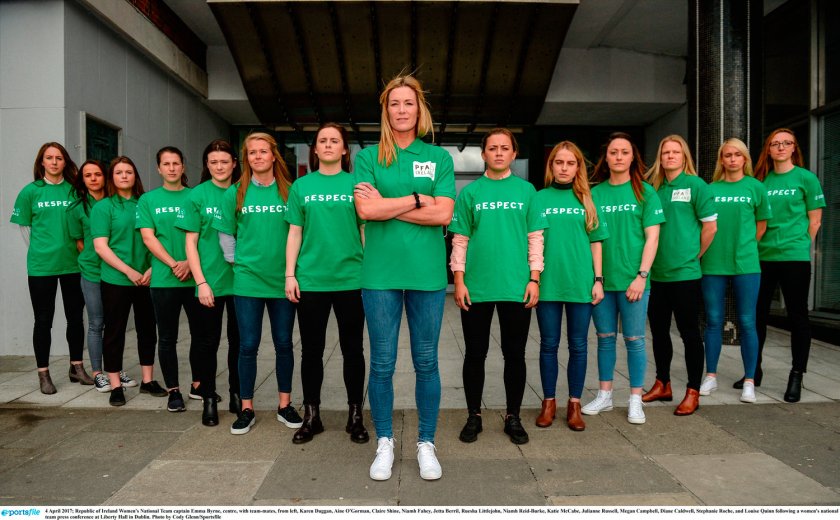
The Irish Women’s National team led by Emma Byrne in their fight for respect in 2017:
Football Culture
I think it’s reasonable to state that men are more likely than women, in general, to engage in boorish behaviour; to be immature and reckless; and to resort to banter and japes more readily than women. (I hate reading articles that spend more time setting out caveats to their main point than they do making the actual point, so I’m not going to apologise in advance for every generalisation I make about men or women. There will be some.)
But looking at football culture, how “laddish” is it? For example, when women appear on television as pundits and presenters, how differently are they treated? There are always going to be dickheads and cringeworthy moments, such as Patrice Evra applauding Eni Aluko during the World Cup or Ruud Gullit’s treatment of Alex Scott when she dared defend Steve Bruce for taking some time off before starting a new job. The latter case is an obvious one where perhaps a female persepective on family, bereavement and health is at odds with the more basic “proper football man” views of Gullit. The Dutchman’s view was not shared by all men in the game obviously and I believe that this attitude is changing. Having brilliant female presenters like Kelly Cates (who could probably at this stage teach her Dad a thing or two about the game) and pundits like Aluko – who blew Evra away simply by doing her job, i.e. researching the teams playing in advance, can only bolster the case for greater gender diversity on TV.
Ruud Gullit PFM’ing Alex Scott

This latter point also highlights another issue – Male pundits can be lazy and useless because they played the game at the highest level with the most exposure and everyone knows them. Do females have to work extra hard and be extra good to even be considered? Next time you’re watching Sky or BT and hearing the same set of cliches as you’ve always heard, consider could this be improved by a new face or new voice, or a new perspective?
Football culture seems to denigrate innovation (how we laughed at Pep and Jurgen) and reward sloth. This plays into the hands of those who prize ignorance and boorishness ahead of considered analysis and understanding of the human side of the game. And this may work against women.
The Game
Obviously women play the same game as men. The rules are identical and in general the variety of formations etc. also mirror the men’s game. The main difference – as in every other sport – is physical; strength and speed. This article on FIFA’s website in the lead up to the 2011 Women’s World Cup gives a few perspectives on this, including Marika Domanski-Lyfors, then head of the Women’s Elite Department for the Swedish FA who stated “There are differences of strength, which you see in particular when it comes to tackling. Speed is a difference too, but there is not so much difference in the relative changes of speed.” and “I think that you see the on-field scenarios more clearly in the women’s game because there is less tackling than in the men’s version. Clearly you can enjoy both: appreciating the men’s matches with their high levels of intensity and good technical skills, and the women’s matches with technical and tactical skills that you can recognise more clearly”.
In the same piece, English coach Hope Powell states that “while the women’s game is slower, that gives more scope for skill, compared to the greater focus on physicality that we see in the men’s game”
These are interesting observations. In general, my interpretation of the above is that the Women’s game may be less hectic overall, which more or less matches what I have seen over the years. This does not translate into an inferior product. The product is not about just the “standard” ( which is itself a subjective concept in any case, and one which has certainly been framed by men historically) but the brand of football; how contested the game is; the tactics on display; and the effort being made. Women’s football does everything the men’s game does and is an equal product in that manner in the exact same way as what Katie Taylor, Cora Staunton and the Irish Women’s Hockey Team have produced in recent years is equal to their male counterparts.
The Players
Of course it’s as much a team game as any other, but in a situation where PR, publicity and promotion is paramount, the old “hero narrative” won’t do any harm. Of course there is a litany of great female players and personalities from across the world, but I have found the careers of the Irish women below which have recently been covered elsewhere, of special interest.
Anne O’Brien
Ridiculous and embarrassing are the only words I can use to describe my ignorance of this woman’s career until I read this article on the42.ie. Born in Inchicore in 1956, she would be included in a group of players described by Italian legend Carolina Morace as “the best in the world (who) inspired the Italians to improve.” Her roll of honour merits a statue on the Aviva concourse. It’s phenomenal:
- First Irish or UK female player to play on the Continent, when she signed for Stade Reims aged 17
- 3 French League Titles
- 5 Italian League Titles
- 2 Italian Cups
A pioneer and a truly great Irish sporting personality. She died at the age of 60 in Rome and her legacy should really be celebrated more. I’m sure today’s Irish Women’s players view her as a trailblazer and an inspiration and as the game here progresses and gets the coverage it deserves, maybe she will too.
Anne O’Brien with Lazio in 1985 – Front Row Second from the Left

Emma Byrne
That word ridiculous comes up again here. Goalkeeper Emma Byrne of Leixlip signed for Arsenal in 2000 after a year in Denmark and time back in Ireland out of full-time football. By the end of her time at the club, she had amassed the following honours:
- 11 League Titles
- 1 Champions League
- 10 FA Cups
- 2 Player of the Year Awards
She was also capped 134 times for Ireland. She is our most decorated footballer and was the captain who led the women’s team’s fight for proper recognition and decency in their treatment by the FAI in 2017. Of all the achievements, this latter one may be that which has the longest and deepest legacy. Her interview with the always brilliant Richie Sadlier on the Second Captains Player’s Chair a few months back was a real eye-opener into some of the issues faced by female footballers. She recently became the first woman to be inducted into the FAI Hall of Fame. Another Irish pioneer.
RTÉ Tribute to Emma Byrne on her Induction into the FAI Hall of Fame
Of course, there have been countless others over the years and you can’t but mention Stephanie Roche and the role that goal played in raising the game’s profile, perhaps even worldwide. The current crop may in the future be looked at as the turning point and their stance against their treatment by the FAI may be seen in the future as a game-changer.
The Issues
When it comes to the issues around this topic, there are two strands at play – there’s the Women’s game itself and then there is the role of women in the men’s game. Starting with the former, we’ve looked at the nature of the women’s game and it’s basically identical beyond the obvious differences in pace and physicality. But there are other issues which need to be examined. There are other differences between men and women and I’d urge anyone to listen to Emma Byrne’s interview above. Just subscribe for one month if you have to, it’s worth the fiver alone.
Issues like relationships within the team are also a feature that you don’t get in the men’s game – certainly not openly – and this can have a profound impact on the “team” philosophy. This has, according to Byrne, manifest itself in scenarios whereby players signing for a club then ask for their girlfriend to be signed as well, and the manager agreeing. A break-up is even more difficult to deal with.
And then there’s pregnancy and that lingering feeling that applies in all walks of life but may be most brutally seen in sport where women are, in essence, punished for becoming a mother. The issue is described by Byrne as a “taboo subject”. There are several facets to this issue. The first is the overriding competitive nature of these athletes who just want to get on and win trophies and qualify for tournaments. Throughout their peak athletic years in their 20’s many will not even consider becoming a parent.
But of course, many do, particularly as they enter their 30’s and it’s at this point that things can become very difficult. Clubs do not provide for this. Female players, just like their male counterparts, are expected to be able to go away for weekends, away games, international breaks, and leave their kids – no matter how young they are. Clubs don’t provide childminding support and it sounds like they essentially view mothers in the same light as those without kids. While more and more workplaces, and society in general, move towards a far more flexible environment for parents – mothers and fathers – albeit slowly, football seems to be standing still in this regard.
Maternity leave and returning to work is very very different for athletes than for the rest of us. We are becoming parents later in life these days so many female footballers can have great careers into their early 30’s before starting a family, but whenever they choose to, it’s just that bit more difficult and challenging to come back into a sport, in particular if your maternity leave cover has been performing brilliantly in front of thousands of people every week. The body changes can be profound as well. It’s a very different scenario to the bloke running over to the corner flag on Match of the Day after he scores pretending to suck a soother while the commentator tells us his wife gave birth to twins that morning!!! It’s not unique to football obviously, but within football, it’s unique to the women’s game.
Women in the Men’s Game
We’ve talk a bit about pundits above, but I’m of the view that we are now in desperate need of more women in the men’s game in two specific areas – Officials and Stewards.
Dissent is an epidemic and a stain on football. The treatment of all officials by players, managers and staff is disgusting nowadays. This needs to end and I believe that one of the most effective ways to do this is to train more and more women to officiate at the highest levels of the men’s game. Even deplorables like Jose Mourinho would think twice about screaming in the face of a female 4th official. (Eva Carneiro may disagree I guess) And I would hope that there is no way in hell that 4 or 5 players would crowd around a young woman shouting abuse in her face over a decision. I could be wrong but if I am, I truly give up on the sport. Train them up and give them a proper go.
Similar logic applies to stewards. I’ve heard this advocated before and have seen it in action. The type of man who even disobeys the instruction of a female steward in a football stadium is a dick for a start. The type who would risk her safety belongs behind bars. Only the lowest form of male life would try to push past a woman, let alone throw a dig in the way many would not think twice about for a man. It’s an innate thing. I’ve seen many instances where female stewards just take the heat out of a situation, even where the chanting is a bit on the dodgy side. Stern but not aggressive and certainly not afraid. It’s not a job for every woman but if more could be employed, I think those types of men would behave themselves a little bit more. Again, I could be wrong, but if I am, I give up on football fans.
We simply need to de-lout the game. Football grounds are not the dangerous cauldrons of piss and violence they were in the 1970’s and 80’s, but recent incidents have shown that there is a remnant element still there and which never went away despite what Sky was telling you. It’s there in all leagues across the world. But when I take my son and daughter to Tallaght for the first time, I really don’t want them to witness the violence I have seen in some grounds over the years, or around the grounds, and I don’t want to hear the ref called a c**t, the opposing players called paedos or any racist or sectarian abuse. Is that too much to ask? And I think making the stadiums and the men’s game more open to greater numbers of women is part of the solution to this problem.
The Future
I have absolutely no doubt that within a generation, women’s football will be given the type of coverage women’s tennis and athletics get now. I can even foresee a scenario where, like Wimbledon, the Olympics and all Athletics events, the Women’s soccer tournaments are held at the same time and in the same place as the men’s. (we may need to row back on the number of countries involved, however). Football has made radical changes throughout its evolution. From rule changes such as the introduction of substitutes, banning the backpass, and the use of technology, to off-field cultural shifts such as all-seater stadia and the embrace of globalisation, both of which involved trade-offs between positive and negative impacts, the game is very different today than from 15, let alone 50, years ago. With women’s football, and an increased involvement for women in the men’s game, there are no trade-offs. No-one loses out and I look forward to seeing the game take that next giant, inevitable leap.
 A Yard of Grass