YoG No. 64 – Barely Holding On?

https://www.offtheball.com/soccer/shamrock-rovers-loi-champions-finn-harps-1270818

Well it has been a while – a long, long time. Almost 4 years since the last YoG article – a weirdly upbeat take on the state of the Irish soccer team as Kenny emerged from Covid with a couple of decent performances. Let’s not dwell on that particular topic or how it all panned out because, well, if you’ve nothing nice to say etc.

I write this article as I recover from long-planned heart surgery to replace a bicuspid valve and part of my aorta. It was zero craic. There were times when it felt like there was a tree trunk in my chest but 4 weeks on from the operation, the pain is gone and the flexibility and energy is returning. The only thing that could do damage now is probably spending too much time hunched over a laptop typing! But it’s doing the head a bit of good. There are no words in either the English or Irish language that can satisfactorily describe the nurses, doctors, cleaners, catering staff, porters and administrators that looked after me in St. James’s over those 8 days. We’ll need to make some up, but to feel that level of care when you’re at your most vulnerable is an absolute lesson in humanity.

I gave up writing this blog all those years back because I ran out of time. I’d taken up the piano a few years previously and I just needed time to practice, then I was roped into coaching my son’s team and am still doing that. 2 nights a week and matches at the weekend. No room for pontificating on the state of the game via a little-read blog unfortunately. But I now had a new audience – a collective of impressionable young minds ripe for moulding into a highly-effective win-at-all-costs machine!!! Or something like that. That line would be a lot funnier if I hadn’t encountered several tragic middle-aged men on the opposite sideline who really think they’re Jose Mourinho or Diego Simeone, destroying any passion the kids have for the game trying to relive their failed youths. But I digresss…slightly…

How a good 20% of underage coaches see themselves – https://focus.independent.ie/thumbor/O49e-WWZ4A5YckG9is0_EBI8KMY=/0x133:3500×2063/1280×853/prod-mh-ireland/09ebfdea-bc6c-11ed-b80b-0210609a3fe2.jpg

Last week a friend was over and I went on a short but effective rant about the proliferation of property porn programmes on the national broadcaster and elsewhere – also inspired by my first purchase of the Irish Times on a Thursday in years and the accompanying offensive vulgarity of their Residential Property supplement – at a time of a profound, deepening housing crisis. At a time where an entire generation is staring into an abyss created by, not in spite of, Government policy, and the global hyper-capitalism they kowtow to; lickspittles and cowards in the face of the mega-rich and sociopathic nerds who now run the world (and to think, our generation was reprimanded for beating up these types of people. Now we’ve empowered them and all their anti-social weirdness). Her response was a much more polite rant, but a rant nonetheless, about football and the same offensively vulgar money therein. I simply agreed but chose not to either (i) mention that 99% of football globally is played on a shoestring with no connection to the elite she sees on TV or (ii) add to her thesis by mentioning the takeover of the game by vile thugs from rogue states or by hypercapitalist yanks, both of whom will pull the plug at their earliest conveniences. Qatar, Saudi Arabia, UAE, FSG et al. The distance from the season-ticket holder in the stand to the men on the pitch has never been greater. The connection to the owners is completely gone.

We’re barely holding on.

Or do we have a firmer grip on the game than ever before?

I talk now of Ireland. A country where football is unlike it is anywhere else. It was right there at the start. The game landed in Ireland in the 1870’s with the first international played in 1882, when the English battered us. Around the same time, we codified our own native games, one of which shared many of the same skills as soccer, while Rugby also emerged. The history of these games is shared – the organisation, the rules, the tactics were not developed in silos and this continues to be the case. The decision in the 20th Century in this country to align Irish nationalism with GAA rather than sports played on the international stage was understandable, but deeply regrettable for those with an outward looking mentality. It was the polar opposite approach to every other country, for good or ill. Most countries saw their national soccer team as a key expression of their national identity. Perhaps they had a clearer understanding of that identity than we had and we chose to look inward instead. Our national identity remains a contested, confused, incomplete, partitioned one, nowhere more obvious than on the football pitch. Easier to talk of County finals than address the deep divide between Windsor Park and Lansdowne Road. Rugby doesn’t really come into this – a minority sport played primarily by middle to upper class folk. A good excuse for an afternoon pint in February.

Within this dysfunctional football world we have 3 levels – the national teams; the League of Ireland; and kids football. As things stand, 2 of the 3 are booming while the men’s national team wallows in its John Delaney inspired perma-crisis which started at the final whistle in Lyon in 2016 and, while it has shown a few signs of ending, it’s been one step forward, two steps back ever since. We are barely holding on to the entire concept of a men’s national soccer team as a going concern. The futility of it all; the ending of campaigns before they begin; green shoots trampled on by the inevitability of being outplayed by a former minnow; all hope transferred to the latest new lad who’ll change everything. Bullshit after bullshit after bullshit.

Blame whatever you want but our reliance from the 1960’s to the 2010’s on the UK; the outsourcing of player development past the age of 15 to English and Scottish clubs was one of those great Irish solutions to an Irish problem. Of course it suited the British teams as well, as Irish players contributed handsomely to their trophy cabinets, but while Delaney was drinking on the job, 2 seismic changes happened – 1. The English Premier League was transformed into the Premier League in England. The game became global and our players were now competing with contintenal Europeans, Africans, South Americans and Asians for time on the pitch, rather than players from these islands and the odd Scandinavian. 2. Brexit and the rupture of the relationship between an increasingly self-harming Britain and the rest of Europe. Any other CEO of a national football association would have seen what happened in 2016 and prepared, building up our academies and forging relationships with the best coaching environments in the EU. But no, he was busy taking €70,000 from Irish football to pay for his 50th birthday party in 2017.

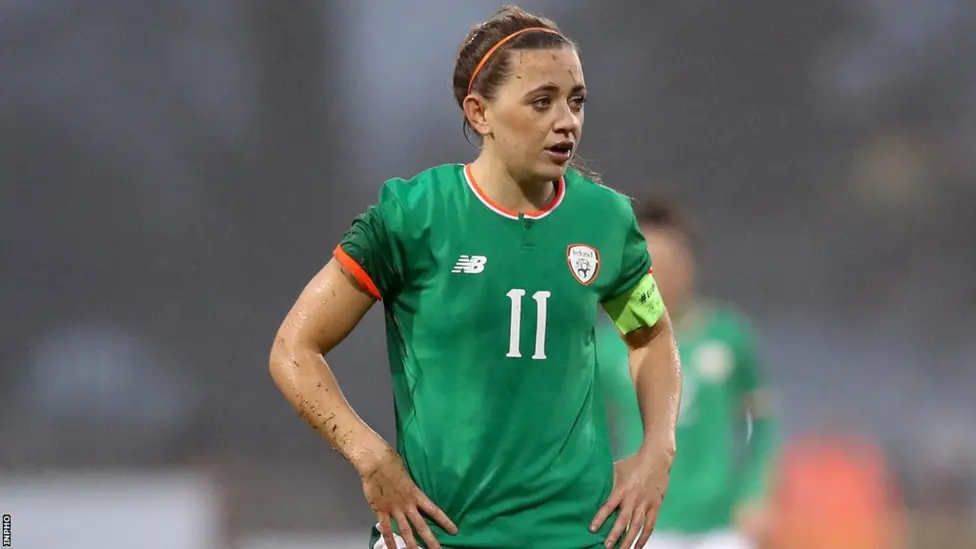
Thankfully the Women’s national team did give us a World Cup in 2023, performing ok even with the Vera Pauw handbrake on, and have come very close to qualifying again. There are massive personalities in that squad and no shortage of “bastards” and leaders the men are crying out for, and who operate at the very top of the game. However, even their successes are mired in FAI bolloxology related to the running of the team; the hiring, non-hiring and removal of managers and assistant managers. Nothing is straightforward. Nothing seems to be done with even an iota of professionalism; tact; decency or guile.

Katie McCabe – Leader and Glorious Bastard. https://ichef.bbci.co.uk/ace/standard/976/cpsprodpb/6494/production/_130284752_inpho_01357126.jpg.webp

Somehow, the League of Ireland has emerged, not as the difficult child that John Delaney dismissed it as, but as the shining light of Irish soccer. How this has happened is beyond me but I think there are 2 major factors. The first I think was the insistence on creating a direct link between the schoolboys/girls game and the League of Ireland (which did happen under yer man’s watch in fairness). The creation of the national league at U13, 15, 17 and 19 and the associated change in the role of schoolboy clubs in the elite level, to be feeding directly into the League of Ireland structure has brought a generation of teenagers, and their parents, under the LoI umbrella which didn’t exist a decade ago. And the expansion of the LoI clubs schoolboy/girls presence across the board has also helped raise the profile of those clubs. The brand (sorry!) is now everywhere in Irish football in a way it absolutely was not even 15 years ago.

The second factor relates back to what my friend’s recent mini-rant was getting at. Elite football, particularly the elite league that is based in England but owned, managed and played in by foreigners, is now riddled with a form of sporting cancer, several forms in fact:

  • Clubs owned by countries, many of whom are simply rogue states;
  • The hyper-capitalist owners who sack the lowest paid workers while splurging millions on questionable talent;
  • These same owners demanding massive State investment to make them richer;
  • Fucking gambling companies sponsoring almost everything;
  • Crypto conmen sponsoring the rest;
  • Social media overdrive – debasing, degrading and demeaning every aspect of the game from refereeing decisions to transfers;
  • Utterly shit fan-boy punditry and piss-weak banter cheapening the entire notion of analysis and journalism. Thankfully, we’ve escaped this in Ireland to the greatest extent but it creeps in, and if the Sunday Game is anything to go by, we won’t be long in getting it;
  • Sick militaristic displays on the football pitch – it’s gonna be November soon, fellow Gaels, fellow opponents of imperialism – watch all the Farage mini-me’s this year!!! It’s gonna be absolutely fucking vile while their predecessors’ historic adventures in the Middle East play out on their TV screens. Images of starving children on the 10 o’clock news followed by soldiers on MotD commemorating those who sowed the seeds of this conflict in the previous century while a good chunk of the crowd vote for Reform to keep out the refugees they helped create. No cognitive dissonance there

I’ve gone too far. Barely holding on are we??

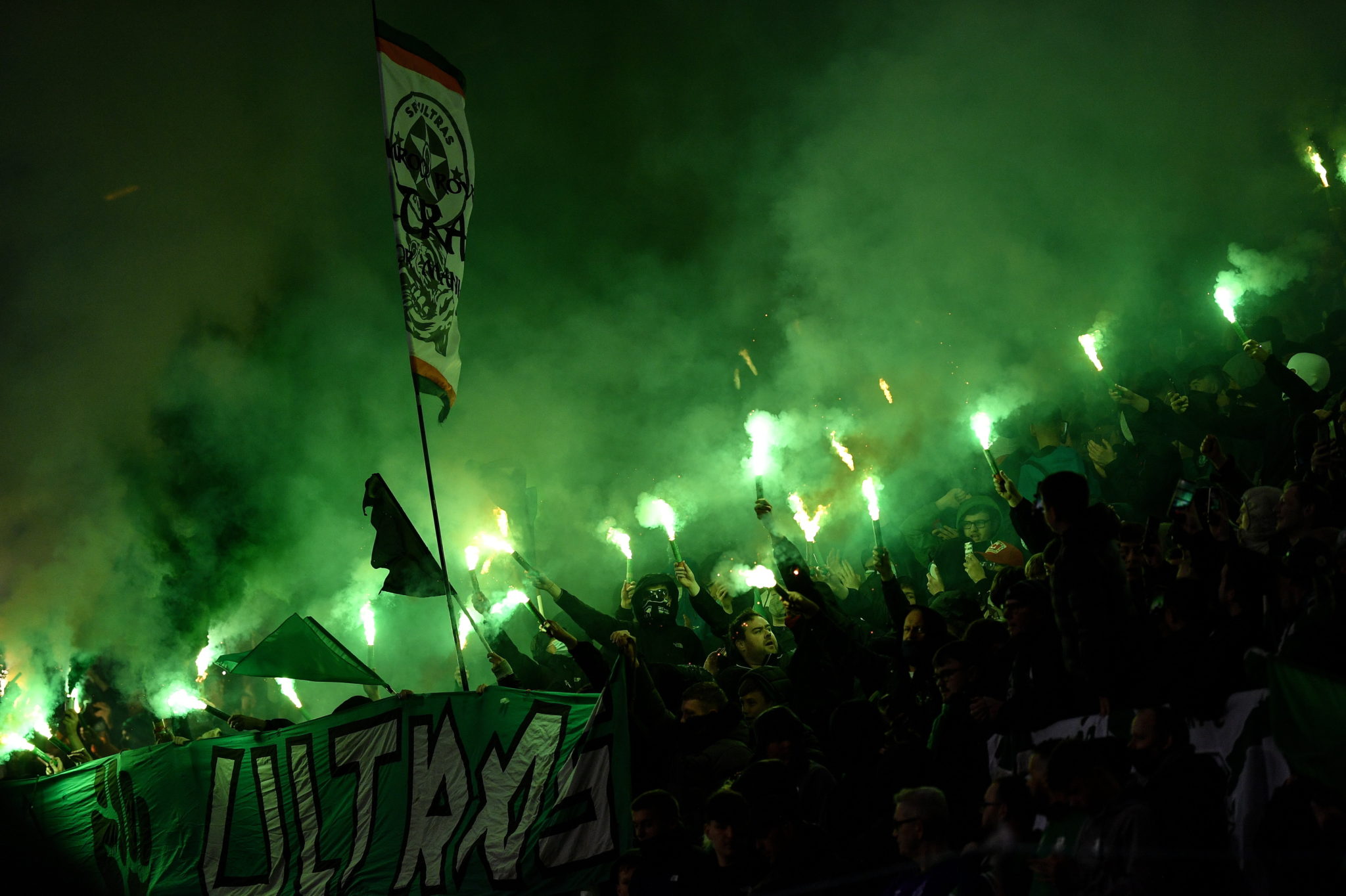
The League of Ireland is the antithesis to this. As are the Austrian, Slovenian, Welsh, Norwegian etc etc etc leagues. We are the 99%! You can smell the grass; you can hear the players; you can feel the experience; they belong to you; presence. Yes, presence. In a world where so many spend so much time detached from reality, glued to a device that no one asked for, it’s so important to be with a tribe, whether it’s in amongst the ultras setting off flares, abusing the opposition manager, never taking a breath for 90 minutes, or sitting in the family section seeing the same grandad with his son and grandson. He may be in Tallaght tonight but he was in Milltown, Tolka, Dalyer and the RDS too. He may be watching Shels win the league tonight but he sat through relegation, and sometimes wondered was La Coruna 2004 a dream? He may be in a packed Ryan McBride Brandywell tonight but he remembers going to home games in Coleraine, and then having nowhere to go. The grip on this game is tighter than it has ever been in my 47 years. What was once neglected and ignored at best, abused at worst, is now central to Irish soccer culture. And it is beginning to feed into the development of players for the national team but more important than that, it provides Irish kids with a perspective on what football really is. A sport, not a reality TV programme.

Allied to this, and as alluded to in terms of the national league, it seems that the schoolboy/girl game is absolutely booming. At my kids age, there are 27 boys divisions in the Dublin and District Schoolboys/Girls League (DDSL) and 8 girls divisions. There are over 30 U10s boys divisions. I know from my own club that about 30% of the boys playing would never have played football 25 years ago. And of course, there were no girls underage leagues. There were approximately 50,000 players under the age of 18 registered in the DDSL last season – that’s just Dublin and parts of Meath, Kildare and Wicklow. Figures from previous seasons – not 100% reliable as comparisons and from various sources – would suggest significant growth over a very short period of time. Not only do we have a tighter and broader grip on kids football, but kids football seems to be holding on in more and more places in our society and culture than it has before.

Barely holding on. The game I grew up with is gone. That’s a sad thing to say. It means less to me when Gravenberch took his turn parading the league title trophy for Liverpool than when Ronnie Whelan did it. It’s only natural. Surely the Scousers feel this more. But it means more to sit with 9,000 others at a Dublin derby than when no-one really cared. And it means more to sit with 40,000 at the FAI Cup final than when often around 10,000 showed up. The national team can never emulate what their predecessors did in my childhood and that’s a loss I can never make up to my own kids, but we need to hold on and hope that they create some memories for them.

But as I concluded to my friend, yes the game is gone, but I watched live on TV with my brother and father Saturday afternoon the 15th April 1989 as 97 Liverpool fans died watching their team in an FA Cup semi-final. I remember a European Cup Final being played after 39 fans had died in the stadium. I vivdly recall the news of Valley Parade fire that same year and the horror that unfolded in seconds. I remember seeing riots on the Big Match. Football may have been closer to the people in the past, but at times it was grim as well.

We’re barely holding on. Rogue states and hyper-capitalists own the elite game now. All we’ve got in our grip is the game down the road. It’s the same game that landed in Belfast in the 1870’s and spread to every corner of the island, defiantly flourishing in the face of official snearing, performative patriotism, and self-harm by generation after generation of adminstrative peasantry. That’s no bad thing. Ireland is a soccer anomaly – even using that word where no one else outside the US really does. Our dysfunctional, but once extremely advantageous, relationship with British football is changing. We’ll make our own football, and we’ll export that to the world. Let’s restart the clock with Troy Parrott and Evan Ferguson and see where it goes. Keep holding on.
YoG No. 63 – From a Whisper to a Scream

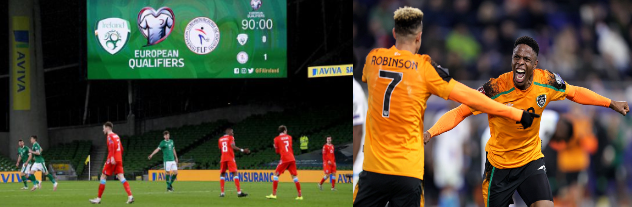
Copyright: Left Brian Lawless (PA) and Right Laszlo Geczo (INPHO)

It started with the most depressing night in Irish football, a shameful unprecedented humiliation against a minnow – at home and in silence – and it ended with the deafening roars of a packed Lansdowne Road who believed they had just seen Ireland take the lead against Portugal.

Throw in the feel-good buzz around the best attended domestic fixture in generations and the absolute battering handed out by the Women’s team to Georgia among other positive results, and the game finally feels healthy in this country for the first time in a long, long time. 2021 may be the year we finally fell back in love with football in Ireland. It was the year in which many Irish people decided, by accident or by design, to give something a chance – to allow themselves to sit back and let football be football. People I know who have never set foot inside a domestic football ground; whose parents and grandparents may never done so either, spoke to me about how much they loved the FAI Cup Final, and how much their kids loved it. And said they would be back. Significant numbers tuned in to see the women’s team play live on RTE. And on the senior men’s front, we finally have a manager who believes in the quality of what this nation can produce and is willing to give youth a chance to shine. His faith, stubborn and persistent through the horrors of March, is beginning to pay off.

And it’s March where we begin. The second major lockdown of the pandemic was just beginning to ease when Ireland travelled to Serbia and came away with nothing despite a decent enough showing. We felt another performance like that the following week might be enough for Kenny’s first win. There were signs of a new approach but nothing substantial yet. 2 goals in Belgrade should never be sniffed at however. Surely we’d get that win against Luxembourg.

But in the cavernous, soulless empty bowl of Lansdowne Road that night, the wheels very nearly came off entirely. We had no complaints. Luxembourg were the better side, or at least the more dangerous side, and a snapshot from distance out of nothing covered the entire Irish football family in a blanket of despair. It was one of those historic nights for all the wrong reasons. It raised to the forefront 2 questions that we hadn’t asked for generations – can we turn this football team around; and does anyone even care any more?

If you think the answer to the second question was a resounding yes of course, then you may have forgotten exactly how even the most loyal and weather-beaten among us felt. Scrap the whole thing and start again! Forget about the senior team for a generation! Rebuild everything! Sack Kenny!

It was desperate in its most literal sense. All hope was lost. A national football breakdown was underway, just as we were emerging from the longest and most severe lockdown of all; just as glimmers of normality were returning, our football team was showing the world that even in modern, rich Ireland, the peasants were still present. Fifteen years of neglect; Fifteen years of theft; Fifteen years of ‘sure it’ll be grand’. Millions blown on malignant oul’ chancers like Trap, Keane and O’Neill. No players primed. No fans excited.

Only something like a run of 1 defeat in the next 10 games; 18 goals scored; 6 conceded; and not just the discovery, but the nurturing, of the guts of an entire squad from inexperienced debutants into lads who could look the likes of Ronaldo, Bruno Fernandes and Pepe square in the eye and think “we’re doin’ you here”, could possibly salvage this year.

And that is exactly what happened.

A slow burning revolution started with a decent performance against Qatar in solemn silence 3 days after Luxembourg. Regrouping in June, while the big boys readied themselves for Euro 2020, two nothing games against Hungary and Andorra steadied the ship – the latter bringing more Irish goals in one game than the previous ten. Obliging opponents but Finland, Bulgaria and Luxembourg hardly strike fear into anyone either. 4 Irish goals, even in a post-season friendly in Andorra, are not nothing.

3 qualifiers over 7 days in September followed and it was down in the Algarve where we saw a true coming of age take its first tentative steps. We saw a 19 year old goalkeeper stand up to the overwhelming presence of Cristiano Ronaldo, bringing us to our feet as he kept out his penalty. We saw John Egan, who brought only 12 caps into 2021 grab the lead for Ireland. We saw Aaron Connolly bundled to the ground denied a spot kick to make it 2-0 and we saw a referee playing on and on and on until the messiah crafted the final line of his story. Robbed, perhaps not on paper, but certainly on grass. We deserved a point. But the chink of light was beginning to break through the curtains. We needed to build on that.

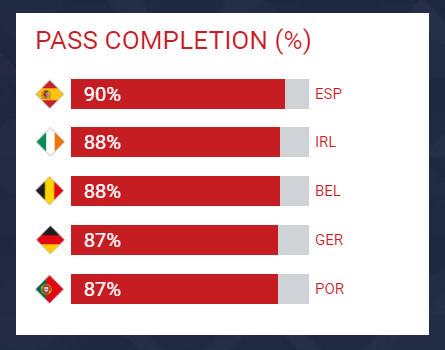
Unfortunately we failed to do that. Stephen Kenny’s first game in front of a home crowd, albeit limited to 25,000, failed to produce a decent result but instead we were subject to a late Shane Duffy header to salvage a point. Post-match pints and post-match recriminations – how could the same team that had Portugal on the rack away not be able to see of the Azeris at home a few days later?? Sober reflections later on revealed some positives – 21 shots, 495 passes and 59% possession. This compares well to the 10 shots, 365 passes and 42% possession upon which we built one of our worst ever home wins against Georgia in 2016 – a defining game of the late MonKeano reign where many of us remember walking away from Lansdowne with the sheepish grins of 17 year olds leaving the offie with the bags of cans you wanted – we got away with it. But surely if we continue to outplay teams, we will learn to outscore them – from where, however would these goals come?

3 days later, it was a similar story on the surface – a late goal from someone on the pitch to score for the opposition, which he also did, salvaging a point against Serbia – a much, much better side than Azerbaijan. But scratch the surface and there were few, if any positives. Outplayed, out-passed and out-thought, to the extent O’Neill’s men were against Georgia, but without any of the good fortune required to win.

Gavin Bazunu was one shining light during what was beginning to feel like a slight transition. We had stopped losing and green shoots of a coherent group playing a coherent way were beginning to emerge from this Irish soccer nursery in which, alongside the kids, established players like Hendrick and McClean were playing better than they had for 5 years. It was never going to be enough to dislodge either Portugal or Serbia in this group, but going into the October games, I think it was fair to say that we needed goals; we needed results; and we needed performances. For the first time, Kenny really needed to deliver.

The first 45 minutes in Baku put all the ghosts of Dublin to bed. 2-0 up away from home and the game looked up for the Azeris. While the home team dominated possession over the 90, it was because they had been blown away by Ireland and Callum Robinson so comprehensively in the first half. A third from Ogbene gave us our first 3 goal haul away from home since the play-off in Estonia in 2011, with the exception of Gibraltar and Faroe Islands. A decent night all round for everyone involved in Irish football. Apart of course from Didi Hamann, who carried on like he had a lot of money on a 4-0 win. We now had goalscorers, one of whom was a complete unknown at this level before summer 2021.

And then came Portugal. A night to remember, for all the right reasons. Almost everything about this game and this match experience felt like an Irish football community emerging from its cocoon. A full house to look forward to; pubs open and full of pre-match drinks, food, nonsense. A reunion; a return to a sense of normality. Town buzzin’. Away fans. Streams of people along the canal and the streets of Dublin 4 packed. It was a night off from Covid-19, maybe only in our heads and hearts, but let’s leave it for an evening and revel in all that we’d missed so much for so long. A proper football night in Dublin against one of the big boys, with the biggest star of all on display.

And display was all he did. Once again, we put it up to Portugal, matched them for shots, possession and passes. Pepe pepe’d up the night with his inevitable red card while Shane Duffy helped strangle Ronaldo, metaphorically and literally.

Copyright: The Irish Sun

Despite there being nothing to play for, it felt like this was a huge match. A fact reflected by the biggest roar in years greeting the Matt Doherty goal, harshly ruled out for a foul on the keeper by Will Keane. The final whistle blew moments later, not before Ronaldo had one last go, but it was not to be for either team. A night that felt like concrete progress came to an end not with a win but with yet another creditable performance. It was a night where for the first time in a long time we felt like peers of teams like Portugal, and despite great results against Germany and a second-string Italy over the years, when did we last feel like we matched a top-seeded side on the pitch and deserved to win? France 2009?

The campaign wrapped up in Luxembourg where we strolled to our second 3-0 away win of the campaign. Ogbene and Robinson getting on the scoresheet again, the former ending a fine move involving a rejuvenated Hendrick and an emergent Jason Knight, who went on to set up the latter with another deft, mature and brilliant touch. This night was about much, much more than revenge. This was about putting down a marker and setting the bar for 2022.

No one is daft enough to think 2021 was a vintage year for Irish football. We’re not going to Qatar and there is no hindsight or revisionism of what our objective was at the start of the campaign that can justify taking 1 point from 2 home games against Luxembourg and Azerbaijan; or can excuse the campaign effectively ending before it really began.

Context, however, is everything, and in 2021 Stephen Kenny has changed the narrative around this team completely. We improved significantly over the year, of that there can be no doubt, and while many managers have “performed” better than Kenny in their first full campaigns, none have had to do the job Kenny has had to do.

No Irish manager in my lifetime ever had to rebuild a squad almost from scratch. No Irish manager in my lifetime could skip straight to reports from the 2nd and 3rd tier of the English game to track his players. And no manager has had to step into a financial wreck of a bailed out FAI which had completely ignored the changing football landscape for 15 years; scandalously blowing millions upon millions of our money on managers with zero interest in developing our game; our players; our clubs and our league. A decade and a half of Italian ignorance “In Ireland there is no league”. (A comment that should have seen him sacked, or at least forced to explain how it was lost in translation) A decade and a half of rancour – Martin O’Neill’s petty, weak and pathetic treatment of Tony O’Donoghue and Roy Keane’s staged faux macho bravado in dealing with the players. And a decade in bed with Denis O’Brien. All the while, the Delaney lad was tearing the association to ribbons while plastering his comically yokelled face all over the society rags – an embarrassment, a sporting vandal, a peasant and a bloody fool.

All of this matters, because all of this contributed to the state of the squad Kenny inherited. Tell me you’re not more excited by Jason Knight than Paul Green? By Ogbene more than Simon Cox? So many years failing to nurture Ireland ‘s football culture. So many years spent not producing the next Damien, Duff, Wes Hoolahan, Andy Reid, Roy Keane, Liam Brady or Paul McGrath!!! How many did we lose to the GAA? It’s no coincidence that Dublin completely dominated during the period that the FAI was being led by a donkey. How many Wes’s were out there, and even he was neglected by the dinosaurs in charge.

Throw Covid into the mix. A first home game with a full house over a year into his tenure. Players missing with close contacts, false-positives and the overbearing pressure on all to keep their distance in a team game where squads are not built on the training ground but in the hotel rooms, bars and restaurants, and yes even in today’s elite sporting culture, a few drinks on a night out. None of this could happen.

Stephen Kenny walked eyes wide open into Irish footballing carnage at a time when the entire world was in a state of chaos. He hasn’t done a good job, he has done a great job. He has earned a go at 2024, and he has earned the respect of the entire Irish football community. Now he, and his players have to deliver in 2022.

Happy New Year.

YoG No. 62 – Diego, Jack and My Eternal Football Childhood

Dissecting Diego Maradona's astounding goal against Belgium in 1986

For Irish football fans of a certain age, our obsession with the game is almost always linked to one long month in June 1990 when our country got to the World Cup Quarter Final; when the nation came to a complete stop for a few glorious unforgettable weeks; then held its breath for one glorious unforgettable penalty kick. In the year that Jack Charlton died, so many memories of pure joy came flooding back. Emotions not felt before for this great man came out. The manner in which we cloaked him in our affections rushed back. And we learned a bit more about how we fell head over heels in love with this game. How could any Irish man or woman of my generation not.

Then in November, Diego Maradona died. The most phenomenal talent of his generation and a player who, for two sets of fans in particular, does not rival deities, but sits among them. His explosive impact in Mexico 86 and for Napoli in the late 80’s did not merely endear him to his country and adopted city and did not bring just legendary status to him in Argentina and Naples – he became the embodiment of everything about that country and that city. We all looked on at this man smash a World Cup to pieces and drag a desperate club to glory in the best league in the world at the time.

In looking back at his career and life, something struck me. Perhaps it was not the long summer of 1990 itself that defined my obsession with the game. It may in fact have been the 8 months prior to it. From the early afternoon of the 15th November 1989, when Ireland cemented qualification in Malta, through Christmas and the receipt of the Orbis World Cup 90 epic stickerbook / album (completed. Last sticker – Uruguay flag) all the way to Day 1 when Cameroon stunned Diego himself, the build-up seemed endless.

In the days before Sky TV, it was left up to Screensport to create that hype. They showed what now seem like dozens of half-hour specials on various teams, including a memorable take on hot young Romanian prospect Daniel Timofte – whatever happened him! But above all else, it was the broadcast and my repeated viewings of “Hero – The Official Film of the 1986 World Cup” that found a permanent place in my consciousness and subconsciousness.

The film focuses on several playmakers across the tournament – very much in keeping with Jack Charlton’s analysis of the tactics on display that month. Every game was played through a number of these players and they were the ones who made each team tick. They were all attackers or creative midfielders – no.10s or no.9s. Platini, Elkjaer, Laudrup, Butragueno, Sanchez, Francescoli and of course, Diego Maradona.

I watched quite a bit of it after Maradona’s death and it just hit me. There could not have been many kids aged 11 or 12 or thereabouts who watched this film at this time, in the build-up to Italia 90, who are not massive football fans to this day. Just look at the spectacle. It opens with a piece on the devastation of the 1985 earthquake, before going to the Azteca for Mexico’s opening game. Even with all the great stadiums around today, this arena looks out of this world. It’s a cathedral. 110,000 souls, almost all Mexican, watched on as they beat Belgium 2-1. It shows a country emerging from a national trauma and the release of all those emotions as their hero Hugo Sanchez scores the goal that would ultimately win the game.

The film looks and sounds amazing with the soundtrack from Rick Wakeman, very 80’s, all brooding synth and epic prog rock. And it’s narrated by Michael Caine, which seems odd but it works. The colours are striking; the entire tournament bathed in Mexican sunshine; every kit immaculate; the Adidas Azteca ball being caressed along the greenest grass in all it’s glory (yes I owned one myself and I remember filling in the markings on it with permanent marker after they had worn off!); and for really the first time, the colour in the stands, as the fans from all over the world created what may have been the earliest true football festival. In particular the Danish fans seem to have helped create this atmosphere, cemented in place in no small part by ourselves 4 and 8 years later. Perhaps Spain in 82 had an element of this but in the past, these tournaments were relatively subdued affairs where all of the action was on the pitch. Compare the news reports from England in 1966 to Euro 96. As flights got cheaper and the international travel industry boomed, the notion of the football tournament being an entirely on-field event was cast aside in those years and it is evidenced even in Mexico, despite the distances needed to travel for Europeans.

But the enduring colours are the sky blue and white stripes of Argentina. And the enduring image is of Diego Maradona wheeling away in triumph after scoring against Italy, England and Belgium, the latter two twice. Of the 5 goals, 1 was cheating; 2 were excellent finishes (Italy and the 1st against Belgium); 1 was pure World Class (the 2nd against Belgium) and the other was simply out of this world. Indescribable magic. Images embedded in my mind as a child that will never be erased as long as I have a memory. The film is available free on youtube. If you are a football fan of any age and you haven’t seen this, please, please do yourself a favour during this lockdown and watch it.

So as we say goodbye to that poxy year of 2020 and hope for better times ahead, we will all come together in Lansdowne at some stage and chant Jack Charlton’s name I’m sure. His passing was one of the most emotional times in recent years in Irish sport, and Irish society generally. I couldn’t add anything more to the tributes paid to him, but I would like to share this incredible piece from Second Captains, as it sums him up so well and introduced a few of his ideas that had never really been talked about or expanded upon before. Every word he says here is vital and inspiring; tinged with sadness it may be, and when set to “The Lucid” by Conor Walsh, ( a musician from Mayo who died suddenly very young) it’s a challenge to avoid welling up.

2020 took a lot from us all, some much more than others. In terms of football, it took away the rituals we all adore so much – the pre and post-match scoops in Dublins 2 and 4; following the floodlights to Tallaght, Phibsboro, Turner’s Cross et al; away trips; hastily arranged Sunday afternoon pints; stopping with your kids in your local park to pass judgment on the Lourdes Celtic or Cherry Orchard under 14’s match; the sound of training nearby; 5-a-sides in UCD or Greenhills Road. Covid did not steal the game completely but it stole a lot and continues to do so.

But 2020 also took two building blocks of our love of the game here in Ireland, particularly for my age group and those thereabouts. Big Jack and Diego may, on the surface, come from very very different places football-wise. A combative no nonsense Northern Englishman and a diminutive dancer who could do magic with his feet. But they had a lot in common. Apart from their obvious success in winning World Cups, they both managed to lift entire nations; their names became bywords for how football can bring light into dark corners; and their legacies will never diminish.

YoG No. 61 – The Longest Year and the Shortening Days

So as we start to push the second wave back, and as the nights draw in that little bit earlier, can we say that football has changed in any meaningful way? Has your view of the game altered at all? And what might we have learned since March? Let’s take a look back at some of the biggest moments in the last 6 months as the world and football got used to this utter insanity….

“RB Leipzig vs SC Freiburg – May 16th 2020”

It was the sound that I remember most. It was a warm sunny Saturday afternoon. It had been pretty much 2 months since any live football of any real standard had been played. I was standing in the driveway while the kids played on the green outside the house. I took out my phone, opened Mobdro and searched for any Bundesliga coverage. It may have been BT and it may have been Ian Darke on commentary, I have no idea. It was in English anyway. But to hear a live commentary on a top-level football match being played in Europe was the most uplifting sound of the late spring early summer. It was a small sign, a door re-opening just a small bit. Could Ireland and the UK follow Germany. Could Shamrock Rovers be given a shot at winning the League of Ireland having started with 5 wins out of 5. And could Liverpool fulfil their destiny and complete their stroll to the Premier League title. It was in those first lines of live commentary where hope was placed for those tentative few weeks.

What did I learn? Never take this game for granted.

“It’s for the supporters, it’s for all of you out there. It’s a joy to do it for you.”

It seems like years ago when “Project Restart”, the ludicrously titled return to play in the Premier League, with what seem now a set of crazy protocols for everything from celebrations to spitting, became the most talked about subject in football in late May. As expected by anyone that doesn’t regularly succumb to irrational bouts of paralysing hysteria, it went off without a serious hitch, as the financial clout of football initiated the type of constant testing regime the NHS and the rest of British society could only dream of. Liverpool took the foot off the gas as expected and coasted to the title, falling just short of 100 points but being officially crowned on a poignant 96 points.

It’s only been in the last few weeks that I’ve truly appreciated the emotion on display by Klopp and the players that night. A bit of hindsight and recall is difficult when you’re living through a situation that changes daily and usually for the worse, but they really had been put through the mill as sportspeople. It was just unacceptable to show sympathy or even a hint of empathy with them at the time, as the Covid fires continued to burn into the summer before a brief respite. But to consider it from this distance – they were European Champions who amassed 97 points the previous season and not won the title. They were 25 points clear with 9 games to go, having dropped only 5 points. Almost every record was within their grasp, including THAT trophy. They were on the precipice of completing an unprecedented mauling of the league when the shutters came down. And were told to just be quiet, people were dying. In the space of a fortnight they went from heroes to zeros. And accepted it, as they should have in the situation. Then they had to put up with all the “null and void” crowd whose faux outrage at the very thought of anything happening ever again in life was seeping out into the ether. How can anyone thing of football at a time like this?

So while us fans were all delirious to finally stroll over the line, from the perspective of the players, it must have been utterly overwhelming. The dream of immortality was so close to being taken away – the prospect of being THAT Liverpool team to do this after 30 years; to truly belong alongside the greats that made winning the league and European Cup matters of course, rather than exceptional occasions, potentially slipping away into the distance without having the right to grumble let alone appeal. It’s no wonder Jurgen and Jordan were incapable of speaking that night.

Was there anything special to takeaway from this? For me it was the incredible power of the team ethic – the ability to forge a force much greater than the sum of its parts through humility, unity and immense hard work.

“Anybody know who I can talk to about the Government food voucher scheme?”

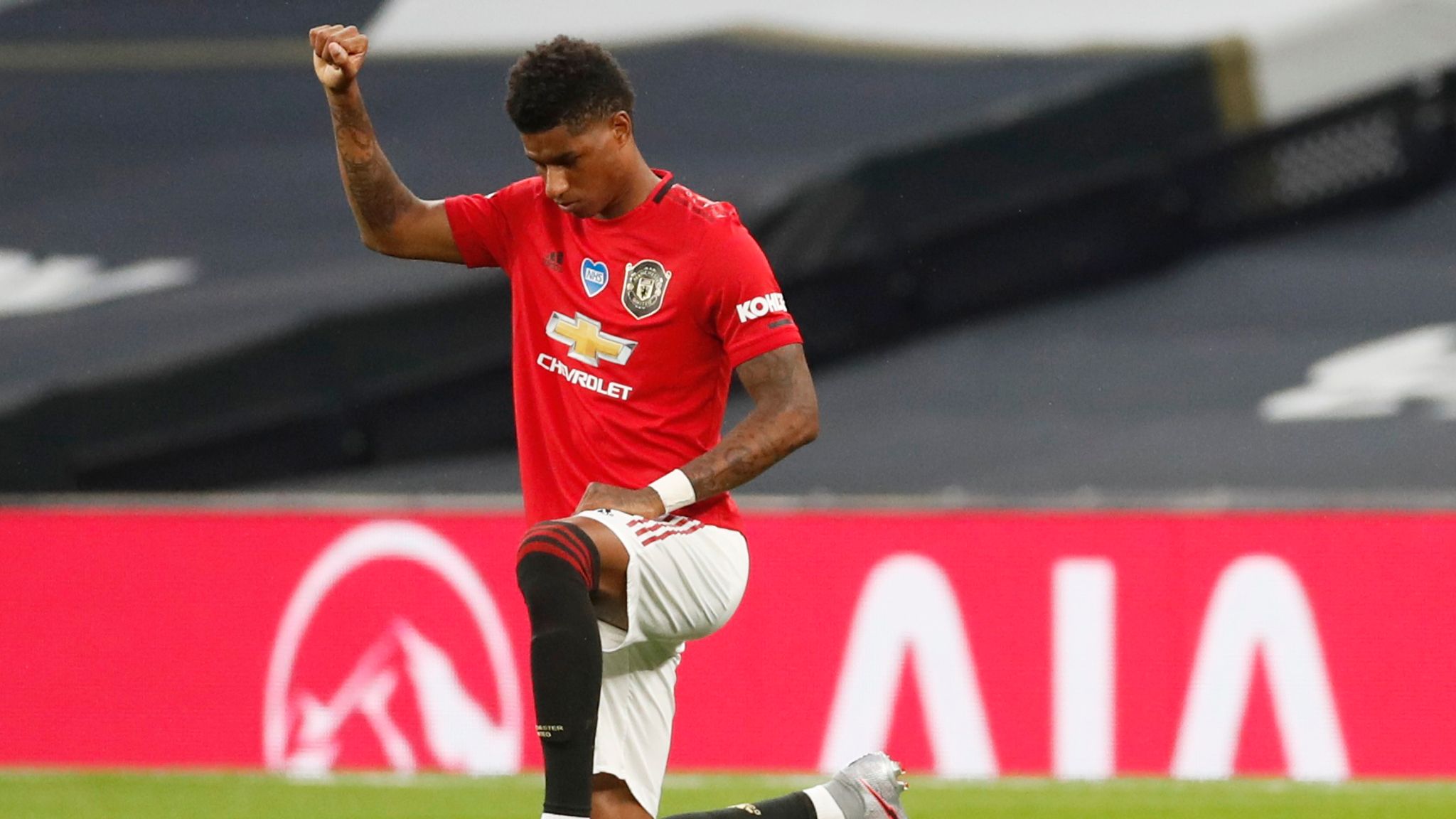
With this one tweet, the magnificent Marcus Rashford kicked off a campaign that has truly done his sport, his family and community proud. A symbol of everything that the dysfunctional lunatic Government in London hated – he dared to be young; he had the temerity to be working-class; he was a bloody rich footballer; he was northern; and perhaps his greatest sin of all in their eyes – he was black. How dare this reprobate, who ticked every box for that brand of Tory knacker running Britain since 2011, speak to them about social policy. What does he know? Turns out he knew quite a lot, enough to force the government to perform a u-turn in the summer and then force them to speak out against extending the scheme this week, with statements such as the following from Tory MP Brendan Clarke-Smith:

“I do not believe in nationalising children, instead we need to get back to the idea of taking responsibility.

“This means less celebrity virtue signalling on Twitter by proxy and more action to tackle the real causes of child poverty.”

Let that sink in. Marcus Rashford has an MBE for his efforts but he is far from finished.

“These children matter… and for as long as they don’t have a voice, they will have mine.”

It’s likely he will succeed again in his campaign. We all want to see fans back in grounds, but when we do, I also want every ground in the country to stand to applaud this man. I want to hear the Kop sing his name. He deserves it.

What can we learn from this? That a simple message of generosity can overcome the most convoluted, arcane forces of injustice.

“We want to be successful in changing the way Irish football is viewed worldwide”

With those words in August, Stephen Kenny started his revolution. Most Irish football fans are sick to death of watching utter shite for the past 12 years. Trappatoni had no respect for the nation that presented him the genius of Liam Brady on a plate in Turin. Martin O’Neill was no better and a bit of a prick in interviews to boot. The hope for McCarthy’s reign lasted about 25 minutes before the boredom of the performance on that Mediterranean rock blew our hopes away. We are gasping for change.

2 tournaments in 20 years – one of which was a complete waste of time – is not enough payback for us to constantly sit through games at home to the likes of Georgia where we are comprehensively outplayed. It’s not good enough. It feeds into this ignorant narrative about our players not being “good enough”, with none of these clowns ever stating what they are not “good enough” for. Qualification? Clearly we are, as demonstrated in 2012 and 2016. To get to a quarter-final of a world cup again? No, they’re probably not good enough for that, but only 1 Irish team ever was. We’re not looking for that. We’re looking for more than 1 fucking goal against Gibraltar, more than 35% possession in home games, and yes we are looking for results and qualification. And there seems to be some belief that the likes of Chris Morris and Alan McLoughlin were all world-beaters. Christ even some of our best back then – Houghton, Whelan, Stapleton, would struggle to get near recent Liverpool or Man City teams or any title-challenger today. Take off your Italia-90 tinted spectacles, engage your brain and look around!!! Until people realise that 90% of international football is a at best a step-sideways and usually a step-down from both the Premier League and, quite often, the Championship, we will never get a proper debate on the merits of the Irish national team.

Kenny’s Ireland is already a world apart from the turgid dross of his predecessors. The lack of goals is very concerning. He’s had severe mitigating factors – losing key players for the play-off then half his squad for the Nations League games is not something that has happened to any Ireland manager before. Not to mention not having had a game in front of home fans. He gets a pass until the World Cup qualifiers start, as far as I’m concerned, and deserves at least 1 campaign to get it right. We’re travelling in the right direction, and I’ll have no time for anyone who thinks it’s same-old same-old. Those types simply do not understand the game of football, not one iota of it. I look forward to every game now, with hope and with a much deeper urge to will them on their way.

What did I learn? To fall back in love with the Irish national soccer team.

“Shamrock Rovers P14 W12 D2 L0 GS38 GA7 GD31 Points 38

In an abridged 18 game season, Shamrock Rovers won the league title with 4 games to go with the above record. They simply blew the league away. Some of their football was a joy to watch, as Graham Burke and Jack Byrne in particular ran the show, with captain Ronan Finn growing more and more into a leadership role as he bagged his 4th Premier League Medal. An unlucky draw brought AC Milan to a deserted Tallaght a few weeks back for the Europa League play-off and there was never really any way forward for Rovers against Ibrahimovic and co. As an aside, it was a killer to know that less than 15 minutes away, AC Milan were playing a competitive match against my team and I couldn’t be there – it really hit that evening. Perhaps a kinder path next season via the Champions League might open up again, as it has for Dundalk this season (although their remarkable progress this season has gone fairly unnoticed!) and we’ll get some memorable sell-out nights down Whitestown Way.

For Rovers, this has been the culmination of several years of progress under Stephen Bradley, based on patience and belief. They have now ended a 32 year wait for the FAI Cup and a 9 year wait for a league title in less than 12 months. Great times for the Hoops.

What could be the lesson from this? To have an even greater appreciation for the game that happens every week or 2 down the road from your house.

Non-contact training can continue for school aged children, outdoors in pods of 15

A life changing line in the list of restrictions the Irish Government imposed last week. Having the shutters fall completely on all sports for all ages was a hammer blow to society in March. We accepted that as we were learning about the virus, we could live with a total lockdown, but now we know so much more, in particular transmission rates outdoors, and transmission rates betweeen children, that it would no longer be acceptable to do so much damage to their mental health and physical well-being again. As I write this, my 5-year old is in his Hallowe’en football camp for 3 hours every morning for mid-term, and his GAA and football academies have continued. Tens of thousands (hundreds of thousands maybe) are still enjoying training and the socialising, even as the competitive matches remain suspended.

What did I learn? To never complain in the many, many years to come, about early rises at weekends; long drives to the remotest soccer outposts of Leinster; drenchings on the sidelines; filthy gear wrecking the car and house; and crap refereeing decisions. I’ll do my best.

“2020 will be remembered as the year the world turned upside down. ‘For us, the world was suddenly the right way round.’”

Martina Cox, wife of Sean Cox, quoted in the Irish Times magazine last week. A story of determination and hope that lights up this dark year. Read more here: https://www.irishtimes.com/culture/books/martina-cox-in-my-eyes-se%C3%A1n-was-always-coming-home-1.4380740

Honourable Mentions

Dundalk reaching the Europa League group stages again. Jack Charlton and Walkinstown Roundabout. Black Lives Matter. Being ok without fake crowd noise. Match of the Day Top 10 podcast on TV. Season 2 of Sunderland Til I Die. Champagne Football. Second Captains (brilliant as usual throughout 2020). The crowd in Helsinki. The madness of Project Big Picture.

And the knowledge that we’re 7 months closer to the turnstiles reopening; the floodlights coming into view again; the final pre-match pint sunk in 7 minutes; and the roar of the crowd, than we were in March.

YoG No. 60 – The Rituals…

Phoenix Park

They’re in your stomach, your gut

The floodlights

the arenas, from Dublin 4 to 24, from 3 to 7 to 8 and beyond

Electricity everywhere

the play-off; the derby; the cup final

Now postponed, now irrelevant. For now.

Just for now

——————————————-

They’re the sounds, the smell

the nonsense, the drink, the laughs, the fog of nostalgia

Outside Inside Pre-match Post-match

Now empty, now idle. For now.

Just for now.

——————————————-

They’re in your park, the boys, the girls

the bibs and cones and the astro’s goals

the unfortunate ref that can never be told

Now silent, now calmed. For now.

Just for now

——————————————-

When we return, what will we see

Values – competition, fair play, graciousness and grace

Re-turn; Re-Orient; Re-Imagine; Re-Discover

——————————————-

Our game in our community, our heroes in our dreams

and our dreams in our heroes

——————————————-

Money. The spectacle, the 24/7 circus

we’ll want no more of that, surely

The blinded tribes, the gambling, the vulgar consumption

we’ll want no more of that, surely

——————————————-

Our game in our community, our heroes in our dreams

and our dreams in our heroes

——————————————-

With the whistles of the wind but no whistles of the games

It’s the rituals that matter. It’s the rituals that stay

The stage stays set, the pitches lined, the people wait and pray

Because it’s the rituals that matter. It’s the rituals that stay…


Yard of Grass – 28/03/20

Europe is shut down due to Corona Virus. The health of our families, friends and colleagues is at the forefront of everyone’s mind. Sport has been postponed indefinitely globally. This does not mean we cannot think about it and does not mean we cannot use this time to reflect on what it really means and what aspects of it matter the most. It is not a matter of life or death, but it is part of the glue that holds our societies together across the globe between neighbourhoods, cities, countries and continents, and I’m sure billions of us are missing it right now. Take care.


Picture of Phoenix Park (c) N. Chadwick https://www.geograph.ie/photo/6016488

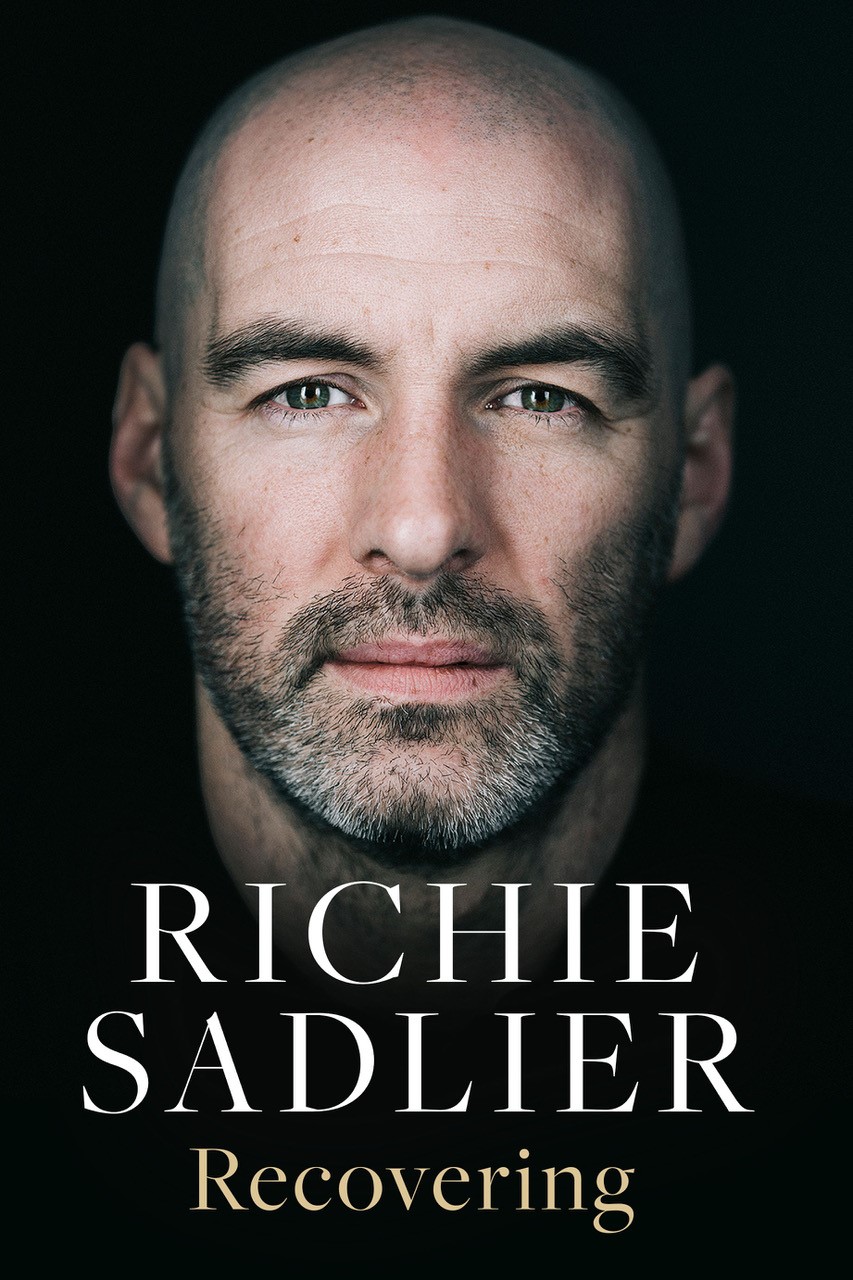
YoG No. 59 – Richie Sadlier – Recovering

This is an important book. For parents of children who may want them to pursue a career in this game, it serves as a warning as to what it can entail. For parents of all boys, it could also serve as somewhat of a red flag as it deals with issues such as sexuality and broader issues around masculinity among young men. It charts a successful sporting career cut short by injury, which in and of itself is a story worth hearing. It then goes into great detail in two distinct ways – first there is the spiral into alcoholism and heavy recreational drug use, linked to a trauma in his past, then secondly the recovery and journey into two new careers; in media, and as a psychotherapist. And it is this aspect that lends this book a depth, breadth and weight that is practically non-existent in works of this genre.

My overwhelming reaction on completing this was to thank Richie Sadlier. To thank him for sharing his experiences, positive and negative; for exposing some of the darker, more nasty sides of the game; for explaining addiction in such illuminating and constructive terms; for allowing abuse victims to speak up; for giving me and all of my male friends a different perspective on issues like sexual consent, one which we can pass on to our sons; and more generally, away from the book itself, for raising the tone of sports coverage across the various platforms and for avoiding the easy path in his media work.

You all know by now how well received and highly commended this book is, so I won’t repeat the reviews you’ve already read. I wanted to take my time in reading this book and then take my time in thinking how to write about it (not this bloody long admittedly but this is a part-time gig here after all) so this piece is relatively late to the party. Away from the major headline issues around abuse and addiction, which are handled exceptionally well by giving true insight, there are a few other aspects of the book, however, that I would like to mention particularly.

First, his detailed description of the manner in which his body was unable to support his chosen career is one which gives an excellent insight into the crippling mental and physical anguish that must accompany an early retirement. It got to the point where he didnt even trust it when he was in pain “I ignored my body telling me  it wasn’t ready. It had let me down so often. Why listen to it now?”.

Throughout the early part of the book, you get a complete sense of the struggles; how he always seemed to take that bit longer to come back; how there was always another niggle around the corner; and – maybe because we read now with full knowledge – the sense that the eventual succumbing to injury was inevitable.

In relation to managers, there are two extracts which really stood out for me. Sadlier’s description of working with Brian Kerr and Noel O’Reilly was quite illustrative and could serve as another stick to beat the Irish football establishment with, as their wisdom remains ignored, sadly permanently in the case of the late O’Reilly. It’s rare you hear the following said about coaches or managers:

“Noel had a way of making you feel this was the best place in the world to be; they both came from the world of Dublin football, but they weren’t insular; they were worldly and open. Noel had a magic about him”.

When describing a stunt they pulled on other teams in Iceland, “it also underlined something else that made Brian and Noel special: there’s nowhere else like this lads, there’s nobody doing things the way we’re doing things”.

And on Brian Kerr himself, “Brian simply knew everything… he knows all there is to know about every team but when you broke it down to individual players, he knew everything about them too.” As Sadlier alludes to, we all now know this about Brian only too well. But what a fantastic tribute to the two of them; their work ethic; their character; and their commitment to succeed with joy.

The second managerial extract is of an entirely different nature. It is about the Sunderland manager who replaced Mick McCarthy, Kevin Ball. “One day, he tackled me a little too enthusiastically and I ended up requiring surgery on my right ankle as a result”. I’m sorry but I needed a double take on that one. The fucking manager put a player in hospital! A player who was in the midst of a comeback into the game having retired from injury? Proper football men indeed. Maybe I’m wrong, and I know some managers like to get involved, but I found that remarkable. I know this wasn’t the issue that caused the final retirement, but jaysus you’d have to wonder about that one all the same.

The final aspect of the book I would like to deal with is Richie’s relationship with his father. As many of you know, Richie does long-form interviews called the Player’s Chair as part of the Second Captains podcast. They go into great detail and depth and are highly illustrative of sporting careers. His interview with Paul Kimmage stopped me in my tracks and nearly caused me to pull over in the car somewhere outside Nenagh. Kimmage was talking about his late father and how much he supported his career and influenced him. There is a very long silence in the broadcast as Paul obviously struggles with his emotions. Only in writing this piece, do I actually begin to appreciate how challenging that might have been for Sadlier as well, with the memory of his Dad’s reaction of not wishing to go to Japan and Korea to potentially watch his son play for his country in the World Cup:

“Dad, this is the fucking World Cup. I could be playing in the World Cup. I want you to watch me if I do. I NEED you to watch me if I do. Why can’t you see that?”

Sadlier’s need to prove himself to his father is a thread running through this book. In contrast to the apathy displayed in the run-up to Japan-Korea, however, is his father’s reaction to Richie’s retirement, when he texted “I’m sure you’ll make a success of whatever you decide to do next. You should be very proud of yourself”. These are complex relationships, and Sadlier sets out his with his father extremely honestly and in a very relatable manner. The detailed manner in which he sets out the resolution of this relationship towards the end of the book gives a sense of closure. A happy ending to the truly dominant theme of the book and of Sadlier’s life. Isn’t it the dominant theme of everyone’s life?

Richie Sadlier’s work on television and on Second Captains has elevated him to a central place in Irish sporting culture. His Player’s Chair series is up there with the best sports broadcasting around. His piece for the podcast on the Belfast rape trial was vital and his work on sexual consent with teenagers is groundbreaking in this country. This is a book that could easily have not been written. There was no celebrity cash-in to be had; no one particular story to be told; and probably no massive commercial clamouring for it. As a result, we have instead a piece of work which cuts across several aspects of a life, but somehow cuts quite deeply into each. I don’t know how much credit is due to Dion Fanning for the writing, but to deal with so many aspects of football, sex, relationships, family, abuse, addiction and recovery in such detail in such a manageable length, is truly admirable.

I haven’t read enough of the other contenders to state categorically that this is the sports book of 2019, although others have already concluded so. I have read many titles this year in all genres and none have affected me as much as this. I rarely get through a book in 2 or 3 sittings. I did with this one. It’s simply brilliant and will stand the test of time with great publications of the past. Thanks Richie.


YoG No. 58 – Micks Abroad

Fans euro26In recent weeks, as yet another Irish Rugby World Cup fell asunder, there was much gnashing of teeth and back and forth about how Irish fans behaved in Japan. They were derided as losers by some football hacks; the word “cringe” being bandied about all over the shop. Their perceived sins included the following:

  • Singing “Stand Up for the Japanese” hours after the minnows humiliated the Irish, keeping them scoreless for 40 minutes;
  • Laughing and cheering into the camera behind Joe Schmidt during the closing stages of the total trashing by New Zealand; and
  • Singing “Fields of Athenry” during the semi-final we weren’t at.

And this whole thing was framed by poor oul Breffni’s “stacked full of lads, total cornage” interview which comprised a better satirical performance than anything Paul Howard could ever conjure up.

Of course, as the likes of Miguel Delaney and Ewan McKenna set out their stalls, which may be summed up as heavy criticism of this self-aware group staging a contrived performance of the “Irish Fan Abroad” –  a self-parody of over-friendly, over-gregarious, uber-craic merchants, with little if any evidence of critical analysis of what was going on on the pitch, to the extent that their apathy to the on-field shambles was enough for some to call out what they saw as a loser mentality. Some Rugby fans hit back and many looked at Irish soccer fans in 2012 and 2016 for cannon fodder. The thing is, they were right! To an extent.

The Anatomy of Irish fandom at major tournaments has gone through a number of stages, which may be summed up something along the lines of the following:

  1. 1988 and 1990 – Let’s call this the “We’re not the Fucking English” stage. The Scots had this as well, starting mainly at Mexico ’86. In order to demonstrate your difference from the thugs and hooligans that followed England as clearly as possible, you behave in the polar opposite manner. We did this in Germany and Italy. I remember sitting in a public square in Palermo with the Dutch fans and the Caribinieri were circling on motorbikes waiting for things to kick off. All we were doing was singing “England go home”. We were different. And we made sure the Italian police knew this.
  2. 1994 – USA was party time again off the pitch but qualification and great results were becoming business as usual. Irish fans tore up the east coast in 1994, but there was a growing sense that tournaments were becoming the norm rather than the exception. So while Ireland may have come to a virtual standstill again for this World Cup, it was no Italia 90. We had already arrived and the world knew us. No need for theatrics.
  3. 1996-00 – Disappointment. After qualifying in 3 of 4 attempts, we missed 3 in a row. A new generation awaited their turn.
  4. 2002 – Japan and Korea obviously priced a lot of people out of travelling, but large numbers still flocked to the far east. Back in the big time, but again, compared to 1990, there was no sense that the Green Army in 2002 were exceptionally different than others. I’m sure there were big nights out. I’m sure there was as much craic and banter as ever, but this seems to have been a very different experience as we looked to reestablish ourselves on the world stage. Perhaps the civil war which preceded the tournament had an impact and the tentative nature of our progress and elimination.
  5. 2004-10 – Another era of disappointment, during which of course, smartphones were invented, YouTube, facebook, Twitter, multiple news sources, memes, virals, Joe.ie, Balls.ie and a million new ways to record and share your life were all developed. And it was a combination of this with absolute hunger for another tournament, which gave rise to the latest incarnation of the Irish soccer fan abroad, which has now since been co-opted into Rugby.
  6. 2012. Rubbish on the field. Brilliant off it. The stirrings of a new breed of Irish performance fan were first felt. Whether it was the “Careful Now” banner being held up as Croats and Poles went to town on each other in central Poznan, or the many clips that were “doing the rounds”, it certainly felt different. It was very funny at times, and it was new, which is very important here. I’m not including the “Fields of Athenry” in Gdansk in this, simply because it does not belong here. That was a spontaneous lament. None of us enjoyed it. It was miserable and it was bloody appropriate too. We were honoured by the Mayor of Poznan afterwards and such awards seem twee now, but in Poland, a combination of the Irish recession; the relationships built through migration from our host country to ours in the preceding few years; the 10 year wait for a tournament for Irish fans and a 22 year wait for one in Europe; plus the futility of Trap’s approach; gave rise to this real nailing down of the “best fans in the world” tag. And at the time, yeh sure I welcomed it. Why not.
  7. 2016 – It began to grate here. Countless crap fed through the channels above with every day of the tournament chock full of “look at us, aren’t we gas” bolloxology. Changing a tyre; singing to a baby; helping a nun cross the road was it? Utterly inane self-conscious nonsense. I was only there for one night (yes that night. In Lille) and it seemed we were all too banjaxed from the heat in the bowl and the journey back on the Metro, to actually have a mad one. Central Lille, apart from the main train station where an epic “Fields” rang out – wrong song choice but whatever – was oddly subdued. But the entire fortnight was full of cringeworthy nonsense. And it wasn’t needed to distract from the football. 2 and a half decent performances there, unlike the zero we got in Poland. There’s even an article out there titled “11 Moments From Euro 2016 Which Endeared The Irish Fans To The World”. Fuck off.
  8. 2019 – Now the eggchasers have it. Singing support for the team that just hammered you is utterly fucking unforgiveable. Wish them well for the rest of the tournament. Tell them you hope they win it, as I did to the Croats, Spaniards and Italians I met in Poland, but sing them a song with a smile on your face? Where’s your Fucking Pride indeed!!! Smile and laugh into the camera as you’ve been slaughtered by NZ?? Many clowns compared this to Gdansk, as we sang with Spain 4 up. No comparison can possibly be made in sport with deeper ignorance. I was disgusted by that sight in Japan, and my feelings were vindicated by my Rugby supporting friends who felt the same way. Unreal and absolutely a loser mentality. A soccer crowd would’ve been seen mouthing vulgar abuse. And YES! That would have been better!

So we are where we are, as they say. A lot of people are of the view that these people are just enjoying themselves and put up a few straw man arguments along the lines of “would you prefer they were crying or trashing town squares?”. No I wouldn’t. Or ask, is there a proper way to support your team? And who decides that? Which is obviously not the case, as all fans are different.

But it would be nice to hear of an incident involving Irish fans at a major tournament that wasn’t vaingloriously videoed and shared incessantly online as a proof of how fecking upyaboya great we are. And that doesn’t conform to the weakest paddywhackery cliches imaginable. I acknowledge that this is part of modern culture – something has not been done if it has not been videoed – and perhaps these things always happened everywhere we went and we just didn’t have the means to record it. I don’t think so and I believe that the technology has in fact played a major part in this. What has happened now is a vicious circle has formed whereby each upload feeds the beast and as this beast gets hungrier and hungrier for more bants and more craic, the boys have that little bit more work to do, and they do it. They know they’re gas craic. They video themselves being gas craic. It looks gas craic. Aren’t we all gas craic. Let’s do something else gas craic now. Maybe even more gas craic than the last gas craic thing we did.

But let’s cut the shit. We are not special. We are just another team in another tournament (hopefully) and maybe our enjoyment of it should be more closely linked to the performance of those teams. As it once was in soccer at least.

YoG No 57 – Is Our Game Being Stolen?

SUBBUTEO STADIA – 12 OF THE BEST

Pic: http://readtheleague.com/the-big-feature/subbuteo-stadia-12-of-the-best 

It would be wrong to over-react to some of the things going on in football in 2019, but it would be a dereliction of duty for those with voices, no matter how small, not to critically analyse recent trends and attempt to chart a course which ensures that when we’re done with it, the game we leave behind can still create the magic it did for us and is as effortless to fall in love with as it ever was. In this piece, I’m going to look at 7 elements of modern football which I believe are fundamentally altering the game I fell in love with back in the 80’s – and remember that was a time when the game’s very existence was being called into question; when people were dying at football matches in Western Europe; and when the on-field spectacle was killing itself too. We’ve come a long way and the vast majority of progress has been positive, but it remains vital that we take some time to check where exactly we are now going. I’m of the view that this check should look at the following themes of modern football:

1. Neoliberalism and Inequality

Bury are not the first club to go under and won’t be the last. Their demise, however, has led to an examination of English football’s greatest open wound – inequality.  Outside of the US, the English Premier League is the number 1 sporting expression of neoliberalism at its most voracious, heartless, corporate best. The wealthy clubs rise to the top and their success breeds more capital and cash in a virtuous circle from their point of view, but a vicious one from many others. Some less thoughtful fans turn the other cheek at the reputations of their owners, blinded by the dazzle from the trophy cabinet. In other cases, they are blinded by mere promises. Hicks and Gillett tore Liverpool asunder while promising the world. The fruits of the Glazer takeover – with no planning or direction post-Ferguson – are beginning to be harvested. Even the 2 biggest traditional names in English football are not immune to this.

But it’s not just the wealth, its sources and their intentions that needs questioning. It’s the sheer inequality that really needs to be looked at across the continent. The wealth of the European elite is such that the whole notion of “competition” is being slowly eroded. What was once highly unlikely is now laughably impossible. Leeds, St. Etienne, Borussia Monchengladbach, Brugge, Malmo, Hamburg, Aston Villa – European Cup Finalists all of them from 1975 to 1982 – 6 leagues represented in all in finals during that 7-year period. Steaua Bucharest, Porto, PSV, Benfica, Red Star Belgrade, Marseille, and Sampdoria are in that list from 1986 to 1992 – 5 additional leagues represented in that 6-year period. Then it became the Champions League. It has now been 15 years since any team from outside the top 4 leagues competed in the final. And between 1992 and the Porto-Monaco 2004 final, only Ajax broke the big 4 monopoly.

Nottingham Forest vs Malmo – European Cup Final 1979

This is a fundamental shift which was designed by, planned for and welcomed by UEFA, the big leagues and the big clubs. Moreover, it is one which many wish to build on, elaborate and exacerbate. It is the slow death of continental club football – an assault on the very notion of the European Cup and as the massive Euro-yawn which greeted this seasons group-stage draw demonstrated, it is beginning to take effect. As a Liverpool fan revelling in being champions, I despair that the excitement of being in it is now dimming, as the failure to do what was once celebrated as an achievement – getting to the last 16 – would now be regarded as an epic and catastrophic turn of events.

We have not even mentioned the Europa League, but we will further down. The Champions League and the top leagues of Europe now operate at such a remove from the fans that they have become beacons of a modern cheap celebrity culture where any sign of humanity (giving the ball to a fan, visiting a hospital) is now greeted with astonishment of these player’s “down-to-earthness”. Heaven forbid that these men, many of whom dragged themselves out of poverty to become sporting millionaires may actually be sound. Behind the velvet ropes, the private parties, the vile agents, the publicists, the sponsors, the minders, the SUVs, the headphones, the mansions and the tattoos may lie people who would have been happy, happier even, to earn in a year what some of them earn in a week. Doing the only thing they ever wanted to do. And maybe all the money was pointless. Damaging. A waste. Has it made the game better? Has it made the game something more worthy of handing on to the next generation? Or has the love of money finally extinguished the love of glory?

2. Gambling

This issue has been to the fore in recent years and months, as this industry tightens its grip on the beautiful game. I don’t gamble. I have no interest in the odds and I hate that it infects so many of my conversation about football. I wrote about it here and I think this quote sums up my feelings on the subject as much as I would like to now:

“Football has in recent years thrown its arms around this insidious industry, and has helped, via its slick and incessant marketing, to make it mainstream and perfectly acceptable. Paddy Power’s funny ads with the steward and the bus driver; Ray Winstone’s bloated cockernee face imploring us to “ave a bang on that” 4 times per ad break; in-game odds on the fucking advertising hoardings during a game – what tasteless bastard allowed that to become the norm? All of this serves to make it ok for us (Irish) to throw €5bn into this industry. It makes it ok to whip out your smartphone on your barstool while your mates are looking the other way and spunk €20 on Coutinho to score next goal on B**V*****’s oh-so-easy to use app (the official betting partner of Liverpool FC) .

Or to do so on your couch, while your kids play on in the same room, oblivious to Daddy’s increasingly serious habit that may one day end up costing them something important. It may be a bit harsh to think of it in that way, but I’m sick to the back teeth of the direction in which my peers, my fellow fans, are bringing the game I love. Every conman needs a rube, and sports gambling has countless millions willing to blow their wages, wages their families may rely on, to feed the industry’s soulless ugly corporate black hearts. The vile takeover is almost complete.” 

Gambling is Football’s rash. Governments across Europe need to act now and treat this plague the same way they treated cigarettes. Sponsorship by gambling companies needs to be banned now before it’s too late. Before a bet is seen as much a part of the game as the match-day programme or post-match analysis.

3. Rival Banter Culture

Lads have always been morons. We all had muppets in our groups growing up and we still have a few now. The “mad fella”, the tool who always just avoided an incident with the Gardaí on a night out. His witterings, his semi-drunk, then drunk, argumentative garbage, is now called “banter”. For football matters, we can all look back with shame at how we may have enjoyed Soccer AM in the early days, as I trace this culture to there. (In much the same way, I trace Brexit to 2004-era Top Gear!). On occasion, it makes any sort of thought; any sort of impartiality; any attempt at genuine analysis into an open invitation for claims of bias, lashings of rage-filled invective, and the making of loud, obnoxious, noxious and psychologically questionable statements on what is a game of football. Arsenal Fan TV was (is?) a prime example, whereby the last days of the great Arsene Wenger were turned into some sideshow about a once fine Empire tearing itself to pieces as two rival factions fought out a veritable civil war (jaysus Brexit again! That’s not a coincidence).

Soccer AM and the Birth of Modern Football Banter

Iconic

The two clowns formerly of Sky Sports (them again, and once again not a coincidence), now of BeIn Sports with their sub-schoolboy sexism a few years back was probably the nadir of this laddish nonsense from a tv perspective, but in the stands, in the pubs and in the workplaces it goes on. Some would even claim that the racism aimed at black players and a particular Irish player from the city of Derry is merely banter. These people need to be shamed into reforming their behaviour and the football authorities need to act. It’s been long enough.

4. Abuse of Officials

It’s a cliche at this stage but without refs and assistants, there is no game. While I don’t always welcome comparisons to other sports, we need to give the refs the status they have in Rugby Union. There used to be a rule that only the captain can talk to the ref. It may seem ridiculous now, but why not bring that back in? Why not empower the ref to book any player that even opens his mouth at him other than to ask him direction on a set-piece etc. The abuse of officials is a cancer on the game, which infects the entire footballing world right down to schoolboys and girls. I honestly have no idea why the authorities do not clamp down. What do they fear would happen?

5. Technology and VAR

It’s daft to say technology in itself is a threat to the game, but in the environment in which we currently find ourselves where unless you have an extreme opinion, you have no opinion, there is a danger that soccer will chew itself to pieces over this.

The answer to the current predicament, and an answer to the abuse of officials lies not in the VAR room, but in the TV studio. Imagine, if you can, turning off the TV at half time and after a match. Imagine Sky, BT et al, only showing action replays from the referee’s perspective. Imagine no faux outrage from former players about the injustice? Imagine no day-long media wankfest over a decision of microscopic proportions? Imagine we could all get on with our lives at the final whistle blissfully ignorant of an event or incident that doesn’t actually really matter that much. Only once in a decade at most will your life be fundamentally adversely affected by a refereeing decision. I’ll give you my examples – Dutch goal offside in Gelsenkirchen 1988 and Thierry Henry in 2009. Off the top of my head, I can’t think of any others which had me in a bad mood the next day. Maybe I don’t care enough. Maybe I care the right amount. It’s not the technology on the pitch that’s the problem. It’s the fact that every human decision being made there is under the microscope and then subject to issues 3 and 4 above.

Raheem Sterling’s Offending Armpit 

 VAR's offside system could be scrapped after a chaotic first weekend in the Premier League which included Raheem Sterling being deemed offside by mere millimetres in the above photo

6. Media and Social Media

Remember that tool I referred to earlier under banter culture, Well in the old days his presence once or twice a week in your life was ok because you didn’t hear him in your ear the rest of the week and you didn’t feel the need to respond to his shite every hour. Now it seems you cannot be a football fan and escape totally from the inane ramblings of absolute fools and from the offensive sharts of his fellow neanderthal travellers.

I don’t particularly like blame being always put at the door of social media. I hate when people say things like “twitter has exploded” or “twitter has responded”. Twitter is not a sentient being. It’s the people on twitter doing this and they are responsible for what they write. However it is clear today that there is a feedback loop between the method of communication and the manner of it that may not have been there in the days of newspapers and near broadcasting monopolies. Twitter and other outlets have completely legitimised the tacky and lazy; the bantz and racism; the easy and cheap; the nasty and offensive. Just because you can tweet does not mean you should. Just because twitter themselves don’t think your material is as welcome as raw sewage does not mean the rest of us agree. If these companies don’t get a hold of their output, serious questions will eventually be asked and reasonable people will turn away.

As for conventional media – print and TV – Why have the idiots taken over? Why have we ended up in a situation where coverage of the game is so polarised between what is absolutely brilliant coverage by a minority of journalists and utter, utter diarrhoea by so many others. Football 365’s Mediawatch is something I still read, but what I once found funny I now find tragic, because the depths to which the tabloid press in the UK have now plumbed are depressing. These journalists are dirt. Their day-to-day vomits veer from the pointless to the sexist, from the meaningless to the downright racist.

While in relation to TV, I accept that this is a hard job and that to find telegenic ex-players to act as pundits is difficult. So why not stop trying? There are at least a dozen journalists – actual real-life journalists who write compellingly about the game on a daily basis and who are guests on podcasts that truly analyse every facet of the game. Get them on! And I don’t mean in a Jimmy Hill Sunday Supplement kind of way. I mean get one of them onto panels on Sky or BT. Or one on MoTD. Surely it’s not just the well-educated fans who despair at the garbage spouted by some ex-players? You don’t need a PhD to realise that the vast majority of what they say is a waste of oxygen!

7. Status and Inequality of Competitions

Related to the first point about more general inequality, this is more about the cheapening of certain competitions, most notably the FA Cup. It’s very sad what has happened to this old trophy. It doesn’t take much work to realise this. All you have to do is think of how much it means to win the FAI Cup in Ireland compared to it. I’m a Shamrock Rovers fan and I know our fanbase would explode if we won it. I was there when Pat’s finally broke their hoodoo and saw what it meant to them. Did City fans even celebrate it last year? When was the last year that you could guarantee that nearly every football fan in the UK and Ireland would have sat down to watch at least some of the Cup Final? A lot has contributed to this – saturation coverage of football on tv; crowded fixture list; United pulling out of it; and a generally more atomised culture in which the collective experience of “the match” is dying. In Ireland, the only Monday mornings in the workplace where everyone would know what you mean by “the match” are those that follow the All-Ireland finals, and even that is starting to fade.

But this matters because a game in which a trophyless season finishing 30 points off the pace in 4th place is deemed even a partial success, is not one worth following. There has to be a dream of glory somewhere. Lifting a trophy has to be the endgame for all players and yes some trophies have always been less valuable than others, but I don’t remember the 2001 UEFA Cup as a stopgap as a Liverpool fan, and I don’t remember meaningless League Cup victories in 1995 and 2003. For absolute certain, the 2001 and 2006 FA Cups were not meaningless in the way City’s seems to have been last year. They won the fucking double! It should be massive, jaysus. It was when Fergie and Arsene were at it. As was the now defunct European Cup Winners Cup when both clubs won it in the 90’s. How did we let this happen?

The European Cup Winners Cup 1991 – The Spark that Ignited an Empire (or was it the 1990 FA Cup?)

Image result for cup winners cup 1991

Final Thoughts

Are we pissing into the wind, trying to hold back the tide. Should we just let the elite football ship sail off into the distance into a European Super League with games played in China and the US? Should we go back to our grassroots completely, back to the days when continental competitions consisted of invitational tours and challenge matches. Whither international football in this dystopian sporting megafactory? I really don’t know the answer to this and perhaps in Ireland we are too conscious of the shadow cast by the Premier League behemoth. Are Dutch and Austrian fans similarly concerned, for example. I would assume the thoughts of a European Super League makes almost all football fans slightly queasy. Would even greater renewed interest in our domestic game or local games ultimately benefit us all in any case? The problem is that fan power is slowly being eroded at the upper echelons. Boycotts may or may not make a difference as the global reach of the footballing megabrands make the local fans less and less relevant.

There are massive and fundamental structural problems within football as we define the game in 2019. There are some solutions I would put forward under the topics below and I think they should be discussed:

  • Real financial fair play
  • A wage cap
  • Champions League places for the domestic cups
  • Ban on gambling sponsorship
  • Empowerment of Referees
  • More female officials
  • Reform of TV Coverage
  • Points deductions for racist or discriminatory chanting

As we have seen with Donald Trump’s ascent and the tragic scenes as the UK’s democracy rents itself asunder, you need to be very careful to nip these types of issues in the bud as soon as they rear their ugly heads. We’re past that stage now, well past, and no-one seems willing to take it on. Plenty is being written and many will agree with a lot of this article, but as long as the powers that be continue to pump the drug directly into our veins almost every night of the week, we seem incapable of kicking back. Just spare a thought for the poor Bury fans who must now go cold turkey.


YoG No. 56 – The End for the Irish Football Peasants

JD

Peasant is a loaded term, particularly in a country like Ireland, defined by its legacy of rural poverty. It’s a term which should not be used lightly and I don’t do so here. Irish football, however, has undoubtedly been overseen and managed by an underqualified, arrogant, out-of-touch and aggressively incompetent peasant class. The central aspect to this claim is that the term “peasant” can mean more than the usual connotations of poverty and a lack of education. To me it also encompasses a particular trait which continues to dog Irish public life – the fact that the peasant is overly concerned with how he or she is viewed by others, most notably those from other countries. This trait is one of the defining ingredients in the almost constant battle between the FAI and the fit and proper governance of Irish football. It can be traced back through our wretched football political history, and reached its nadir in the last few months as John Delaney’s antics came to light in the most spectacular manner.

There are several elements to this story, but it starts with that most peasant-like characteristic of all – the decent skin. Sure, isn’t he a grand lad, didn’t he open that pitch over there paid for by “his” FAI. This sort of thinking makes me sick. It’s bad enough that the man was merely doing what he was paid to do: develop Irish football, but the money was not generated by some commercial genius CEO – it was the taxpayers money. John Delaney’s oversized novelty cheques were funded by you and me, and many hundreds of thousands of Irish workers with feck all interest in football. Yet the peasants were grovelling at the feet of this messiah; this phony; this man of little substance. Lest he think they were not worthy of his patronage.

Then there was the desperation of the peasants. We need a world class manager. A marquee name. Damn all the others. We are Ireland and if John Delaney needs to swing his mickey in Nyon at UEFA or in Zurich with Sepp, he has to have that name. That name was Giovanni Trappatoni and the FAI would facilitate disgusting sportswashing by Denis O’Brien, who stumped up for half his wages, in order to have that name. I’ve always hated this relationship and I believe that when we’re finally rid of all the wafflers and nodding donkeys in Irish football, we will look back at this grubby little episode with the most regret.

The peasants were so grateful to Signor Trap’s amazing work in getting this shower of amateurs to the dizzy heights of a tournament (for the first time ever was it?), having narrowly missed out in a play-off the previous time when the tactic was to ignore the manager, that his contract was extended in advance of a tournament, in which we were shamed by all-comers. More, and deeper, shame was piled on Ireland by the Germans before Trap was paid off by Messrs Delaney and O’Brien. How much money exited Irish football in that period, and how much do we have to show for it? Seriously, how many great memories do you have from Trap’s era? Poland was great for me because I went and for the first time, you were far better off being an Ireland fan at the tournament than at home because you had distractions, but what else was there?

Then like all peasants, they do have some good times. Martin O’Neill did well and got us to France, beating and drawing with the Germans who had routed us under Trap. All was well in 2016, but again the peasant grovelling at the feet of their colonial masters with all their European cups and witty ripostes, decided to extend the contract and the whole thing went into meltdown. Again. Irish football would be a shambles. Again.

But they were just the on-pitch scandals. What has emerged in the last few months eclipses all of this. His exorbitant wages have always been a massive issue, related closely to the idea that “sure aren’t we lucky to have him” – the catch-cry of the blinkered lickspittles, yes-men and cavemen. But to hear now that he was effectively using the FAI as his own personal bank is just beyond the pale. The expenses and the credit card bills. The commissioning of expensive management consultant report after report, and the imposition of legal costs which, if spent on the game, would make a huge difference to the Irish soccer community. This man has taken millions away from the boys and girls that will constitute the Irish senior national soccer teams of the future, in order to cover his arse, procrastinate and obfuscate.

Then there was the king of the peasantry himself, the chief of the Healy-Rae clan, with both his literal flat cap on his head and the metaphorical rope around his trousers. What a horrible embarrassment he was at the Dáil committee. I feel limitless sympathy for the honest, bright, visionary folk of Kerry who did not give him a 1st preference vote at the last election. He may top the poll, but 75% of “his people” would prefer if someone else represented them. Many of them, one would have to assume, have strong feelings on the matter. He represents Kerry in the same way Ahern represented Dublin. But, in fairness to him, he is stil a statesman compared to Ivan Yates, a broke bookie rabble-rouser whose tragic attempt to jump on the anti-Healy Rae bandwagon backfired in a truly spectacular fashion. People may not like the Kerry TD much, but they have no time for insincere, boorish, clickbait masquerading as TV journalism.

All the while this was unfolding, the little people, John’s people, the so-called grassroots, were coming out to defend him. The little men with their new astros, and their new balls. The loyalists. The bought and paid for. With their Ctrl+C, Ctrl+V unanimous, identical, support for him. Clubs like Limerick FC – who could afford the time to release one of these statements, but could not afford to pay their players. The grassroots – the gombeenmen, the peasants. A great bunch of lads. The absolute fucking state of ye!

And yet, every so often, on Virgin media, or on Today FM, the comforting, soothing tones of Dublin soccer personfied, (indeed Dublin City) was wiling away his time broadcasting. If not wasting his talents, at least not using them to his maximum advantage, or ours. As Brian Kerr spread wisdom on the airwaves, John Delaney spread exasperation. And then there was Niall Quinn, another voice of reason. There were tennis balls and Damien Duff’s fall from grace. There was Richie Sadlier’s gaze into the heavens and considered outbursts at every new revelation, every so often only the F-words would do. Second Captain’s listeners with young kids would postpone an explanation to another day.

Irish football is in crisis mode. 2 senior qualifiers came and went. We won both and played quite well in one and we look forward to the next. McCarthy is a breath of fresh air in a fog of uncertainty. Stephen Kenny is an energetic presence and one to look forward to. Our U-17’s were unlucky in the Euros and the local football crowd turned up in good numbers for a good spectacle. Attendances are up across the board, with a whopper crowd and a mega-whopper atmosphere at a mental Dublin derby, and another proper title-race in the making. The crisis is not on the pitches. If anything, we are in a relatively ok place as a footballing nation. On the pitches.

But off the pitch, we need to remove the FAI in total. We need an absolute clear out of the higher-level executive and board. We may need a troika-style takeover in the interim, but we must also seek to take back the game. Ask Quinn, Kerr et al what they would do. Listen to the educated voices, the voices of experience. Bring in a non-football CEO, a non-football treasurer – an absolute nazi in charge of the accounts. Transparent, evidence-based expenditure plans subject to appraisal, where every cent can be justified on the basis of how many will benefit from it and how it fits into the FAI’s corporate plan, the norm in many organisations must become the norm here.

We are beginning to see the light at the end of the tunnel. The peasants have been exposed and are in the process of being expelled, but they need to be replaced by thinkers, innovators, honest men and women with integrity. Only then will Irish football stop wallowing as the poor relation of Irish sport; the stain on Irish sporting governance; the runt of the litter staring doe-eyed at the GAA and IRFU with their competence and their professionalism. Only then will we finally get the association we deserve and the only then will we get the game we deserve.


YoG No. 55 – Women and Football

This time around on YoG we look at the role of women in football today and into the future. Do we foresee the level of coverage we see currently in the likes of Tennis, Athletics and Swimming, or will football, like most field sports and golf, keep women and the women’s game firmly in a very distant second place to the men’s game. I’m 41. No girl I ever knew as a kid even joined in in the kick-arounds with me and the lads, let alone played in a formal setting. Things have changed radically since then, but are we on the path to a world in which the striker for the Women’s Premier League Champions is as famous as Serena Williams, or where as many watch the Women’s World Cup Final as watch the Women’s 100m Final at the Olympics. It has been a long road for the women’s game up to now – but it wasn’t always this way – and it has been a long road also for women in the men’s game.

The Story So Far

Massive kudos to the incredible Football History Boys  for their wide-ranging and brilliant recent series on the history of Women’s football from the late 19th Century. It finally inspired me to write the post I’ve been thinking of writing for a long time. The series was an absolute eye-opener for me, shocking to the extent that some parts even sounded fictional to a late 20th century product like myself, e.g. the following excerpt from Part Two:

“Perhaps the greatest example of the huge growth of women’s football comes from one match. At Everton’s Goodison Park, the Dick, Kerr’s Ladies took on local side St Helen’s Ladies in front of an estimated 53,000 spectators. According to Tim Tate a further 14,000 were turned away from the match and left outside the gates on a cold Boxing Day two years after the climax of the First World War.”

Clip from 1921 game in New Brighton, Merseyside between Dick, Kerr’s and Ellesmere Port Cement Works Team

Incredible stuff. So much so that the response of the Football Association was to ban women from using their grounds. Yes, while their game was flying in popularity, those in power banned half the population from playing it. The FA statement at the time read:

The Council feel impelled to express their strong opinion that the game of football is quite unsuitable for females, and ought not to be encouraged. 

According to the Football History Boys, there was also an element to this which related to the re-assertion of the game’s masculinity; that if women could play it then men shouldn’t. Whatever the reasoning, it was a move that was “of its time” to be polite. Women’s football carried on under the radar and beyond the FA’s grounds. World War II came and went, as did the 50’s and all of its modesties and austerities. Then in 1969, unconnected to the FA, the Women’s Football Association was formed, with our very own Dundalk among the founding members, and the ban was overturned a few years later.

The women’s game grew and garnered greater and greater legitimacy from the mainstream game, culminating in the first FIFA World Cup in 1991, won by the United States. And in my experience, it was Stateside where the women’s game really centred from then until recently, and the likes of Brandi Chastain and Mia Hamm are well known by supporters of the men’s game across the world.

Today in Ireland, we are fortunate to have new media willing to give the women’s game some exposure, from Second Captains interviewing Emma Byrne on the Player’s Chair to the power of the viral social media propelling Stephanie Roche to 3rd place in the Ferenc Puskas award in 2015. RTÉ have also been willing to show a few games and since the Women’s National Team highlighted the inequalities they faced a few years back, the FAI have pushed a lot of content for the women’s team into my Inbox, and there’s not much of a patriarchy evident on their website, with WNT sitting right next to MNT. To some, the latter acronym grates, but this is something they will just have to get over. So while we’re nowhere near equality, things have moved on a bit. But what are the main elements that we need to consider when thinking of women in football.

The Irish Women’s National team led by Emma Byrne in their fight for respect in 2017:

Republic of Ireland Women's National Team Press Conference

Football Culture

I think it’s reasonable to state that men are more likely than women, in general, to engage in boorish behaviour; to be immature and reckless; and to resort to banter and japes more readily than women. (I hate reading articles that spend more time setting out caveats to their main point than they do making the actual point, so I’m not going to apologise in advance for every generalisation I make about men or women. There will be some.)

But looking at football culture, how “laddish” is it? For example, when women appear on television as pundits and presenters, how differently are they treated? There are always going to be dickheads and cringeworthy moments, such as Patrice Evra applauding Eni Aluko during the World Cup or Ruud Gullit’s treatment of Alex Scott when she dared defend Steve Bruce for taking some time off before starting a new job. The latter case is an obvious one where perhaps a female persepective on family, bereavement and health is at odds with the more basic “proper football man” views of Gullit. The Dutchman’s view was not shared by all men in the game obviously and I believe that this attitude is changing. Having brilliant female presenters like Kelly Cates (who could probably at this stage teach her Dad a thing or two about the game) and pundits like Aluko – who blew Evra away simply by doing her job, i.e. researching the teams playing in advance, can only bolster the case for greater gender diversity on TV.

Ruud Gullit PFM’ing Alex Scott

0_JS173689605

This latter point also highlights another issue – Male pundits can be lazy and useless because they played the game at the highest level with the most exposure and everyone knows them. Do females have to work extra hard and be extra good to even be considered? Next time you’re watching Sky or BT and hearing the same set of cliches as you’ve always heard, consider could this be improved by a new face or new voice, or a new perspective?

Football culture seems to denigrate innovation (how we laughed at Pep and Jurgen) and reward sloth. This plays into the hands of those who prize ignorance and boorishness ahead of considered analysis and understanding of the human side of the game. And this may work against women.

The Game

Obviously women play the same game as men. The rules are identical and in general the variety of formations etc. also mirror the men’s game. The main difference – as in every other sport – is physical; strength and speed. This article on FIFA’s website in the lead up to the 2011 Women’s World Cup gives a few perspectives on this, including Marika Domanski-Lyfors, then head of the Women’s Elite Department for the Swedish FA who stated “There are differences of strength, which you see in particular when it comes to tackling. Speed is a difference too, but there is not so much difference in the relative changes of speed.” and “I think that you see the on-field scenarios more clearly in the women’s game because there is less tackling than in the men’s version. Clearly you can enjoy both: appreciating the men’s matches with their high levels of intensity and good technical skills, and the women’s matches with technical and tactical skills that you can recognise more clearly”.

In the same piece, English coach Hope Powell states that “while the women’s game is slower, that gives more scope for skill, compared to the greater focus on physicality that we see in the men’s game”

These are interesting observations. In general, my interpretation of the above is that the Women’s game may be less hectic overall, which more or less matches what I have seen over the years. This does not translate into an inferior product. The product is not about just the “standard” ( which is itself a subjective concept in any case, and one which has certainly been framed by men historically) but the brand of football; how contested the game is; the tactics on display; and the effort being made. Women’s football does everything the men’s game does and is an equal product in that manner in the exact same way as what Katie Taylor, Cora Staunton and the Irish Women’s Hockey Team have produced in recent years is equal to their male counterparts.

The Players

Of course it’s as much a team game as any other, but in a situation where PR, publicity and promotion is paramount, the old “hero narrative” won’t do any harm. Of course there is a litany of great female players and personalities from across the world, but I have found the careers of the Irish women below which have recently been covered elsewhere, of special interest.

Anne O’Brien

Ridiculous and embarrassing are the only words I can use to describe my ignorance of this woman’s career until I read this article on the42.ie. Born in Inchicore in 1956, she would be included in a group of players described by Italian legend Carolina Morace as “the best in the world (who) inspired the Italians to improve.” Her roll of honour merits a statue on the Aviva concourse. It’s phenomenal:

  • First Irish or UK female player to play on the Continent, when she signed for Stade Reims aged 17
  • 3 French League Titles
  • 5 Italian League Titles
  • 2 Italian Cups

A pioneer and a truly great Irish sporting personality. She died at the age of 60 in Rome and her legacy should really be celebrated more. I’m sure today’s Irish Women’s players view her as a trailblazer and an inspiration and as the game here progresses and gets the coverage it deserves, maybe she will too.

Anne O’Brien with Lazio in 1985 – Front Row Second from the Left

AoB

Emma Byrne

That word ridiculous comes up again here. Goalkeeper Emma Byrne of Leixlip signed for Arsenal in 2000 after a year in Denmark and time back in Ireland out of full-time football. By the end of her time at the club, she had amassed the following honours:

  • 11 League Titles
  • 1 Champions League
  • 10 FA Cups
  • 2 Player of the Year Awards

She was also capped 134 times for Ireland. She is our most decorated footballer and was the captain who led the women’s team’s fight for proper recognition and decency in their treatment by the FAI in 2017. Of all the achievements, this latter one may be that which has the longest and deepest legacy. Her interview with the always brilliant Richie Sadlier on the Second Captains Player’s Chair a few months back was a real eye-opener into some of the issues faced by female footballers. She recently became the first woman to be inducted into the FAI Hall of Fame. Another Irish pioneer.

RTÉ Tribute to Emma Byrne on her Induction into the FAI Hall of Fame

Of course, there have been countless others over the years and you can’t but mention Stephanie Roche and the role that goal played in raising the game’s profile, perhaps even worldwide. The current crop may in the future be looked at as the turning point and their stance against their treatment by the FAI may be seen in the future as a game-changer.

The Issues

When it comes to the issues around this topic, there are two strands at play – there’s the Women’s game itself and then there is the role of women in the men’s game. Starting with the former, we’ve looked at the nature of the women’s game and it’s basically identical beyond the obvious differences in pace and physicality. But there are other issues which need to be examined. There are other differences between men and women and I’d urge anyone to listen to Emma Byrne’s interview above. Just subscribe for one month if you have to, it’s worth the fiver alone.

Issues like relationships within the team are also a feature that you don’t get in the men’s game – certainly not openly – and this can have a profound impact on the “team” philosophy. This has, according to Byrne, manifest itself in scenarios whereby players signing for a club then ask for their girlfriend to be signed as well, and the manager agreeing. A break-up is even more difficult to deal with.

And then there’s pregnancy and that lingering feeling that applies in all walks of life but may be most brutally seen in sport where women are, in essence, punished for becoming a mother. The issue is described by Byrne as a “taboo subject”. There are several facets to this issue. The first is the overriding competitive nature of these athletes who just want to get on and win trophies and qualify for tournaments. Throughout their peak athletic years in their 20’s many will not even consider becoming a parent.

But of course, many do, particularly as they enter their 30’s and it’s at this point that things can become very difficult. Clubs do not provide for this. Female players, just like their male counterparts, are expected to be able to go away for weekends, away games, international breaks, and leave their kids – no matter how young they are. Clubs don’t provide childminding support and it sounds like they essentially view mothers in the same light as those without kids. While more and more workplaces, and society in general, move towards a far more flexible environment for parents – mothers and fathers – albeit slowly, football seems to be standing still in this regard.

Maternity leave and returning to work is very very different for athletes than for the rest of us. We are becoming parents later in life these days so many female footballers can have great careers into their early 30’s before starting a family, but whenever they choose to, it’s just that bit more difficult and challenging to come back into a sport, in particular if your maternity leave cover has been performing brilliantly in front of thousands of people every week. The body changes can be profound as well. It’s a very different scenario to the bloke running over to the corner flag on Match of the Day after he scores pretending to suck a soother while the commentator tells us his wife gave birth to twins that morning!!! It’s not unique to football obviously, but within football, it’s unique to the women’s game.

Women in the Men’s Game

We’ve talk a bit about pundits above, but I’m of the view that we are now in desperate need of more women in the men’s game in two specific areas – Officials and Stewards.

Dissent is an epidemic and a stain on football. The treatment of all officials by players, managers and staff is disgusting nowadays. This needs to end and I believe that one of the most effective ways to do this is to train more and more women to officiate at the highest levels of the men’s game. Even deplorables like Jose Mourinho would think twice about screaming in the face of a female 4th official. (Eva Carneiro may disagree I guess) And I would hope that there is no way in hell that 4 or 5 players would crowd around a young woman shouting abuse in her face over a decision. I could be wrong but if I am, I truly give up on the sport. Train them up and give them a proper go.

Similar logic applies to stewards. I’ve heard this advocated before and have seen it in action. The type of man who even disobeys the instruction of a female steward in a football stadium is a dick for a start. The type who would risk her safety belongs behind bars. Only the lowest form of male life would try to push past a woman, let alone throw a dig in the way many would not think twice about for a man. It’s an innate thing. I’ve seen many instances where female stewards just take the heat out of a situation, even where the chanting is a bit on the dodgy side. Stern but not aggressive and certainly not afraid. It’s not a job for every woman but if more could be employed, I think those types of men would behave themselves a little bit more. Again, I could be wrong, but if I am, I give up on football fans.

We simply need to de-lout the game. Football grounds are not the dangerous cauldrons of piss and violence they were in the 1970’s and 80’s, but recent incidents have shown that there is a remnant element still there and which never went away despite what Sky was telling you. It’s there in all leagues across the world. But when I take my son and daughter to Tallaght for the first time, I really don’t want them to witness the violence I have seen in some grounds over the years, or around the grounds, and I don’t want to hear the ref called a c**t, the opposing players called paedos or any racist or sectarian abuse. Is that too much to ask? And I think making the stadiums and the men’s game more open to greater numbers of women is part of the solution to this problem.

The Future

I have absolutely no doubt that within a generation, women’s football will be given the type of coverage women’s tennis and athletics get now. I can even foresee a scenario where, like Wimbledon, the Olympics and all Athletics events, the Women’s soccer tournaments are held at the same time and in the same place as the men’s. (we may need to row back on the number of countries involved, however). Football has made radical changes throughout its evolution. From rule changes such as the introduction of substitutes, banning the backpass, and the use of technology, to off-field cultural shifts such as all-seater stadia and the embrace of globalisation, both of which involved trade-offs between positive and negative impacts, the game is very different today than from 15, let alone 50, years ago. With women’s football, and an increased involvement for women in the men’s game, there are no trade-offs. No-one loses out and I look forward to seeing the game take that next giant, inevitable leap.