
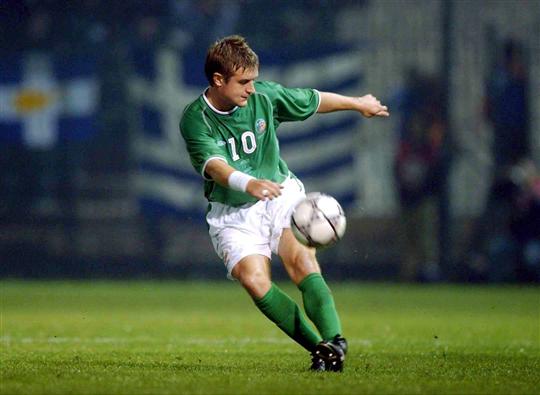
In the 2nd of this series, I look at another fine Irish midfielder.
Stephen McPhail retired at the end of the domestic season after 3 seasons at Shamrock Rovers. Once dubbed “the new Liam Brady” by George Graham, he was part of a truly great Leeds United squad that reached the Champions League semi-final under David O’Leary and a key member of the Irish U-18s European Championship winning team with Brian Kerr as manager. He also led a Cardiff team out at Wembley for the 2008 FA Cup Final. His career, however, was blighted with injuries and illnesses. Despite his success, despite his great achievements, and despite the fact that he has been appointed Sporting Director with Rovers and will hopefully have a long, and deserved post-playing career in football, there is a sense that had a bit more luck shone his way, we would be speaking of him in the same vein as his former teenage teammates Robbie Keane and Damien Duff. Even a glorious end at Rovers would have been nice, but managerial upheavals and the presence of great Dundalk and Cork City sides kept the Hoops well off the big honours in McPhail’s time at the club as a player.
Born in Westminster, London, he was raised in Dublin. His schoolboy career was forged in that great Dublin Academy of Home Farm in the early 1990’s from where he earned a spot in Leeds’ youth system. For those of you too young to remember, Leeds were giants of English football in the 90’s and into the early 00’s. Some of you are probably old enough to remember them as giants in the 1970’s as well. The now much-maligned and perennially unemployed David O’Leary was their manager through this golden period as McPhail made 78 appearances for the first team. O’Leary’s sacking, combined with a massive financial implosion and the subsequent scrambling around for new gaffers and new ways to dig themselves out of their abyss, meant the glory days were well and truly over for the club, and Stephen left to join Barnsley in 2004 after loan spells at Forest and Millwall. From being an unused substitute in a Champions League semi-final against Valencia to the 3rd tier of English football is quite a drop in a few years, but he went on to rebuild back up to the pinnacle of the game not long after.
After playing a part in Barnsley’s promotion to the Championship in 2006, he left to join Cardiff City. He spent 7 years with the Welsh club and racked up 190 appearances, captaining them on many occasions, including the 2008 FA Cup Final. This honour has fallen to only 2 other Irishmen in recent decades – Ronnie Whelan in 1989 and Roy Keane in 1999, 2004 and 2005 (thanks DannyInvincible on foot.ie). It’s quite an exclusive list to feature on. Unfortunately Cardiff were beaten by Portsmouth that day.
Injuries would interrupt the next few years, followed by a cancer of the lymphoma diagnosis in November 2009. He would be out until the following February, which was a remarkable recovery turnaround and a testament to his character. Over the following years, he was in and out of the side with injuries and illness, including Sjogrens syndrome. Despite this he was given the honour of Clubman of the Year in 2012, but was released by Malky Mackay at the end of the 2012/13 season after only 2 appearances that term. After a brief stint at Sheffield Wednesday, he came home to Shamrock Rovers at the start of 2014. He made 53 appearances for the Hoops, scoring twice.

He has 10 Ireland caps and 1 goal, the last appearance coming in 2004. I don’t understand how he wasn’t capped more often, in particular during his time at Cardiff City. It seems ridiculous that an Irish player can lead a team out at Wembley and not feature for the national team. He was drafted in by Trappatoni in 2008 but never featured. The fact that he was a fine footballer maybe explains that.
I think we can all trust that Stephen will continue to give his all to Shamrock Rovers in his new role and bring home his wealth of experience gained at the highest levels in England. He has had an extremely successful career for which he deserves great credit. And despite the difficulties he’s had to overcome in forging a 20-year playing career, his humility in his statement on his retirement shows he is precisely the type of personality that we need to keep in the Irish game.
His statement ended very simply with the words “Football, thank you for everything”. It’s a sentiment we all understand to some degree, but rarely express. I hope he has many more happy decades in the game.



 A Yard of Grass