YoG No. 4 – The Fans Fight Back

p160206-092-liverpool_sunderland-729x483

Saturday was a bad day for Liverpool FC. But it was a great day for Liverpool fans and the wider football community. It’s not the first sign of dissent from football fans, but it certainly was the most vocal, most noticeable, and as time goes on, it may turn out to be the most effective tactic in the fight to bring football back to the people. And by football, I mean English football. In most of Europe this is not an issue. A season ticket for Bayern Munich was €140 this season and €130 at last season’s runners-up Wolfsburg. In the 1970’s and 1980’s football hooliganism was known as the ‘English disease’. Today’s ‘English disease’ is the daylight robbery of the fans that built this sport. And unlike hooliganism, it is completely legal; completely supported by the elite; and if it goes unchecked will – eventually – destroy English football.

It may take a decade for the scales to fall from the eyes of the Premier League, the Football Association and the clubs, but you cannot have walkouts like Saturday. It cannot be allowed spread. The fans have to be listened to. I’m a Liverpool fan. From Dublin. I’ve been to Anfield twice in my life. Twice they won 3-0. In 1993 I sat on a roofless Kop during a downpour as they crushed Wimbledon. Great atmosphere, great scouse wit on display in the face of a monsoon. In 2011 I sat in the Anfield Road end as they battered Newcastle by the same score. Surrounded by tourists (like me?) I felt I had to keep a bit quiet. Every exasperated “for fuck’s sake ref!” was almost frowned upon by the crowd around me. There was no craic at all. No atmosphere down there. I really wished I’d been on the Kop. Or in Tallaght at a Dublin derby.

Regardless of your background, you know this sport is for everyone. I know that the people that can make football matches the best 90 minutes of your life that week, even that year, are drawn from all places. It’s not like Rugby in that way. The craic and the banter is of a different shade – more cynical, more fatalistic and more cutting. And funnier. The anger is different too, in that it exists. What makes football crowds around the world the most energetic, heaving masses of equal parts joy and borderline violent, depending on what they are seeing, is because many of them see those 90 minutes as a glorious release from the rest of their lives. Many people simply need it.

Anfield, Liverpool is a poor place. The ground is surrounded by rows and rows of small terraced houses. The people in these areas are not rich. A 3-bed house on Arkles Road, 3 minutes walk from the Kop, is currently for sale for less than £80,000. 2-beds can be bought for less than £50,000.

The people who live on Arkles Road, the people who have lived on Arkles Road and surrounding streets since the houses were built, are the heart and soul of Liverpool Football Club. And Everton Football Club. And the same people on the same streets in Moss Side and Salford are the heart and soul of Manchester football. But the clubs don’t think they need those people anymore. Not when there’s thousands of Thais, Chinese, Americans, and yes Irish daytrippers, willing to pay the price the owners want.

But you can keep that English league with its English disease. It’s not for me. And it’s not for the 10,000 leaders of the fightback on Saturday. I was proud to be a Liverpool fan this weekend, albeit from the armchair. And I hope that one day soon this English disease is defeated. Perhaps the miracle of Leicester City is part of the solution. Dozens of individual players in England cost more than the entire Leicester team in transfer fees. Maybe Liverpool and other clubs don’t need to squeeze every last penny from their fans to be successful. I hope the fight continues. I hope it spreads, or at least threatens to spread, to other clubs. And I hope the clubs listen.

Owners come and go. Directors come and go. Managers and Players come and go. But the people of Arkles Road and the city of Liverpool, one of the truly great football cities on Earth, remain. And they need to be able to pay in to see their team.

You can see them, their great grandfathers, grandfathers and fathers in the clip below. A different world, but the same game. On the same pitch, with the same Liver bird on the chest…


Read more here http://www.spiritofshankly.com


YoG No. 3 – Players You Love to Hate

The announcement by John Terry at the weekend that he was leaving Chelsea was typical of the man. Unnecessary, unwarranted and unapproved by his club, it was just another in a long line of incidents that has made him a disliked individual for many football fans. Even Chelsea fans – those with a moral compass – must agree that in many ways he is not the soundest individual. And it’s not just his footballing activity that is hateful. While donning his full kit to celebrate a Champions League win he played no part in was a sign of his lack of self-awareness, his racist taunting of Anton Ferdinand; his assault case; parking his Bentley in a disabled parking space; and alleged affair with a team-mates wife, all point to a fairly nasty individual. A magnificent player, but in my eyes, he epitomises the slow descent of the modern footballer into the gutter. And he’s far from alone. Here’s a few of the worst:

El Hadji Diouf:

Nasty nasty El Hadji. As a Liverpool fan he brought me nothing but shame. Spitting at Celtic fans while wearing that jersey was simply unforgivable.

Ashley Cole

Alongside Terry in the most despised (and most successful) Mourinho inspired Chelsea defence, everything he touched turned to rage. Remember why we called him “Cashley Hole”? It was the extract from his autobiography in which he stated he nearly crashed his car when he heard he had only been offered €55k a week to play football. Now watch him absolutely hack into the Spurs player below and then do his, and Chelsea’s, trademark petulant, aggressive harrying of the referee. Screaming at the injustice of it all. How could Ashley be booked for this? He deserved a red.

Mario Balotelli

A nightmare. An out and out nightmare. Useless at Anfield and clearly not liked by his team-mates, evident from the lukewarm response to his penalty goal in the Champions League game against Besiktas. He took the ball off Jordan Henderson to take it. Why always you? Is it because you’re an arsehole maybe?

Diego Costa

Another Chelsea player. Another one who epitomises the vulgar side of football. Look at the stamp on Emre Can at about 0:35 below. A reason to turn the football off and watch something else.

There are more out there. Gary Neville, just for being so damn Manchester United; Suarez, not just for his racism and biting, but also for that celebration in the tunnel against Ghana in the 2010 World Cup; Roy Keane for his abuse of referees and for Saipan; Joey Barton; Craig Bellamy; Arjen Robben. The list goes on. And on.

While we all need an enemy, and there’s a lot to be said for it, I often wonder would football be a better place without these characters. They’re not dirty players. They’re just a bit nasty. They dive; they pull jerseys; they stamp; they chase refs; and they sometimes spit and bite. Personally I think we could survive without them.

And we’d be better off with more like this man:

18 goals. 4 penalties. 13 from outside the box. 2 from inside his own half. A football genius.

YoG No. 2 – Under-rated Irish – Tony Galvin

eire-tony-galvin-435-panini-italia-90-fifa-world-cup-trading-sticker-60327-p

A full 3 years before the USSR collapsed, the process was begun when Ireland’s Tony Galvin dismantled their magnificent football team in Hanover in a EURO 88 group game. His degree in Russian Studies from Hull University may have helped him play such a key part in this landmark game for Irish football. To this day, it remains probably the greatest Irish performance of all-time, if not the greatest result. The 1-1 outcome may push this game down the pecking order compared to better days and nights for Ireland, but the overall performance has yet to be bettered. Ireland were outstanding, and against a team who were edged out in the previous World Cup in an epic 2nd round match which finished 4-3 after extra-time. They lost out on that occasion to an excellent Belgian side, who were themselves only knocked out by Maradona in the semi-finals. This USSR side also went on to the final of EURO 88 itself.

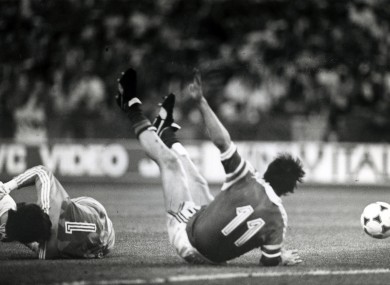
But in that group game, Ireland were far superior and Tony Galvin was our star. He tormented the Soviet defence, which included Khidiyatullin, Kuznetsov, and Demyanenko, protected by the likes of Aleinikov, Belanov and Vasyl Rats in midfield – a fairly solid bunch. Run after run down the Irish left led to chances for Aldridge and Stapleton. While Ronnie Whelan’s volley/shinned screamer is deservedly the most memorable moment of the game, giving Ireland the lead in the first half, it should not be forgotten that Galvin was completely upended in a one-on-one by Soviet keeper Rinat Dasayev in the second half, with the match still at 1-0. Had Galvin not been poleaxed, he most certainly would have finished it to make it 2. As it happened, the collision ended Dasayev’s participation eventually, after hobbling around for a few minutes as Ireland – with Galvin to the fore – kept up the bombardment.

While Galvin’s performance has gone down in history, let’s not forget that other Irish legend which was created that night. As a Charlton-esque hoof from the back landed at the feet of Oleg Protasov at the edge of the Irish box, the young George Hamilton let out that infamous cry of “danger here”. The ball went through Packie Bonner’s legs and the phrase has been a dreaded part of the Irish soccer commentary folklore ever since.

In 2012 the Irish Independent published “The Legends” magazine listing the top 50 Irish soccer players of all time. Galvin came in at 36 just behind Chris Morris and ahead of Tony Cascarino. And when you consider the exalted cult status of the latter, it jars slightly with the under-rated tag I give Galvin here. Perhaps, but Cascarino’s status has as much to do with his media appearances, eye-opening biography and his exuberant personality, than anything he did on the pitch.

Galvin’s club career is defined mainly by his years at Tottenham Hotspur. Signed by Keith Burkinshaw on the recommendation of Bill Nicholson in 1978 from non-league Goole Town, Galvin is still remembered fondly by Spurs fans as a major part of a very successful side which won 2 FA Cups back-to-back in 1981 and 82 and the UEFA Cup in 1984. En route to the latter, he scored 3 goals over 2 legs against Feyenoord in the second round. That Feyenoord team included Ruud Gullit and Johan Cruyff.

Galvin left White Hart Lane in 1987 to go to Sheffield Wednesday. Hit by injury there he went on to Swindon Town in 1989, and with former Spurs team mate Ossie Ardiles in charge he became assistant manager the following season. He followed Ardiles to Newcastle in the same role until the Argentinian was sacked in 1992.

As I mentioned earlier, Tony Galvin has a degree in Russian Studies and he also studied teaching at Trent Polytechnic. He now teaches at a London College.

It’s not usually fair to distill a great and hugely successful career down to one match, but sometimes a game just stands out and will stand out forever in the hearts and minds of those who saw it – Richard Dunne in Moscow for example – and when I think of Tony Galvin now, it’s the socks down around the ankles almost goading one of the world’s best defences into even attempting to dispossess him that I think of.

And to end, here he is in all his glory, having been absolutely creamed by Dasayev… It was all they could do to stop him that night…

tony-galvin-390x285