YoG No. 54 – Only 9 Goals to Show for Weekend as Pressure Tells on Leaders

This weekend, Liverpool and Man City continued to crack under pressure in this most intense title race of all time ever. The Reds stumbled to a routine 3-0 home victory over a an amateur Bournemouth side who’d never met each other before kick-off, in which 3 or 4 further excellent chances were pathetically and disgracefully squandered, while the Sky Blue City demolished London minnows Chelsea by a mere 6-0. Shambles. A decent side would’ve won by 8.

Liverpool were so awful, a shadow of the already useless team who have managed to be top of the league for 2 months despite playing terribly all season since day one (4-0 vs West Ham). They are still level with City with a game in hand even though they have been in crisis for the past month, since being battered 2-1 away to the “greatest team to have ever played in England”, a result determined by massive margins of millimetres and which in no way could have possibly turned out any different.

Since that day, City and their hilariously nicknamed Pep Fraudiola have also retaken top spot despite being exposed for the total charlatans that they are by the part-timers of Newcastle United (the 19th richest club on Earth) . This followed defeat by Leicester, who haven’t won a single trophy since the Premier League title in 2016, and Crystal Palace who never beat anyone decent ever, except every so often when they play them.

Liverpool boss Jurgen Flopp, again (high-larious), denies that by maintaining top spot alongside a team that garnered more than 100 points last season, while being on course for the clubs highest ever points total, they are in fact “bottling it”. Notwithstanding the fact that nobody seems to be capable of defining “bottling” or “it”, this term now seems to mean “not losing to anyone ever apart from the greatest team in history”, or “drawing 2 matches”. We’re not quite sure.

What we are sure of is that Man City have 11 games left to save their season while Liverpool have 12. We are also sure that whoever does not win the title this season should immediately undertake massive surgery on all of their footballing and non-footballing operations. The manager will need to be sacked. What is known as a “clear-out” of the oft-derided “dead wood” will be required. Some “period of transition” will ensue in which the culture of the club which includes the Academy system and their scouting department will be remodelled from scratch. Some may even go so far as to change their moisturising partner, so Adam Lallana will shit himself.

The only alternative to the above is to accept that football is a game played all year long around the world by millions of teams. Some teams win things. Others don’t. You have good days and you have bad days. If Liverpool win the league, it won’t be because Guardiola is useless. If City win it, it’s not because Klopp is naive. No one can “bottle it” against either of these teams, they can only simply lose the race. Chill out everyone. Relax, Calm down. It’s a title race being played out by 2 of the best sides we’ve seen in England for a while. The record points scorers against the Champions League finalists from last year. Enjoy it. I’m a Liverpool fan and the stress has been enormous over the last few weeks. But for almost 30 years, with a few exceptions, I’ve been desperate to feel that stress. So bring it on. It may be ages before it happens again. But please, not every kick of the ball is a turning point, or a crisis, or evidence of epic failure. Its just football as it always has been.

Oh and I suppose I should mention Spurs…

YoG No. 53 – Sunderland ‘Til I Die

This Netflix documentary is quite simply the best on-screen sports production I have ever seen. There have been countless great documentaries and series over many, many years and I’m absolutely sure I haven’t seen a good number of the best, but this one is far, far more than a football or sports documentary and this is why I rate it so highly. This is an exercise in social studies; urban psychology; personal exploration; the world of sports business; mental health; love; depression; hate and everything in between. It paints a rich and deeply textured intimate portrait of the city of Sunderland, its people and their club. Their club. An institution that channels the entire town; a beacon; the reason anyone beyond has even heard of the place and something to which every man, woman and child of the city is tethered for life. And it is these people that are the stars of this production.

Back in my youth, I toured the UK in a punk band many, many times. On one occasion we were in the north-east, possible playing Newcastle University and we stayed in a gaff in a place called Peterlee about a half-hour south, a new town built after the war. The part we were in was not the most beautiful place you could imagine. Inside this pre-fab terraced house, however, was a feast for the eyes. Every last fucking thing in the place was red and white. The entire home was decorated in Sunderland colours and I mean every last inch. So talk turned to football as you can imagine, at which point the gentleman host turned to me and pulled down his lower lip to reveal a tattoo which read “FTM” – which stood for ‘Fuck The Maggies’, Newcastle. A lot of this series reminded me of him – passion, obsession and a life lived not on the edge, but on the fringes.

Sunderland ‘Til I Die is all about the characters from these places, but a few of them really stand out – (Spoiler alert for those who’ve not seen it yet or have no idea how things go for them. Believe me, even full knowledge of every result won’t take away from the experience.)

Joyce Rome, the club chef, is just one of those people. You know the sort of mother figure you get in many workplaces whose face just lights up a room and drags you out of whatever mood you might be in. A true fan and a stalwart of the club, whose reading out of her text message from Chris Coleman after he’d been sacked is really all you need to know about the place of SAFC in the local community and the type of club it is. It also tells you a lot about Chris Coleman.

The local taxi driver fan who is the voice of reason throughout the team’s struggles. He seems like a truly nice man and again from a humble background. The scenes of him leaving his small terraced house among the rows and rows of houses to walk to the match, including on his own birthday, are great. Like the walk through Phibsborough, Inchicore, across the Square Car Park, or down Lansdowne Road, each step is marked in turn either by naive optimism or the dread that only experience can give you. Frank Styles’ mural of striker Raich Carter, captain of the league title winning team in 1936 and the FA Cup winners the following year, on the side of the Blue House pub loom large over his walk.

Raich Carter mural on the side of the Blue House pub, Hendon

Then there’s one of my highlights when a fan sits down to listen to an away game from Bristol on his radio at home. He agonises and rages as they go 3-0 down by half-time. He is philosophical as he makes a cup of tea during the break. There’s no way he’s turning it off. They may get beat by 5 or 6 but this is what he does. He sticks by through every minute and never misses a second. They claw back to 3-3 and that same naive optimism is writ large across his beaming face once again. Only football can really do something like that.

All over this series there are snippets of fans raging into cameras from the stands, grieving another defeat outside the ground. Singing; abusing; chanting; crying; laughing and just surviving. It is a gripping and beautiful paean to the passion of the football fan. It has a plenty of nasty parts as well – the sheer menace for the pre-season friendly with Celtic surprised me to be honest, as small skirmishes break out and bottles get thrown on the streets afterwards. At one point during a league match, the rage is taken out on the cameraman, while the confrontation between Chris Coleman and a fan after relegation is unsavoury at best. But it’s a warts ‘n’ all series and there is no merit in brushing the realities of the game under the carpet.

And Chris Coleman does come across as a genuinely decent bloke whose hands were tied by the lack of investment and the general mire that he walked into. The quite ludicrous take of Aiden McGeady on his management style – he doesn’t shout enough – tells you more about the player’s own indiscipline or lack of wit than it does about Coleman’s style. It’s some comedown from managing Wales to the semi-final of a major championships though. As for the manager at the start, Simon Grayson, he seemed fine but was never going to spark enough life into that team or that club.

I’ve read a few comments online about the Chief Executive Martin Bain, much of them I thought unfair. Yeh he’s a bit slick, but I found that in general he came across ok, with his hands tied over finance in the same way that the manager’s was. It was a good insight into the constraints that apply and the manner in which things are always that little bit more complicated than they might seem to the outside – the refusal of Jack Rodwell to leave, a refusal which he was completely entitled to give, being one example.

As for the players, Darron Gibson drunken antics, which bookend the series are the stand out incidents. At the beginning of the season he tells a bunch of fans that half the squad are not bothered what happens while at the end he is involved in a pretty serious drink-driving accident which cost him his job while writing off a few parked vehicles at the same time. It could have been much, much worse. He’s at Wigan now and I hope he’s over all of these issues.

Others like Jonny Williams show that no matter how secure a footballer might be financially and no matter how much of a dream it may seem to most of us, this is a difficult job, mentally as well as physically. The sheer enthusiasm of Academy graduate and local(ish) lad George Honeyman is a tonic to the general cynical view of footballers, and relegation leaves him almost speechless with genuine sadness.

Everything you need to know about Sunderland ‘Til I Die happens during the opening credits. Set to the song “Shipyards” by The Lake Poets, aka Sunderland native Martin Longstaff, they let you know very clearly that this is a series about a city. A once thriving industrial city that has struggled to find an identity in the malaise of post-industrial Britain. With nowhere to turn to, they seek identity in the club. They also seemed to have sought it by voting 61% in favour of leaving the EU. This is a place that feels left behind because it has been left behind, and when someone compromises the only thing they have left, there is despair, anger and rage.

As an Irishman, there’s been a strong link with Sunderland in recent decades through Niall Quinn, Roy Keane, Mick McCarthy and a raft of players. Seeing this will only strengthen that. For the first time in my life, I’ll be watching the League One results with interest every Saturday. Watch this series by whatever means necessary. It is a gem.


YoG No. 52 – 2018, A Year That Defined Modern Football

On the surface, 2018 was no different to any other football year, with very few surprises across the major leagues in Europe and at home. The big boys all won as expected and the gap between the haves and have-nots grew even more, prised open ever further by increased TV money leading to a raft of record transfers. But looking back now, a few significant things did indeed happen:

  • Video Assisted Refereeing was not only introduced but has become such a part of the game that it is now being cried out for across many competitions and at as many levels as is feasible. The technological revolution, for so long resisted by the traditionalists, has arrived in football, and it will only go in one direction. This will lead to a fairer game with less and less incorrect decisions due to human limitations.
  • Women in football began to be heard that little bit more. From an increasing TV presence, to the award of a Ballon D’Or for the first time, let’s hope that the role of women in soccer can be elevated to the level of coverage it has enjoyed historically in the likes of Athletics, Tennis and latterly Gaelic Games. Who would have thought that women’s hockey would provide one of Ireland’s great sporting highlights this year but it did, and I for one long for the day that the Irish Women’s National Team do something of that scale. That will require our support with more of us willing to attend the games and more journalists willing to give it column inches and bandwidth.
  • Probably not unconnected to this, the macho bullshit so beloved of Proper Football Men is now on its last legs and this above anything else may mark out 2018 as the year football culture grew up. The boorish garbage spouted by Roy Keane all year long finally caught up with him, but not to the extent that he felt unable to go on one last dreadful rant against United’s players after Jose’s pox of a reign came to an end. The relatively young – by managerial standards – alpha male Mourinho now finds himself with nowhere left to go in the club game after a 6-month strop. Pulis, Allardyce, Pardew, Hughes et al look increasingly anachronistic. All while characters like Klopp – an on-pitch hug for every player and an arm around the shoulder when needed – go from strength to strength. The truly tragic side to the old ways continues to emerge with Gareth Farrelly the most recent one to speak up at the horrors inflicted on young men and boys by the toxic masculine culture that defined our game for so many years. The likes of Keane may blindly and ignorantly deride the modern player for being “very weak human beings” as he did about United’s players this week, but they’re not hiding their misery behind a rake of pints every afternoon Roy. They may not be your sort of man but they are still men.

These were my big all encompassing trends from 2018 in terms of the culture of the game itself, but now we can have a look back at the biggest on-pitch events of the year, starting right here at home where the domestic game harried and bullied its way into the mainstream of Irish soccer, as the quality and the brand of football could no longer be ignored by the general public or the powers that be.

Dundalk

Brilliant. Just brilliant. Again and again and again. When I saw the Lilywhites play Legia Warsaw in August 2016 in Lansdowne, it was the best game of football I had seen at the new stadium, and probably still is. Their entire Champions League and Europa League experience that season was a clarion call to the Irish soccer community, announcing at long last what we were capable of doing. With the right approach, the right attitude and the right coaching, Irish footballers can exceed expectations, and exceed them to a huge degree. Where Shamrock Rovers went in 2011, Dundalk went further in 2016, and they have maintained that approach up to today. Their second double in 4 seasons, playing a magnificent brand of football, this Dundalk team will be spoken about for many years to come. Patrick McEleney was their standout player this year and despite losing players across the water, they have maintained a core throughout this period with the likes of Seán Gannon, John Mountney, Robbie Benson and Gary Rogers.

But perhaps the most important mainstay throughout this period has been Stephen Kenny. From setting up Tallaght Town in his 20’s with the aspiration of bringing League of Ireland football to this massive suburb, to his eventual appointment to the Irish national team manager’s job in 2020, Stephen Kenny has immersed himself in Irish football, often taking on massive challenges. As a Rovers fan, I regret the lack of patience shown towards him by the fans and by extension, the club itself during his brief spell there. A success everywhere he’s been, with the exception of Dunfermline where he was relegated albeit in a season where they only lost the Scottish Cup Final 1-0 to Celtic, he never got the chance to impose himself on the Tallaght club, desperate to maintain the standards set by Michael O’Neill in previous years. His ascension to the Irish job is the recognition, long since warranted, that a small football country need not have a small football mindset. I know he will make the most of the 2 years in charge of the U-21’s and in his overseeing role for the entire underage set-up. My only fear is that the national team’s gain is the League’s loss. It’d be nice to end Dundalk’s general dominance, (admittedly Cork have been right up there) but not at the expense of the league overall.

Ireland’s Annus Horribilis

What a waste of a year for the Boys in Green. What a toxic, useless and depressing 12 months of dire underperformance, immature and reckless management and delusion of a scale unseen in this arena previously. Graham Burke’s goal against the USA was the only smidgeon of joy to be garnered from the entire year. He became the first League of Ireland player to score for us in 40 years, since Ray Treacy scored against Turkey. It should have been a celebrated milestone, but it was clouded over by the general apathy around the national team’s lack of direction.

I wrote about Roy Keane enough already. It’s a shame his glorious playing career has given way to managerial and punditry careers which reflect only the darker side of his on-pitch presence. Great clickbait all the same!

As for O’Neill, his reliance on the wisdom of a football genius from the 1970’s and 80’s for inspiration was baffling; the lack of coaching irresponsible; the lack of preparation unprofessional; the attitude to the media unnecessarily immature and poisonous; and overall, as evidenced by Stephen Ward’s WhatsApp voice message, the atmosphere around the squad seems to have grown toxic. The one thing we always relied on was the bursting desire to pull on that jersey and it seemed lost. It cannot be a coincidence that Declan Rice seems willing now to declare for Ireland since the toxic twins have departed.

Having dragged Ireland back to where we felt we belonged in 2016, 2017 was a shitshow, and 2018 the final nail in the coffin. It’s hard to imagine from our position, but right throughout the hierarchy, from the European aristocrats down to the most remote footballing outposts of the continent, the Nations League was embraced and, in many cases absolutely loved. But in Ireland, it was almost disregarded as some mickey-mouse tournament unworthy of attention. It was a shameful experience all round, it’s only function to expedite the curtain’s fall  on the MonKeano pantomime.

There were only 2 men I wanted to take over this job, so imagine my surprise when they both got it! I’ve written enough about Stephen Kenny above, and I had started an article on Mick McCarthy before he got the job, which I never got round to completing. Suffice to say, that I think he has it all – the personality; the humour; the team ethic; the footballing style; and the one thing that we want above all else – the ability to get players to play out of their skins. He led us through a group of death to the 2002 tournament, got us out of the group despite the turmoil, but lost that battle in the end. In a funny way, had Saipan not happened, you could imagine that he could still be manager today rather than coming in for a second stint!

Will we qualify? We’ve every chance, as I argued here. Mick will get a lot more out of this group, and I think we will enjoy it. For the first time since 2016, I’m looking forward to a campaign.

Liverpool

I’m a Liverpool fan. 2018 has been unreal. From the relentless assault on Europe, ending in calamity, but only at the final hurdle, to the relentless solidity on display in the league campaign so far this season. There is no one wearing a red shirt this season that I do not trust or do not love. Even Lovren and Matip have been ok when called for. The first 11 or 14 have been immense. Van Dijk makes me feel inadequate as a man – so cool, never bothered by anything. Shaqiri brings me to my feet so often with his effortless command of the football and his goals. Salah is still the King; Mané and Firmino have not set the place alight but have managed to knock in a few in any case. Allison looks a bargain; Keita and Fabinho have yet to be unleashed. Milner has maintained his incredible form and – I use the word again – relentless positivity and collective ethic. And before you say anything, Robertson gets his own section below.

I can’t say they are favourites with City still holding that particular status, even with a gap of 4 points, but this is the best Liverpool team in 30 years. That alone is worth enjoying while it lasts. A trophy would be nice. A league title would bring me to my knees in praise of God, Allah, Kenny, Bill and Bob, and require a week off work to watch every second of the season again. Here’s hoping. (and no apologies for my partisanship)

Man City

I wish they’d just piss off, but they are incredible. Despite succumbing to Liverpool’s shock and awe in the Champions League, they were head and shoulders above the lot in the league and are there again. Definite favourites – the pressure is all theirs, but could Pep and Jurgen not have gentlemen’s agreement that City can have Europe and the Reds get the title? No? Yeh Unai and the Mauric(z)ios may have something to say on that even with the gap to the top. One other thing is also certain. This has been the best Premier League in a long time, and that’s with the biggest giant of all curled up in his cave asleep.

Sergio Ramos

The most successful shit of all succeeded again. A nasty bastard; a sly and entitled Real Madrid prick who denied Europe what was shaping up to be a truly great final by taking both Salah and the useless-enough-already Karius out of the game. Listen he didn’t score an overhead kick like Bale did, or do anything much to win it, but we all know now how he affected the game. Karius is not a good keeper but even he isn’t as bad as the 2 goals he threw away. He was taken out by that elbow meaning his usual 5/10 standard dropped to 2/10. And that, along with Salah’s injury, was the difference on the night. I’d hoped Liverpool would draw Real in the last 16. And done them.

Man United and Jose Mourinho

No empire lasts forever. Liverpool, the last great English football superpower, have spent the guts of 3 decades rebuilding with fleeting successes serving only to highlight how far off the pace they really were. United’s fall is similar in many ways – a succession of managers that didn’t work out; media becoming dominated by former players weighed down by medals; dissatisfaction with the owners and the structure; and a feeling that football itself has left you behind. But on the pitch and in the dug-out, Liverpool never imploded in the way United have this season. And the critical factor in that contrast is Jose Mourinho. A poisonous presence in the game and in that great club, his descent justifying their decision not to appoint him in 2013. No one will write as well as Ken Early on this, but it is clear to all that the man is suffering some sort of professional breakdown and will need time out if he is to regain any status in the European game.

United, on the other hand, have so much on which to rebuild that it won’t be long before they put this dreadful period behind them and start playing the United way and with some success. The immediacy of the new manager bounce evident in Cardiff should not be taken with a great degree of caution. The leash was off and everyone seemed happy but greater challenges await. The current squad is probably good enough for the Top 4, a few additions and a manager (maybe Solskjaer) would definitely have them challenging for the title, but remember Liverpool challenged under Evans, came runner-up under Houllier and Benitez, should have won it under Rodgers and now sit first again under Klopp. Decades pass in the blink of an eye and the football world moves on.

Best Book – “State of Play – Under the Skin of the Modern Game” by Michael Calvin 

Following on from the phenomenal  “No Hunger in Paradise” Michael Calvin trawls through every aspect of modern football in another grand exposé of the game’s underbelly. The heartbreaking analysis of the impact of concussion and dementia is one of the early highlights of this work. But he goes into areas of increasing corporatism; women in football; the rage unleashed by Fan TV outlets; the rage of modern football in general; referees; racism; and the central role of the sport in countless communities. Only by writing this piece have I realised that I need to read this again. This is an epic tome, not in its length, but in the weight and substance of its content.

Best TV

I’ve only watched 2 episodes of “Sunderland ’til I Die” and within 30 seconds of it starting, it was obvious that something very special was to follow. As a Dubliner, it’s impossible to really understand how one institution can so fully represent a city and its people in the way football clubs often do in one-club cities. This is a sporting documentary but also a social study of how a town ravaged by under-investment and reeling from the collapse of its old industries and ways of life without replacement seeks answers in a club that they love and loathe in equal measures. I look forward to watching the rest of it.

England v2.018

When we all laughed at England in 2016  we could never have envisaged how the entire culture around their national team could be turned on its head so quickly. Back then, having limped home from France after defeat to Iceland, it all looked so desperate, but in the space of one summer month, England fell back in love with the three lions. Gareth Southgate took on the burden of the poisoned chalice and, notwithstanding the ease of their passage, went where only 2 men had gone before. Only Bobby Robson and Alf Ramsey had led England out at a World Cup Semi Final. Both are revered knights of the realm; both are spoken of with awe and held in the highest esteem possible. Southgate’s England are less easy to despise than all previous incarnations. He seems like a very decent, thoughtful and intelligent man. The players, when in this group, come across as dedicated, professional and immune to the myriad distractions that have plagued previous squads. This may truly be their golden generation and I would not bet against a trophy being added to the Jules Rimet at Wembley in 18 months time.

The 2018 World Cup

Which brings us onto the World Cup. A full YoG was done here and looking back now, it never failed to provide the entertainment, the intrigue and the epic sporting stories that we all crave every 4 years. Every day provided a new talking point. While only France vs Argentina and Spain vs Portugal can be recalled as truly great games, there was more than enough to warrant this tournament’s place as one of the better iterations. The early shambolic exits of Spain and Germany and the Italian and Dutch no-shows did take a little bit from the tournament and will have the English, Belgians and Croats really kicking themselves that they didn’t win it, but my highlight was undoubtedly South Korea doing the Germans in injury time. That was a remarkable event in every manner.Watching Luka Modric play every few days for a month was also an honour. The last summer tournament for another 8 years though, which is a massive shame and a disgrace, but we’ll have to live with it. It’s impossible to feel anything other than slightly sick when thinking about Qatar, so we won’t for now.

My Favourite Player of 2018 – Andy Robertson

I was a left-back in my playing days. I still am. You never stop being a left-back. Which is why I wrote YoG No. 33 – The Left Back . It’s a very specialised position that only other left-backs understand. But surely right-backs do too, I hear you cry. No. They don’t. They are completely different. Honestly they are. I’m not gonna explain myself, but let’s just say that when I see a great left-back in action, my heart sings and I’m brought straight back in my mind to a freezing field somewhere on the edge of Dublin in the early 90’s, overlapping at full-pelt down the wing, running onto the pass, beating the right-full and whipping in cross for the striker to slot in (I’m sure I managed that once or twice). Or beating a marauding winger to the ball and taking him with it. Lovely stuff

This is why I love watching Andy Robertson. He does everything required of a left-back and he does it to perfection. I also love him because he has transformed from a journeyman Scot at Hull into the love-child of Paolo Maldini and Roberto Carlos. He just never stops. He never stops running; harrying; tackling; passing; sprinting; crossing; dribbling; turning; talking; instructing; leading; inspiring. He has been the undoubted highlight of a year of highlights for Liverpool. The sort of player you’d want your kids to be like. World-class and not a hint of an ego to be seen. I hope he plays for Liverpool for the rest of his life and that Scotland make it to a World Cup so the rest of the international left-backs union can watch in awe and admiration.

Second Captains

The lads on the Second Captains podcast just keep getting better. Their output in 2018 was truly outstanding. The highlights for me this year was missing actual football during the World Cup (maybe the first half-hour of a match or two) because I wanted to finish listening that day’s podcast. Ken Early’s travelogues are the best sports broadcasting has to offer. His tiff with Eamon Dunphy was priceless and the player’s chairs delivered truly brilliant insights, in particular the Paul Kimmage and Liam George ones. My head towards the end of the year couldn’t handle the extremely well-received and extremely important Brian Lenihan episode, but I will get around to it.

The lads are just getting better and better. Richie Sadlier is becoming a very strong force for good in Irish media. His analysis around the Belfast rape trial and the culture around being a teenage boy in today’s world belongs as much to current affairs as sport. It was powerful vital stuff. As I alluded to, the end of the year wasn’t great personally, but through a lot of driving back and forth to Vincent’s Hospital, I took great comfort and escaped from it all listening to Second Captains. If any of you are reading this, thank you for doing that little bit to help bring a smile back to my face on those difficult evenings. It was badly needed.

My Dad

My father died in October after a long battle with cancer. There is just no way to do justice on here to how much he influenced every single aspect of my life, my career and what type of Dad I have been myself. But as with so many fathers and sons, and increasingly mothers and daughters, football was the unbreakable bond that was stitched into every fabric of our relationship from the day I was born to the last days we shared.

Born in 1947 in the inner city, his family moved to Artane when he was 4. He went to O’Connell’s School in town. His was the generation of the ban, and he was suspended after a Christian Brother caught him playing the garrison game on a Saturday morning in Fairview Park instead of attending a school Gaelic football match. Such compulsion had the opposite effect and there was no doubt that soccer was his game.

The Busby Babes were his first love and he always remembered the moment he heard about the Munich tragedy. But it was during his teenage years when the Holy Trinity of Best, Law and Charlton came of age that Manchester United became embedded within him and he got to see them in the flesh when they played Waterford in Lansdowne in 1968. Memories of him screaming at the radio when they won the league in 1993 “I’ve been waiting 26 years for this!!!”, or roaring the house and neighbourhood down when Solksjaer scored that goal in the Nou Camp in ’99 when only a phone call from my (also United supporting) sister at full-time allowed him catch his breath, will always stay with me, in particular because as a Liverpool fan, I was grudgingly sitting arms folded tut-tutting at how bloody jammy they had been on every occasion!. I also have a memory of one of the many Liverpool vs. United matches we watched together when I punched a lampshade in relief when Liverpool equalised. The lampshade didn’t matter to him, but the scoreline did. And of him telling my brother Karl (also a United fan) on the phone the day after Istanbul that “yeh he’d had a few last night”. They were still up when I got home!!!

As a kid, he took me to Dalymount and Tolka a load of times when we lived in Portmarnock. He was never a fan of any domestic club growing up – he used to just support whoever his uncle – the goalkeeper Mick Smyth – was playing for, in particular during his early years with Drumcondra, so whoever was playing a decent game at home we’d pop along. When we moved to the Southside, we went to the RDS quite a lot to see the Rovers of Vinny Arkins, Derek Tracey and Gino Brazil. These games stayed with me and despite not attending domestic league matches for many years, I always followed Rovers, and renewed that interest about 10 years ago and started going to Tallaght more regularly.

But if there was one football moment or one experience with my Dad that I will always cherish and one I think of at least once every day if not every hour, it was Ireland at Italia 90 . He brought the whole family over to Malta for a week and we went via catamaran to the games against Egypt and Holland. We were there behind the goal in Palermo when Niall Quinn scrambled the ball into the net and the entire nation went into meltdown. As a 12-year old football obsessive, this was the greatest experience I could ever have. As a 40-year old, it still hasn’t been beaten. We were there. The seeds has been sown and life would never be the same again. The obsession is now evident from my season ticket for Lansdowne; trips to Poland in 2012 (I rang him after every match for an “explanation” of what I had just witnessed) and France in 2016; in a grandson whose first word was “ball”; and this blog. I have my Dad to thank (or blame!) for all of that.

Weekends were all about the game when we were young. I remember most clearly the times around the age of 13 to 16 that I’d go training with Granada FC on a Saturday morning. My brother might have had a Leinster Senior League match for St. Joseph’s that afternoon that we’d go to in Tivoli Terrace in Dún Laoghaire. We’d drive around Dún Laoghaire and Blackrock doing a few bits and pieces as BBC Radio 5 Live flitted in and out of audibility on the Medium Wave 606. Then on Sunday morning usually, I’d have had a match. He was at nearly every game we both played at home at least, and for me a lot of the schoolboy away matches as well, bringing a clatter of my teammates in the car with us. We’d usually be well home in time to watch whatever match was on the telly that afternoon. And the lampshades were put away.

He’s there still every Saturday afternoon as I listen to the games on the radio at home or driving around the place with the kids, and I hear his reaction to every incident and his wisdom in or around 4:45 each week as the results come through. I remember him saying to me about Liverpool exactly what I said above about United. After they ended their 26-year wait, I said Liverpool would never go that long without winning the title. His response, borne from bitter experience, was that you never know. I do now.

There are countless other memories throughout my life, my family’s life, including the grandchildren, of my Dad as a football man and all I can hope to do is pass his love of the game onto my kids, as well as everything else. It won’t be an easy Christmas this year but life does go on. There’ll be many more 4:45s on Saturday afternoons and many more nights in Lansdowne and I’ll be thinking of him at every kick of the ball.

Thanks for reading.

Dad Italia 90

Half-time against Egypt in Palermo


YoG No. 51 – Proving that Ireland Have the Players

Introduction

This piece demonstrates clearly that Ireland has the players required to qualify for major tournaments. Using the value of certain categories or levels of football as a proxy for quality, it can be seen that Ireland, contrary to the lazy consensus, is still exactly where it always has been in the European international football hierarchy, save for one  anomalous glorious campaign over 30 years ago – in or around the runners-up spot or the play-offs. The aim of this task was to do the following:

  1. Compare the current Irish squad to the European Squads that played in the 2018 World Cup; and
  2. Compare the current Irish squad to those making up Pot 2 of the Euro 2020 Qualifiers – i.e., our rivals in qualification.

To do this, I wanted to demonstrate the futility of the argument which states that because we have no-one in the Top 4 of the Premier League, or that no Irish players get within an asses roar of a league title or a European Cup like they may have done in the past, that we are in fact a significantly worse team now than back then; that we are a significantly worse team than our rivals for qualification; and that any achievement, even mere qualification, should be greeted with surprise and relentless gratitude to the manager who miraculously dragged this supposed shower of journeymen to the promised land. We have good players. We do not have the best in the Premier League anymore, but we should still always expect to push close for qualification. That was my hypothesis at the outset, and the methodology can be summed up as follows:

Methodology

Step 1: After initial research on transfer markt relating to the value of club squads and leagues overall across Europe, the football world was divided into 13 categories in descending order of value as follows:

  • European Elite – any club that has played in a Champions League final in any of the last 5 seasons (average value of these squads was given as €748m)
  • Premiership Top 4 – any club that finished last season in the top 4 of the EPL, apart from those in the European Elite – this left Spurs and Man Utd (average value of these squads was given as €752m)
  • Other Top League Top 4 – any club that finished in the top 4 of La Liga, the Bundesliga or Serie A, apart from those in the European Elite (€372m)
  • Premier League Top 10 – any club in the top 10 of 2017/18 not already accounted for (€306m)
  • Champions League Group Stage – any club that qualified automatically for the Champions League via their 2017/18 league finish not already accounted for (€204m)
  • Premier League Bottom 10 – self-explanatory (€180m)
  • Other Top League – any other clubs in La Liga, the Bundesliga or Serie A outside the European Elite or Champions League Group Stage (€135m)
  • Ligue Un – any team in the top French division outside the European Elite or Champions League Group Stage (€84m)
  • Championship – any club in the English Championship (€45m)
  • 2nd Tier European League – any club in the Top Division in Russia, Portugal, Belgium, Ukraine, Turkey, Austria, Netherlands, Denmark, Greece and Switzerland (up to place 15 on the UEFA League Coefficient ranking) (€28m)
  • 3rd Tier European League any club in the Top Division in Croatia, Czech, Cyprus, Serbia, Scotland, Belarus, Sweden, Norway, Kazakhstan, Poland, Azerbaijan, Israel, Bulgaria, Romania, and Slovenia (up to place 30) (€9m)
  • Other European League (assumed €5m)
  • Other (assumed €5m)

Step 2: The squads of each European nation who qualified for WC 2018 were analysed and each player placed in each relevant category, based on the club they were playing for when they went to Russia. In the case of the European Elite, this does mean that a player playing for Chelsea in 2018 was categorised as European Elite even though Chelsea last appeared at this stage in 2014. It’s a method, it can be argued over, but there has to be some leeway given on these matters and assumptions made.

Step 3: The Ireland squad from November 2018 was analysed in the same manner based on each player’s current club. The squad selected took account of those missing through injuries.

Step 4: The squads from all countries in Pot 2 of the Euro 2020 qualifiers were analysed in the same manner as Ireland with account taken of injuries and withdrawals etc. Neither Step 3 nor Step 4 can be 100% accurate and of course different squads could have been chosen, but a genuine attempt has been made to be as reasonable as possible and to pick the highest value players. Northern Ireland were added for the craic, just to show the difference on paper relative to the difference on grass in the Aviva the other week.

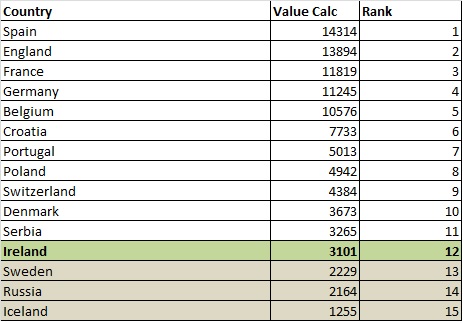
Step 5: Multiply the number of players from each squad in each category by the value of that category. This value was calculated using transfer markt. This gave each national squad a total notional value, and the results are set out below:

RESULTS

Ireland vs. The European Qualifiers for the 2018 World Cup

The Players WC Ranking

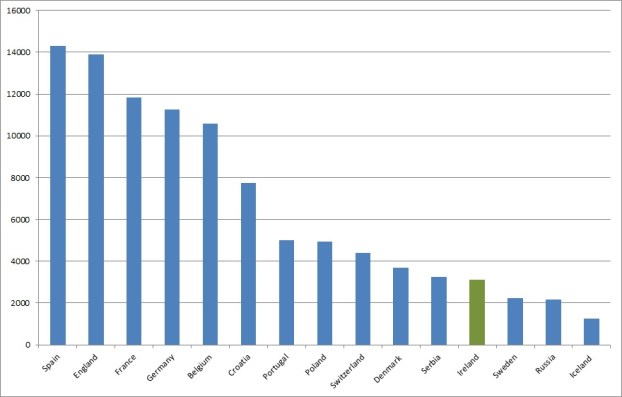
In graphical format, the spread is clearer:

The Players WC Ranking Graph

What this shows is that Ireland’s squad belongs at or close enough to the top table. Ahead of 3 nations that qualified for the World Cup from Europe and 12th overall in this grouping. There are some caveats here – Italy and Holland on any other day would more than likely push us down to 14. France caused a problem because their league is not quite elite – despite PSG – nor is it quite 2nd tier – because of PSG (and 1 or 2 others). As such, Ligue Un was dealt with completely separately. Russia seemed an anomaly, then you look at their squad and remember that a calamity was indeed forecast before the World Cup and their run to the Quarter Finals was quite a surprise.

Of interest is also the distribution of the players from each squad. The graphs below show a select few. The more you see on the left of the graph the better the squad:

SpainSpain truly are the European Elite. A disaster at the World Cup for obvious reasons but you can really see how the last decade of unprecedented International and Continental Club success has panned out and how intrinsically linked their club fortunes and national team fortunes are.

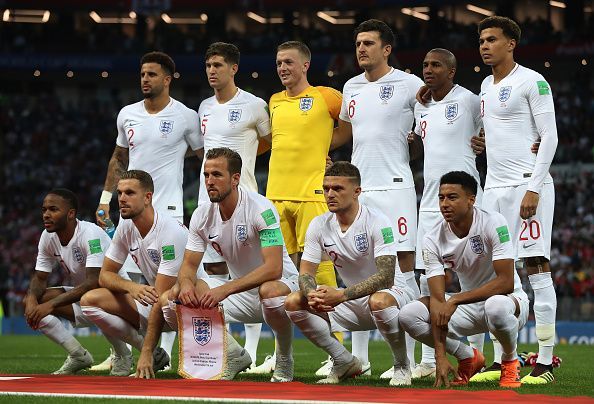
England

Similarly, the semi-final place England achieved should not have been that surprising. Their players are the 2nd most highly-valued in this methodology, and while the old argument that English players are over-priced certainly does ring true, this analysis is based on ALL players in the Premier League regardless of nationality. Their 7 Elite players do include Jordan Henderson and Gary Cahill, but the former did play in the last European Cup Final and the latter has won one European Cup and two league titles.

As for ourselves:

Ireland

Ireland’s graph is skewed somewhat more to the right you might say. 13 Championship players, 9 Premier and one based in Scotland – Goalkeeper Colin Doyle. The fact that if I had chosen Caoimhín Kelleher of Liverpool instead would have taken Ireland into 10th place ahead of Denmark and Serbia demonstrates just how close this ranking is and how arbitrary decisions can change things significantly. Fine margins and all that! And of course this is the case on the pitch as well. 0-0 away to Denmark, followed by a complete demolition in the home leg caused in part by an arbitrary managerial decision at half-time. And with Serbia, there was little between us as well over those two games. On the scoreboards at least.

Speaking of Danes:

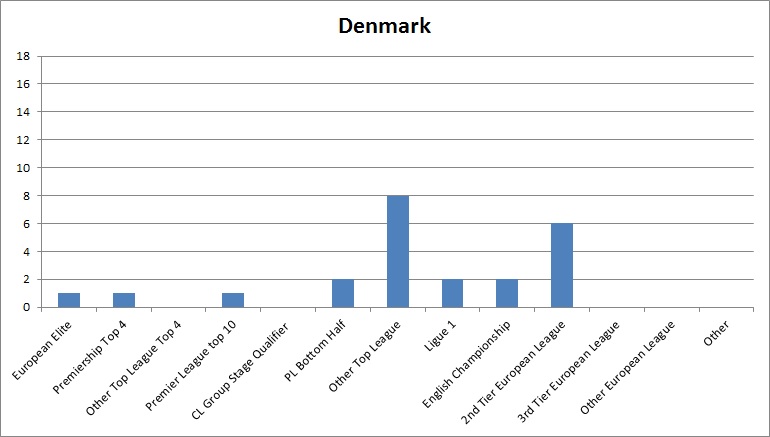
Denmakr

Much more to the left than Ireland, but a lot more in the 2nd tier leagues, which are less valued than the English Championship. Age Hareide may have had a point, but again the gap is not huge.

Ireland Versus Pot 2 – Euro 2020

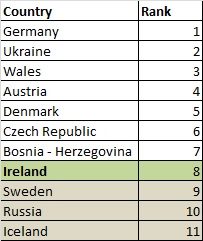
Can we qualify automatically for Euro 2020? Of course we can. Is it likely? Should we qualify? On paper, we do in fact have a good chance. The table for this comparison reads as follows:

The Players Pot 2 Ranking

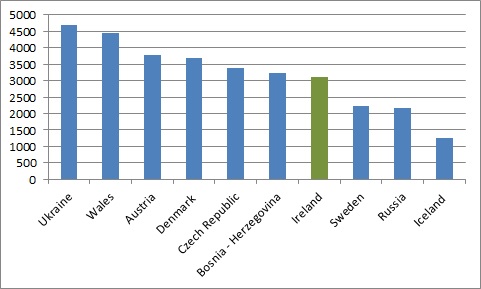
Germany are way ahead obviously, but in there among the other 9 second seeds, Ireland come out higher than 3 of them. And as the graph below shows (Germany left out for visual reasons), we’re not that far behind Bosnia-Herzegovina (who we beat to get to Euro 2016 obviously) and the Czechs. In other words, we have nothing to really fear from Pot 2 apart from the Germans.

The Players Pot 2 Ranking Graph

Ireland vs Northern Ireland

Ireland

Northern Ireland

Stats and facts don’t lie. Maybe we imagined that match in Lansdowne. Clearly, Ireland have better players than Northern Ireland. 9 Premier League players versus 4 and a far greater reliance for Northern Ireland on the Championship and Scotland. Yet they outplayed us. In Dublin. Michael O’Neill got them to the Euros and out of their group, beating Ukraine along the way, all the while playing attractive football that gets the fans out of their seats. The gap isn’t huge but good management can close that gap. We need good management now to do exactly that so we can overcome those countries in Pot 2 to qualify automatically for Euro 2020. If only someone like Michael O’Neill who cut his managerial teeth in the League of Ireland, won a few titles and brought an Irish club into the Europa League group stages was available! At the time of publishing it looks like we’ll have to settle for the man who captained us to the Quarter Finals of one World Cup and captained us to the last 16 of another. Fair enough I suppose…

To conclude, the Irish squad of 2018 can hold its own against those it needs to hold its own against – those on the cusp of qualification. With the exception of Euro 88, we have never won a qualifying group. As such, being in or around 2nd place is how it has always been. Nostalgia for the medalled players of old, who may not get anywhere near today’s top 4 or European elite is misguided and ignorant. What we lack more than anything else, and have done since 2005, is a manager capable of galvanising the best elements of the Irish squad and getting the best out of their abilities. What is Robbie Brady capable of? Coleman? Hourihane? O’Dowda? And Jeff bloody Hendrick? With the organisation and the belief of a proper modern manager, what could they actually achieve? It may be scraping 2nd place again. Or falling to 3rd place again, just like O’Neill’s campaigns, but at least we’ll know they played to their potential and showed it. Or they may surprise us all, play above themselves like previous Irish squads did and beat the second seeds comfortably into the runners-up spot. We’ll find out in March. Thanks for reading. Please share on Twitter and Facebook.

Caveats

  • Fundamentally this method assumes that financial value equals quality
  • It assumes that every player in each category is equal
  • There is a time lag in how I defined European Elite and the current or WC national squads
  • PSG are defined as “Champions League Group Stage” qualifiers whereas their squad of individuals may be regarded as “European Elite”, certainly they cost elite money. This reflects the team’s poor record over the last 5 years
  • Russia came out quite low scoring. They didn’t exactly tear up the Nations League but it’s hard to envisage Ireland being any better than them on a one-to-one basis. It remains to be seen


YoG No. 50 – McClean, Poppies, Nationalism and Brexit

Image result for james mcclean wales

There’s a fine line between Nationalism, pride in your country, and the extremism, xenophobia and outright racism that has crept into mainstream, political discourse in the UK, parts of Europe, all over the US, and which threatened to drown a recent meaningless race for a symbolic office here in Ireland. James McClean is no shrinking violet. He is a decent footballer by any measure and one who may love his country just that little bit too much, but he remains a lightning rod for cavemen English nationalists every poxy November.

He has his faults and he overdoes things on an off the field for some people’s liking, including mine at times, but at this time of the year, his noble stance against the forced recognition of the poppy is admirable and is perhaps silently supported by many of his fellow professionals.

Nemanja Matic has certainly aligned himself to McClean’s stance in a non-silent manner. He removed the poppy from his jersey at the weekend because as a child he witnessed Her Majesty’s finest do their work as part of a NATO bombing campaign in former Yugoslavia. He said today:

“… for me it is only a reminder of an attack that I felt personally as a young, frightened 12-year-old boy living in Vrelo, as my country was devastated by the bombing of Serbia in 1999… Whilst I have done so previously, on reflection I now don’t feel it is right for me to wear the poppy on my shirt”.

On mature reflection, perhaps inspired in part by the Derryman.

Argentinians and those from some African and Middle Eastern nations must also have some reservations when donning something representing an historical and current foreign agitator. Surely Aguero and his fellow countrymen must have thought about the Falklands and the Belgrano at some point, or had it pointed out to them by someone, as they donned the symbol of the Army which carried out that action; one which many right-minded Brits regard as a somewhat controversial act of war. Maybe not. Maybe Geography; maybe the more recent stains on the Union Jack caused in Ireland and Serbia have not been expunged in the manner that historical colonialism, slavery and the Falklands have? And in the case of the Middle East, things are perhaps even more complex.

But one thing is for sure, there are an awful lot of footballers, pundits and media people across the board who don the poppy thoughtlessly or simply do not want to be seen to cause offence. They are unaware that the fields of Flanders from where the symbol came, and the many battlefields of World War I were not theatres for some noble fight against tyranny, as Europe was from 1939-45; they were theatres for colonial and imperial competition; and they were scenes of absolute and total butchery – the slaves and servants of the kings and emperors sent to their brutal deaths. Brave? Noble? It was an industrial slaughterhouse. Now let’s stand for a minute’s fucking silence 100 years on to remember them, surrounded by ads for gambling leeches in a stadium named after whatever foreign global corporation bid the highest for the rights.

But the Brits and the hyper-English are entitled to their myths and their symbolism. We have plenty of them ourselves. Ireland’s 20th Century is not without its shame; Irish Nationalism not without its butchers, from Ballyseedy to Omagh. Irish culture is not without its extremists, from the GAA bans to the dictators who ran the Catholic Church and via McQuaid and De Valera, the State, for so long. But in 2018, what are we forcing on anyone? We are emerging from a period of monoculture, and while you may hear the term “true Gael” every couple of summer Sundays, the oppressive old definition of Irishness is well and truly dead. The nation can unite and be brought to its feet by Protestant Hockey players in the same summer that it turned its back on the Pope. Elsewhere they are moving towards monoculture and what it means to be English, British, American etc etc. It’s deeply tragic in nations which have always, always, been the most diverse and multi-cultural.

And poppy fascism is the latest cri de couer for the true Anglo. The great irony is that those people should really be wearing swastikas to match their attitudes. The even greater irony is that some of them do.

In the current climate of English politics, it cannot be a coincidence that every November, this gets worse. As the UK further degenerates over the coming years into a certain type of England in London; a different one elsewhere; an irrelevant Wales; a restless, possibly independent Scotland; and christ knows what in Northern Ireland; this fractious kingdom will be defined more and more by this Faragian, Rees-Moggian approach to discourse. And people like McClean and Matic will be further and further denigrated. God help the working class blacks, Asians and other “foreigners” in those forgotten cities and towns, as a multi-cultural nation turns inwards into a septic isle; a poorer isle, looking for minorities to blame.

Where does it go from here? McClean has been warned by the FA over his use of the c-word and will face no further action. I have to commend the FA for this, as I had expected more (or less) from them. Stoke have yet to come back on the latest statements, but I presume they won’t go any further than the FA. As for Nemanja Matic, things could get interesting for him too. Will Poppygate finally be exposed as mere good old-fashioned anti-Irish xenophobia. Banter. A bit of crack (sic). Or will fans start to taunt Matic as well? What should McClean do now? He has been at his most vocal this week since this all started back in 2011. Gone are the days of hoping it will all go away with a brilliantly worded open letter like the one he wrote to Dave Whelan at Wigan. Nah, in post-Brexit Britain, logic, compassion, understanding and empathy have no place.

I still think they have a place in Ireland, despite the vile shart that was Peter Casey’s presidential campaign and post-election deluded, ignorant and egotistical witterings. McClean divides opinion on both sides of the Irish Sea. I don’t subscribe to the genre of Irishness that glorifies violence, or any narrow definitions of what one should believe about the Rising, the Civil War, the Troubles or anything else. No conflict on this island has been black and white; and in Irish football things have been multiple shades grey since day one – McClean’s former club being one of the great symbols of that greyness. It’s up to James what he does next. I like him. I hope he is ok. If he feels he has the inner strength to put up with the cavemen year in year out, I wish him the best. He is under no obligation to leave his job, or his adopted home. But when he does, he has an entire city in the north-west of Ireland which will welcome him back with open arms, and a majority on the island that fully respect his overall stance on the substantive issue under debate here.


YoG No. 49 – “Keano is a Pox”

RK

Regardless of the outcome of Tuesday’s meaningless game against Poland, there is only one question to be answered. Should Martin O’Neill fire Roy Keane or should John Delaney sack them both? A change is now needed, and given the tendency for the FAI to only wake up several months after each regime has become untenable, we’re guaranteed scenario 2 will not happen.

Which brings us to Roy Keane. I think after all that has emerged in recent weeks, that it is time for his affair with Ireland to finally end. It’s been wonderful at times, tortuous to the verge of tragic at others, but Roy, for the good of Irish football, I think it is time to finally end this relationship. Go back to your click-bait love/hate-ins with Ian Wright on ITV and leave us the hell alone… and thanks for the memories (most of them anyway).

I had high hopes for this management team, I really did. I may have been naive and I may have been desperate after the calamitous collapse of the Trappatoni regime in 2012, but aren’t we all filled with idealistic notions at the start of any relationship. We must also be reasonable in that they did deliver for some time. From 2015 to the end of 2016, this was working. Some special nights and a hint of progress was seen. This must be viewed, however, in the very cold light of day. We got out of a qualifying group in 3rd place – a route unavailable previously – and then got out of the Euros group also in 3rd place. We also seem to have, as a nation, removed the Belgian fiasco in Bordeaux completely from our memory, let alone some of the turgid dirt that we scraped through with, against the likes of Scotland and Georgia, and some of the results we needed to go our way. Anyway, on we marched and by the end of 2016 we had beaten Austria away, drawn in Serbia and seemed destined to win our group. Then it all went to shit, absolute shit. The win in Cardiff was a great result which should never have been needed, and the play-off 2nd leg said it all.

The O’Neill / Keano combo had had its day. Last Thursday should be the final nail in its coffin, but it probably won’t be. Either way, Roy Keane has to go. To fall out with two players like Walters and Arter is unforgivable. How the fuck is an Assistant even given that level of involvement? How is he let talk to players like that? In any job, if the second in command lost 2 key personnel, it would be he or she about whom questions would be asked. In addition to this, if that is the level of toxicity around this squad, then how would that influence Declan Rice. Or any of the other players for that matter?

Arter is no Roy Keane. He’s probably just about Matt Holland in terms of ability, but we are screaming out for premier league players, and we lost 2 in a week. This is ridiculous and I’m certain that many other players lack the motivation and that cliched boring hackneyed “spirit” that some (mainly across the water) always talk about. Roy Keane is beyond a shadow of a doubt, responsible for an element of this.

He divides opinion, always has, always will. Many leap to his defence with really boring views such as:

  1. It’s a man’s game – Arter should man up!
  2. He’s the best we’ve ever had and we should be aiming for his level
  3. Fuck the FAI, it’s all Delaney’s fault

On 1, yes it is a man’s game, the men’s part of it at least, but this is an absolute bullshit argument in favour of the most base, macho, chauvinistic, cliched, chest-beating, ape-like behaviour imaginable. No-one should be called a “prick” and a “wanker” as Arter was in June. It doesn’t matter where you work – and remember this is not even WORK for Arter, it’s international duty. “Men” are not all the same. Some need the banter and the ribbing and the “hard man” nonsense to get through – mainly because they are ill-formed insecure little boys on the inside who failed to grow up. Many men – even footballers, YES EVEN PROFESSIONAL FOOTBALLERS – need the exact opposite. Harry Arter has been through a personal tragedy the likes of which no-one should ever experience, so when some ex-player who is failing miserably at his own job, calls him a prick, he sees the perspective and tells the entire organisation to fuck off. So would I.

Pro-Keane Argument 2 – he’s the best and he’s always pushing Ireland to be better. Bollox! We had great teams and great performances before Roy Keane, without Roy Keane, and after Roy Keane. I completely agree that his impact at times was phenomenal and dragged us out of the dirt in some campaigns, but let’s not get carried away here. We qualified twice with Roy Keane in the squad. He wasn’t central to some golden period in Irish football history. He was by far our best player, which I cannot say enough times, but he didn’t always inspire greatness in others like some claim. He may have inspired fear, but, reaching play-offs regularly notwithstanding, the only real campaign where you may argue that he dragged us to the next level was in 2002. Even then, I feel the presence of Shay Given, Damien Duff and Robbie Keane all at their peaks may have had something to do with that success as well, and sure wasn’t he injured himself when these “lesser men” went to Tehran for the second leg and saw it out in front of 100,000 welcoming Iranians. It takes more than fear to inspire. It takes more than leading by example as well. You need to be able to transmit that to lesser players and Roy Keane never universally did that anywhere. He was the best player in a very good Ireland team, which proved its worth in his absence, and the best player in a brilliant Man Utd team.  In both cases, I have no doubt he made some players better, but his approach does not work with all of them. In his current post, it is bloody obvious he is inspiring the sum total of sweet-fuck-all from this group.

The 3rd argument is less clear. Delaney wanted box-office from Keano and O’Neill. Now he’s truly got it. Unlike what he maybe had in mind, this offering has turned into some cheap, tacky Channel 5 celebrity reality show. Even the die-hards are tuning out now. It’s time for the final curtain to fall.

The fact that the brand of football is utter shite does not help. The senior team is now playing the most backward, pig-ignorant, dinosaur tactics of any team in this country. The League of Ireland has better football. The women’s teams play better football. The Schoolboys teams play better football. That old phrase “you wouldn’t see the likes of that in the Phoenix Park” has been turned on its head. It’s still right. No self-respecting Leinster Senior League team would dare churn out some of the crap that passes for football as churned out at the Aviva.

Roy Keane also has the highest profile of any assistant manager in world football. Why does he do Press? Why is he having such conversations with the players? Why is he always in the news every international week? Do a little quiz there yourself. Ask yourself who Jack’s assistant was? Now ask who Mick McCarthy’s was? They’re not difficult questions for most Irish soccer fans, but some of you might not have gotten both. Some may have had to think a bit. But I do guarantee you one thing – you’re struggling to imagine their voices, and there’s no way in hell you can recall either of them doing a press conference.

Box-office indeed. It’s time for change. Sack them both on Wednesday, but if John Delaney can’t bring himself to do that, perhaps advise Mr O’Neill that the services of Mr Keane are no longer required. The 3rd option, of course, is for Delaney to sack Keane and make Martin choose to walk or not. Now that would really be interesting… never gonna happen though. Expect a re-post in October!!!

(P.S.the title of the post is just a pun on the famous “Bono is a Pox” which is scrawled all over Dublin, and is a common meme by this stage. I don’t really mean it!)

YoG No. 48 – Declan Rice – Move on

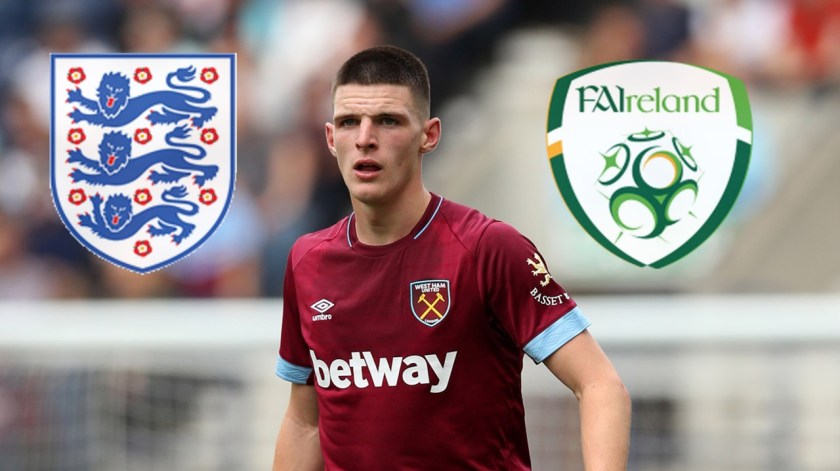
declan-rice-west-ham-england-ireland_cbidjly9uk5z19wn93j23juphDeclan Rice has decided to have a wee think about who to play for. Let’s make it simple for him – Declan, your Irish international career is over. I don’t care that he’s a young man and I don’t care that national identity in this world is fluid and not perhaps as binary a thing as it once was, particularly in this complicated corner of the globe. I don’t want his likes to represent us. I want the likes of Kevin Kilbane – a man, who even as a boy, never doubted his allegiance. Rice may be getting bad advice from some dirty little agent thinking he’ll be better off financially with 20 England caps than 80 Ireland caps or whatever. I’d have some sympathy for him in this situation, but not enough. He has played 3 times for Ireland – he should never waver after such a commitment.
He obviously has been slightly caught up in the fervour around Gareth Southgate and his team’s progress to the semi-finals this summer; blinded by the “It’s Coming Home” brigade, surrounded by his friends and family members who are English. Perhaps that’s enough to sway a young man on many issues, but you cannot doubt such an important calling, even at 19. He has obviously been approached by the FA as well, as is their wont. This is not something that FIFA should allow players to piss about with. Once you have a senior cap, that’s it. I would go even further and state that every professional player should be required to declare an international allegiance at 18 and stick to it. You might say that it’s too young for such a massive career decision, and I would disagree fundamentally with you. At 18 you are old enough to vote; more than old enough to be a parent; old enough to drive; drink; and get your own passport. If you can do all of that without trouble, then you can choose a damn country.

As for the mixed nationality issue, while there is a lot to this, in particular the shambles that is the Irish / English / British / Northern Irish blancmange of options, I find it hard to believe that anyone can feel as passionately for one flag as another. Many sportsmen and women from Unionist backgrounds in Northern Ireland are ok with being cheered on by a crowd draped in tricolours, but major changes have been brought to the symbolism around these all-Ireland sports to accommodate their backgrounds. Such accommodations can never be made to the half-Irish half-English footballers who are confused as to their allegiances. I still don’t know how deeply the likes of Aldridge, Houghton, Townsend et al felt their Irishness. They never seemed anything other than committed, but was that tribal Gaelic passion or immense professionalism and a love of the squad and the experience? And did they ever waver?

People will somehow blame John Delaney, the FAI or Martin O’Neill for this. But that would miss the point completely. Every journalist who asks a question about this in the future – during the next series of games, for example – will be partly guilty for any emerging shambles and for making this a bigger story than it merits. Declan Rice is not an Ireland international. I don’t think he ever will be and I don’t think he ever should be. Let’s not turn this into another pathetic Grealish situation where we look like desperate peasants. Let O’Neill concentrate on the players he has. Rice may or may not turn into a world-beater, but he’s not Irish. Let him move on and for all of our sakes, move on yourself.

YoG No. 47 – Not My President

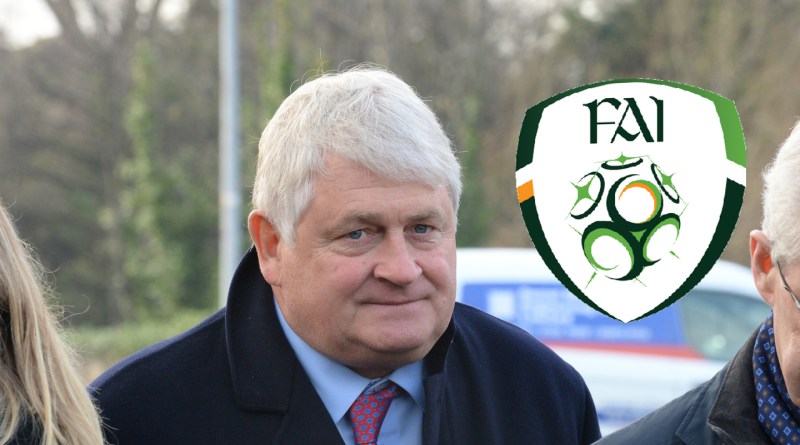
denis-obrien-FAI

The extraordinary relationship between Denis O’Brien and Irish football took yet another twist when he was named an Honorary President of the FAI last week. This is a man who was found, in the course of a tribunal, to have donated huge sums of money to a politician, who then gave him information needed to secure a mobile phone license. The precise wording of the tribunal report reads as follows:

“Mr Michael Lowry, in the course of his Ministerial office, as Minister for Transport, Energy and Communications, by his acts and decisions, conferred a benefit on Mr Denis O’Brien, a person who made payments to Mr Lowry… and who was also the source of money in accounts held in the name of and for the benefit of Mr Lowry…”

In other words, in black and white, a tribunal of the State found that payments were made by Denis O’Brien to Michael Lowry and that Michael Lowry then secured a mobile phone license for him. Call it what you want, but that is what he was found to have done.

But you know this already. We all knew this years ago. The name of Denis O’Brien is now as synonymous with whatever you want to call the above activities, as it is with his business success. At least in Ireland.

Since the late noughties however, Denis O’Brien has turned his hand to a lot of other work. His activities in Haiti after the 2010 earthquake alongside Bill and Hillary, did indeed play a huge part helping that nation recover – yes he may have made money in doing so, but no-one can begrudge that in and of itself; and the views of the international community, such as those hugely-compromised Clintons, are a matter of repeated public records. The closets of people in those particular circles tend to be riddled with skeletons, however, and even the latest RTÉ documentary reputational  rehabilitation attempt cannot rewrite Justice Moriarty’s findings. His main role as far as our game is concerned, as you all know, was to pay half the wages of Giovanni Trappatoni from 2008 and then of Martin O’Neill until this year. All in all, €12m was “donated” by one rich businessman into the accounts of 2 rich sportsmen over the guts of a decade.

And we’re supposed to be impressed? We, the Irish soccer community, are supposed to be grateful for this benevolence? And we are supposed to be ok with the bestowing of a great honour on this man on our behalf even though his total contribution to Irish soccer was never invested in the game itself? The very presence of John Delaney in all of this is just further evidence of the sheer Oirishness of the whole thing. A man, Delaney, being paid an outrageous sum of money by international standards, metaphorically bending over so that a billionaire, found to have paid huge sums of money to a politician, can funnel outrageous sums of money to an underperforming pair of dinosaurs (Trap and MO’N). No wonder they have both seemed so arrogant and dismissive of dissent, or even light probing from the taxpayer via Tony O’Donoghue in the case of O’Neill. They’ve been largely bulletproof, shielded by this tag team of fellow travellers. Trap’s O’Brien-funded reign ended in absolute disgrace with several kicks to the soccer community’s teeth along the way. O’Neill has the Nations League to save himself, but it’s a long, long road to redemption after a dreadful, dreadful, performance in Dublin last November. And he can do so without O’Brien’s money at long last, as he no longer pays the wages. One wonders if the inflated pay-packet is now permanent – that we can never hire a manager for anything less. That is a truly worrying prospect – how much FAI money will be diverted from the game to men who will generally have made their big money before taking the job.

Let me remind you of the relationship that has developed between Delaney and O’Brien. (Satire really is dead.)

Of Delaney, O’Brien once said:

“John Delaney could run anything. He could run UEFA. He could run FIFA, certainly better than Sepp Blatter”

I’m not a Delaney basher. I can understand in Ireland, where GAA is intrinsically linked to the very idea of Irish nationhood and funded with that in mind, and Rugby intrinsically linked to the moneyed classes, that finding any room for football is difficult, and the presence of the Premier League monolith on our doorstep all adds up to a difficult task for the FAI and whoever is the CEO. I also had no problem with him embarrassing the aforementioned Blatter into a €5m gift. Fair play I thought.

This relationship with O’Brien, however, is too much to take. I’m conscious that the media mogul is prone to litigation and I chuckled to myself when the comments were closed on this story on the Journal on Saturday. He has even threatened Waterford Whispers News to the point where they took down one of their stories. He is not a man who I believe represents all that is good about community, society or sport in this country and I despised his role in funding our managers, regardless of what scant sporadic successes we’ve had during those reigns.

That’s a personal view that I am entitled to hold. I don’t regard him as worthy of the title “Honorary President”, whatever such title means. I don’t want to see his name in the programmes alongside the likes of Séamus Coleman or James McLean. Such a view I would hold even without O’Brien’s past, because I despise the corporatisation of our game in any case.

The World Cup this year showcased exactly why international football matters so much. It’s an escape from the over-hyped bullshit of the Premier League, La Liga and the Champions League; where Messi, Neymar and Ronaldo were brought down to earth with a bang – their wage packets and endorsements made irrelevant by lesser stars. Even the traditionally overblown English showed work ethic and togetherness mattered more than greed and selfishness. It showed that playing for your country matters more and that supporting your country can sometimes bring you to the heights of incomparable joy alongside the more regular periods of incomparable misery.

Meanwhile as we Irish looked on, we were safe in the knowledge that a billionaire was regarded by our CEO as worthy of the sporting equivalent of a knighthood. John, it’s bad enough that we are still expected to parade around with your latest corporate partner on our chests – the only nation on earth whose soccer fans must have the sponsor on their jersey – but this is a step too far. You’ve let us down again.

YoG No. 46 – Páirc Uí Chaoimh

This has been a bad, bad week for sport in Ireland. The sordid manner in which a tribute match was dragged through the back alleys of the Irish media for so long did no-one any favours. I’m a soccer man, as they say, and have always been waitin’ in the long grass, as they also say, to have a pop at the GAA for what I see as outdated parochial insular activity on a regular basis, but even I had some sympathy with them by the end of the affair. Neither side of the debate came out well, but I’d like to offer a different view – one from neither side and both – one that actually refuses to take a side, no matter how old fashioned and 20th Century such a nuanced approach might sound.

First and foremost, this was about Liam Miller, or rather it should have been. I remember standing on the old South Terrace back in 2006 when he unleashed a belter against Sweden in Steve Staunton’s first game in charge of Ireland. I was in the perfect position, right behind him and I’d say I was the first one in Lansdowne to know it was a goal. It was in as soon as it left his foot and was one of the better goals scored by an Irishman in the old ground (or the new one). His first and only goal for Ireland and a memorable one. Go to 2:25 on the clip below.

He made 21 appearances for Ireland and his club career would be fairly described as that of a journeyman, but one which took in Ireland, Scotland, England, Denmark, Australia and the United States – some journey. He achieved the stuff of Irish boy’s dreams in lining out for both Celtic and Manchester United, but made his biggest mark in terms of appearances and goals for Hibernian. His biggest mark overall, however, was made on his home city of Cork, and this is where we found ourselves last week.

Having sold out 7,000 tickets for the tribute match in Turners Cross in minutes, a request was made to the GAA to allow more tickets to be sold and more money to be raised for Liam’s family and charities by moving the match to Páirc Uí Chaoimh, with a 45,000 capacity. What followed was an absolute disgrace of a spat that shamed almost everyone involved, including maybe some of you readers who may have commented online where you shouldn’t have, or said something over coffee break that maybe you regretted or should regret. I could not believe the vitriol directed at the GAA, and then aimed straight back at the soccer community.

First of all, technically, legally and from all other cold, rational perspectives, the GAA were under no obligation to allow this match to be moved. I have no doubt whatsoever that they should have let it go ahead, and were right to do so in the end, but they needed to come to that conclusion themselves, but to do so required their arcane and archaic structures of committees and councils and whatever yer having yerself, to kick into gear and call whatever meetings were required and make one of their famous tortuous decisions. In a summer where a County was refusing to tog out for a Championship game unless it was moved to where it always should have been in the first place, right up to a few days before the game, were we really expecting this fundamental shift to happen quickly?

No, they had a meeting with the organisers, then had a meeting with themselves at which they made a classic committee (pronounced with the emphasis on the last syllable obviously) decision. They would go away and consider it. Days later they agreed to it.

Now other sporting organisations, including the FAI and IRFU may very well have dragged out a decision like this, but if the senior managerial moves of both bodies is anything to go by, these decisions are made in a classic una duce una voce manner. Twice John Delaney has extended contracts out of the feckin blue in 2012 and 2016 on the eve of major tournaments – they may have defied logic as decisions go, but they were made swiftly and without fanfare, but recall there was much faffing around the latest extension.

No decision by the GAA is ever made without fanfare and without a row. This applies to the abolition of Rule 42, the black card, the Newbridge or Nowhere fiasco, suspensions, fixtures what have ya. All designed to maximise exposure for the organisation and to further instil this deeply wrongheaded notion that they are the big dogs of Irish sport who no-one comes close to touching, and they are intrinsically front-page news for the Irish media, belonging as much in current affairs as sport.

None of the above, however, should lead to the anger and rage among the media and wider social media commentariat that emerged and completely overshadowed the event and the life of Liam Miller. Damien Duff in particular should have kept schtum. This guy togged out for Ireland and by extension the FAI over 100 times; he’s coaching for a club that was teetering on the edge not long ago due to bad management; in a league that had 2 squads ready to walk out when this fiasco was unfolding last week, and which regularly falls victim to the dinosaur thinking he was accusing the GAA of when it comes to investing in facilities. Granted it has been turning around in recent years, but for every Drogheda plan or Shamrock Rovers development, there’s another Monaghan waiting in the wings, and it’s proven every year. Irish soccer is still run on the basis of an inferiority complex; a reliance on Britain to mould our kids; and a “sure it’s grand we’re only a small country” mentality – a dinosaur one, in other words. One that is changing, but not at a pace much faster than that of the GAA.

The abuse meted out on the comments pages by the general public – mainly anonymous as these things normally are, but some were not – was disgraceful and we ended up in a massive GAA vs Soccer tribal war across the airwaves, in print, and online. The usual cliches came out again – how can those bastards get public money for that stadium and not open it up? It’s clear the Gah don’t care about the Cork community!!! Fuck Soccer, let the FAI develop a 45,000 seater stadium in Cork! It’s only a dregs game for knackers anyway, and on it went ad nauseum. The only people who seem to have handled this situation well were Liam Miller’s family, who said nothing at all to the best of my knowledge, and Michael O’Flynn chair of the organising committee.

But where does this rage develop? Is it merely that social media exaggerates and then spreads this attitude quicker than before. If those anonymous posters met and had a pint to discuss this would it be ok? Maybe some already have. I dunno. It seemed to me as it was developing that the GAA were concerned about total and absolute dilution of what they see as their unique position in Ireland. Which is reasonable if you still believe they are unique. And I don’t believe they are. All of the attributes ascribed exclusively to the GAA – community, volunteerism, super-human dedication etc. etc. – apply to all other sports in Ireland. The only difference is we judge the rest against the greatest on the planet. We judge Gaelic footballers and hurlers against the best in their province and in Ireland.

Putting myself in their shoes, I would have felt maybe those delusions were under serious threat. They’ve survived through the rise of soccer through the Charlton era and the (mainly made-up by south Dublin media) rise of Rugby more lately, but they must have worried when they saw higher viewing figures for a recent England soccer match than any GAA match. They must be worried how long Gaelic Football may last if the Dubs aren’t caught on more than one occasion in the next 5 years. They must be worried that player-power and County-power as exemplified by Kildare threatens their control. And fundamentally, they must be worried that amateurism, in whatever form it still exists, is in dire straits, particularly if the demands on players keep increasing. There is a looming existential crisis in the GAA and this event, and their reaction, will not have helped.

Yes, organisations need to be accountable; they need to explain their actions to their members and they need to show empathy to others, but they don’t need the entire public to whip themselves into a frenzy over each and every decision. I’ve had enough rabble rousing; I’ve had enough of Dunphy, Brolly, Hook and Yates; enough lies and anger going viral at 100 times the rate that the truth and compassion do. This was a poxy week for Irish football of the Gaelic and Association codes and one I hope we never see the like of again.

Liam Miller was 4 years younger than I am now when he died. He left a wife and 3 kids behind. He was a good professional who represented his community, his city and his country with dignity. He deserves to be honoured with that same dignity in that town he called his home. Leave the anger at the turnstile, or better still leave it behind now and pay your respects.

YoG No. 45 – A Month of Football Magic

The World Cup – one month that feels like three but seems to fly by nonetheless. Russia 5-0 Saudi Arabia may as well have happened years ago for all it means today. Day-by-day new talking points emerged; new heroes and villains were created; each story bulldozed into history as the next one dropped unceremoniously into view. This is the Yard of Grass take on 4 weeks the likes of which won’t be seen again for another 4 years.

VAR

The undoubted star of the early games of this World Cup and the greatest talking point was the Video Assisted Referee. I’m in favour of it. I think it works and I was very disappointed to hear normally intelligent people like Didi Hamann so brazenly dismiss it. No one said it would be perfect and no one said that all controversy would be removed. It exists simply to give the referee a second (third, fourth, fifth etc.) opportunity to look at an incident again and make his or her mind up with additional evidence. If the referee is fully confident in his or her decision, play goes on as normal. I never understood any of the concerns, even with some teething issues. It’s not that slow; it has helped inordinately with punishing defenders fouling from set-pieces and has removed the “I didn’t see it” excuse from the referees. As the tournament went on, it was called into use less and less frequently and barely merited mention in some of the quarters and semi-finals.

Of course, as we all knew it would, it was called into play in the final, and it was here where it showed exactly why it’s a good thing. The referee completely missed the Perisic incident. He therefore had absolutely no opportunity to make a judgment on this handball. VAR was called into play, and he made the call to give a penalty. I didn’t think it was a peno; most people I know didn’t; but most of the RTÉ panel did; and most importantly the referee did. VAR did what it’s supposed to do – give the ref a chance to administer the rules as he sees fit.

According to BBC , 335 incidents were checked during the group stage, which equates to around seven per game. 14 on-field reviews were made by referees and three reviews made by the VAR team. Without VAR, referees called 95% of incidents correctly but the system improved that to 99.3%. We’re now miles from the chaos of Liverpool vs West Brom in the FA Cup in January, or even the madness of Portugal vs Iran only a few weeks ago. That 4% jump in accuracy is the difference between Argentina beating England in 1986; Henry’s handpass to Gallas; Ramos’ being red-carded for smashing Karius; and it was the difference in many, many incidents throughout this World Cup. FIFA deserve credit for bringing it in on this stage at this point. The uproar over it, in particular in the tabloid world across the water, looks a bit silly now. Of course it can be improved, and knowing the conversation the referees are having is the next logical step in making it more transparent. People will still moan about it, and may even point to the penalty decision in the final as proof that it’s a failure, but they will have missed the point completely. Again.

Brian Kerr

One of the more irritating aspects of modern media is how viral memes take hold and eventually make a boring mockery of the things they were intended to celebrate. It got a bit like that with Brian Kerr as the tournament went on and he was reduced –  in the eyes of the football illiterati – to a one-liner factory. The truth is that Brian Kerr is a truly brilliant football man. A diligent worker, never found wanting in terms of information, knowledge, or – above all else – genuine insight. We know more about football after hearing Brian co-commentate than we did before. Sometimes a lot more, and that’s a talent.

The fact that he is a 1-man Dublinese Preservation Society merely adds another layer to his value. The quips and one-liners can be priceless, and his description of a shirtless Shaqiri may go down as one of the great Irish football quotes, but he knows his stuff more than anyone watching. His insistence, during the Croatia vs Denmark shoot-out, in relation to the rule whereby keepers cannot move from their line before a penalty is taken was a bit much, but we know that beneath that lay the rage at the injustice meted out to the Ireland U-17’s in similar circumstances only a few weeks previously.

Brian Kerr is also Ireland’s most successful coach and the mentor for much of the last generation that represented us on the World Stage. He also has the highest win percentage of any permanent Ireland senior team manager. He is one of our best footballing brains, personalities and characters, and he had a brilliant World Cup.

Individualism vs The Collective

As has been said countless times before, football is a microcosm of society. As we move more and more towards an atomised, individualised world, where the real joy of the shared experience has been replaced by the ever-elusive joy of experience-sharing, football has become more and more about the individual, with the heightened importance of Ballons d’Or and individual stats and records. World Cup 2018 kicked back against that trend, even if for a brief moment.

England – more on whom later – epitomised this. In the past, individual world-class stars comprised a team of abject failures. The early exits of Ronaldo, Messi and Neymar signalled a period of irrelevance for all of them. More on them later too. The starless Russians making the quarter final through the type of collective action that made their preceding State so powerful was a message. Belgium, for all their stars and all their personality issues, were dragged forward by the less glamorous, selflessness of Lukaku and Fellaini as much as by De Bruyne and Hazard. Dotted throughout the tournament were glorious team efforts which made their mark on a great tournament – South Korea vs Germany; Japan’s performance vs Belgium; Sweden making the last 8 with few, if any, decent players (remember we fairly played them off the park with Zlatan in Euro 2016!).

No other team performance matched that of Croatia however. Inspired, or more simply just led, by the footballing treasure that is Luka Modric, their journey to the final was a lesson for us all. Three times they faced extra-time. The balls required of Modric to take a shoot-out penalty in the last-16 against Denmark having just missed one to send them through cannot be overestimated. The suckerpunch late equaliser from the Russians sending their next tie to penalties as well was another gargantuan test of steel, character and unity. They passed. England once again took them to extra-time and once again Croatia emerged victorious. Modric started the tournament as the star man alongside Rakitic and Mandzukic, but in these games new household names emerged – Rebic, Vida, and Vrsaljko, all took their place alongside the former three while Ivan Perisic raised his solid reputation to world-class heights as well. Credit too to the oft-maligned Dejan Lovren – not many players ever get to play in either of the games two great showpiece finals. He played in both within 6 weeks. Bad players simply do not get to do that.

Football is a team game and while the narrative around the Super Clubs and the global megastars throughout the regular season may tell us different, international football through June and July 2018 reminded us of the purity of our sport and the potential for achievement beyond the rational; that collective action trumps individual actions. A message to how we run our affairs beyond football perhaps.

Ronaldo vs Messi

Following on from the above, we can finally put this tiresome debate to bed. It doesn’t matter. Both of these colossal football geniuses, corporate powerhouses, and inspirations to the masses cowered in the monstrous shadow of the beautiful game itself. Irrelevant after the last 16, giving way to Mbappe, Griezmann, Cavani and Suarez, as Argentina surrendered to the French when only 2 goals  separated them, while Portugal crashed out 2-1 to Uruguay. The two greatest players in the world were gone. The world got over it and the greatest show on earth rumbled on relentlessly. Millions more would go on to be inspired by others.

Neymar

The pretender to the formers shared crown left Russia in disgrace; a parody of a modern footballer; the epitome of the selfish, petulant cheating blackguard we all hate. Had Firmino played instead of Neymar – an unthinkable choice in all fairness – they would have gone further, and this is something Brazil will have to consider in the future.

England

Well it wouldn’t be an Irish football blog without a big ol’ piece on the English. And what a tournament they had! Didn’t they? Was this not the greatest performance since Euro 96? Their best World Cup since 1990? While yes technically, this was their first appearance in the last 4 since those tournaments, behind that albeit meaningful fact lies another – England never beat a good team, and always looked vulnerable to a meeting with the likes of Croatia.

They scraped past Tunisia in a way that would embarrass other European nations, Ireland included. They dismissed Panama efficiently and then lost the reserves exhibition match against Belgium. So their World Cup did not start until the last 16 against Colombia without their star man James Rodriguez. Again, this was not a real match, with a poor, dreadful Colombia reducing it to a scrap. The dramatic late equaliser was deserved and the game did give a hint as to what could await in later rounds, because when Colombia played football, England looked quite vulnerable. They eventually drew and then proceeded to put their penalty hoodoo to bed. In doing so, they probably garnered greater benefits than had they won 1-0, or even strolled to victory by 2 or 3 goals. This game galvanised England, the team and the nation. A routine win over Sweden – how they got this far is anyone’s guess – and they had reached the promised land – the semi-final.

Yet still it felt like their tournament was only starting. Compared to Euro 96 where they came out of the group on fire, screaming into the last 16 with a comprehensive 4-1 disassembly of the Netherlands, following a 2-0 win over Scotland. They reached the semis with a hard-fought penalties victory over Spain –  not a vintage Spanish side, but a Spanish side nonetheless. They had battled to this point. Ditto Italia 90. Hard-fought draws with Ireland and Holland and a 1-0 win over Egypt gave them top spot in the group. An extra-time winner against a decent Belgian side was then followed by a bit of an epic 3-2 victory over a Cameroon side who can probably still lay claim to have had the best African performance at a World Cup (Senegalese and Ghanaians may disagree). Again, they had battled to the semi-finals. In both these tournaments, every match meant a lot and every match was competitive. Their tournaments in 1990 and 1996 started at the first whistle and ended in agony to German penalties.

This was different, and while they are absolutely right to celebrate and do all the things one does during a summer of renewed love for your football team, in the cold hard light of day (or 5 minutes after the final whistle if yer a Corkman on ITV), the analysis will tell the truth. This is not a revolution for English football. Not yet. They were efficient, their most memorable performance being the victory over Colombia, but they are still behind many other nations, some of whom may have exited earlier this time but are unlikely to do so again. In the Euros in 2 years time, you will not see Spain descend into chaos on the tournament’s eve; Germany will not go out with a whimper at the group stage; and the Dutch and Italians will be there. As Keane said, this was their big chance. 2018 and all the factors around the quirks of the draw did give England a fine chance not only of making the final but owing to the randomness of one-off games, of actually winning it. It’s unfortunate that a once-in-a-generation opportunity came too early in this squad’s evolution, but it did.

But let’s not piss on all their chips. Let’s talk about the good things about England this summer. For a start, they have comprehensively and definitively washed away years and years of negativity. Two years ago, I raged about the dreadful English football culture in the wake of the Iceland defeat in Euro 2016. The national team was a lost cause and there were too many factors that needed addressing for it to change. They then appointed Sam Allardyce and seemed to be destined for 2 more years of bad football; an absence of adventure, vigour and youth, followed by a 2nd round or quarter-final exit at best. Instead, Allardyce blew it completely thanks to a pint of wine and some shady conversations, and they appointed Southgate. Hardly earth-shattering, but he has turned out to be exactly the type of manager England have craved for many years. Since 1996 they have bounced back and forth between old-school “up and at em” Englanders and experienced, considered foreigners. Southgate seems to represent the best of both worlds (I accept Hodgson did too, but he was possibly out of his depth as he had been at Anfield). He is a young, outward-looking, intelligent man but steeped in English football culture. His open approach to the media and his ability to forge a collective team spirit where half a dozen of his predecessors failed, was admirable. They have found a man in Southgate who could conceivably hold this job for a decade – and win something.

England also have the nucleus of a decent side when it reaches its peak. Most of the squad are kids in footballing terms and will have matured immeasurably as a result of this run. Watch out for them at Euro 2020, and it’s possible one may wish to avoid them altogether in 2022. The signs are pretty good and if they add one or two more over the next couple of years, this could be a good side. Then again, they reached the semi-final in 1990 and look how they fared over the next 2 tournaments.

The Winners

France were worthy champions. Any team that can find the net 4 times on 2 occasions in a knock-out setting deserves to win the tournament. They tore into Argentina; dismissed Uruguay; smothered Belgium; and taught Croatia a lesson in clinical, brutal, harsh football. They were simply brilliant. It’s difficult to decide which French performance was best, but I think the discipline they showed in beating Belgium – who were probably the 2nd best team in Russia – was immense. It wasn’t a classic semi-final in terms of excitement, but the weariness of some neutrals would have been offset by the depths of the tension felt by French and Belgians watching that. You could not take your eyes off it even when nothing of note had happened for more than five minutes. A gripping encounter which could have flipped entirely in a split second.

We knew going in to this tournament that this squad had great talent. They ran out of steam in the Euros, strangled by the Portuguese, but 2 years older and wiser, Deschamps’ charges never looked like slipping up. All of their men showed up for duty – Pogba showing his worth; Griezmann too. Even Giroud – who I think is very underrated – had a constructive tournament. Mbappe stole the show however. His pace coupled with his abilities on the ball, made an absolute mockery of the Argentinians in the last 16, and he kept it up right into the final. The emergence of Pavard was also a major plus for the French. They played a classic tournament, holding back reserves in getting through the group, and then catching fire when needed, and sitting back when needed. It’s hard to believe 2 decades have passed since Deschamps lifted the trophy as captain – his is a remarkable, remarkable achievement to do so again as manager and to write his name alongside Beckenbauer and Mario Zagallo. The France of 1998 and 2000 was the best international team that had been seen since 1970. The Spanish team of 2008-12 eclipsed that one. The question is can this team go on and win more. It’s difficult to see any reason why not, other than the fact that it is extremely difficult and therefore extremely rare for it to happen. No one has retained the World Cup in 56 years. The only countries to hold the World Cup and European Championship together are Spain and France those 2 times, and West Germany in 1974. France will get better, but as I said earlier, so will a lot of other teams. They were great winners of a great tournament and they can rightly enjoy this one for now.

Football

This was the showpiece event for the sport. The greatest show on earth. It doesn’t always work out though. Some tournaments are forgotten about, barely to be mentioned again, while others are etched in the collective conscience for generations to come and not just for the quality on the pitch – they are epic summer events that help shape the game itself. Russia 2018 could not have taken place at a more cynical time. Within football, you had the money getting more and more ridiculous; personality-driven hype was drowning the communal essence of the game; diving; cheating; harassment of officials. Within Russian sport, you had the stench of drugs and Sochi lurking, alongside the threat of hooliganism whipped up by the British press. Outside sport, there was the murky goings-on between Putin and Trump hanging around; the poisonings in Salisbury and then again in Amesbury during the tournament; Ukraine; and the general feeling that this was a country where basic freedoms were being denied. There was an unease about Russia 2018 to the extent that the old idiom whereby once the first ball was kicked, you could forget about everything else, rang truly hollow. Football could do without all of this other stuff, it was struggling enough under the weight of its own baggage.

Then the first ball was kicked. With it, we were treated to one of the most dramatic, explosive and ridiculous tournaments of all time, which even 3,200 words cannot even start to do justice to. So many late goals, so many upsets. Relentless drama upon relentless drama. Out go the Germans, undone by South Korea in a comical manner; out go Messi and Ronaldo on the same day; the hosts dump Spain; Belgium scrape past Japan with one of the greatest counter attacking goals you’ll ever see in one of the most incredible contexts you’ll ever see – on and on it went. It was the most enjoyable tournament I’ve witnessed without Ireland being in it. It was exactly what football needed – what it was crying out for. It put international football back where it belongs – not only at the top, but way, way out ahead of club football. Teams rose and fell, and entire nations with them. So sit back over the next few weeks and savour what you have just seen. It’ll be a long, long time until the next one.

Thanks for reading.