YoG No. 24 – Eamon Dunphy…baby

From national football icon to national broadcaster clickbait, Eamon Dunphy’s career has been an immense one. From ‘not a great player’ who was good enough to represent his country 23 times, to a coach with a vision for the domestic game at Shamrock Rovers, then onto a new career as a powerful sports journalist and author, he is now in danger of petering out as some sort of parody of himself. But as he proved recently when waxing lyrical on Juventus’ first leg triumph over Monaco, when he is good he is compelling and a joy to listen to. But when he’s bad, he’s dreadful. His weekly headline-making nonsense on RTÉ radio comes across like a contractual obligation to provide content for the website every Tuesday morning and does him no favours.

Dunphy’s schtick is beginning to get boring. And old. Primarily because he is 71 years of age and there’s is nothing he has not seen, and nothing he has not said. But one day he will retire, and that will be a very sad day for Irish football. Yard of Grass is a fan of Eamon Dunphy’s, because in my view no-one in these islands views the game in the same way as Eamon and no-one frames the sport in the same way. Context and culture drive everything you see on the pitch. It’s not just a game. Football is an expression of your environment and your society. The reason Juventus held out 2 of the most lethal attacks in Europe this season is the same reason Jack Charlton removed the midfield from Ireland’s play. It’s in their blood. Dunphy gets that. And has expressed that brilliantly over many, many years.

He’s had his moments however. In recent years it was his blindness to the clear brilliance of Cristiano Ronaldo. While his criticisms of his style were correct, his damning “this fella Ronaldo is a cod” quote must haunt him to some extent. At the time, Ronaldo was blowing hot and cold, and his cheating and attitude stank. But when he was hot, he was unplayable, and has remained so ever since. His total demolition of Atletico recently just being the latest in a litany of domineering performances, while dragging Portugal to a title sets him above Messi on the international stage.

Dunphy has always tended to the absolutist – the extreme view, when the more nuanced was necessary. His stance on matters Irish have at times divided the nation, in particular on our managers and styles of play. He enraged many during Jack Charlton’s glorious reign. In this case, a more nuanced approach certainly would have served the viewing public better. He was of course absolutely right about the style of play and the disgraceful treatment of players like Liam Brady and Ronnie Whelan. The former banished entirely, the latter getting only 27 minutes in Italia 90. But we did get to last 8 of that World Cup. We beat England and Italy in major tournaments. We qualified for 3 out of 4 tournaments having qualified for none previously. This was a time for measured critique. Yes the display against Egypt was abominable, but it was in a World Cup! For the first time.

Dunphy explains the famous “pen-throwing” episode very well in “The Rocky Road”. His anger was not just about the football, but as I referred to earlier, the context and the culture around it. For the first time in his life, his game was to the forefront of Irish life. Tarred as a shoneen; a garrison-game loving west-brit; brought up in a land where non-Gaelic players were effectively persecuted by a holy trinity of bastards who defined “true Gaels” as GAA lovers (and haters of all other sports by definition, especially British sports), Catholics, and Fianna Fail voters, Dunphy speaks of that same land gripped by football fever as he made his way to Montrose that day. It felt as if all 3 million “true Gaels” were watching the great sport of Giles, Brady, Best, Blanchflower and Jackie Carey. Having held the Brits at their own game days earlier, recognition at long last had come to the Irish football community from the plain people of Ireland. As he puts it “an end to sporting apartheid, the moment when our beautiful game of soccer would be recognised, and those who loved it would finally be assimilated into Irish culture”.

Then the game happened. And Dunphy was fucking ragin’. Perhaps he was naively over-optimistic and caught up in the externalities, when he should have known Charlton would serve up 90 minutes of more dross. Sure the England game was a dog as well! But he wasn’t perhaps fully mentally prepared for the sheer awfulness. And his criticism backfired on him as he was vilified here and in Italy, recounting in “The Rocky Road” the real fear he felt as he made his way to Palermo for the Dutch game. But the bandwagon and the new Irish soccer fan-base rumbled on as we made our way out of the group and to a day which stands 27 years on as a touchstone in Irish history. Another shite match but a glorious victory against Romania. Eamon was probably content to – at least temporarily – put analysis to one side, as the country went into total meltdown for the game he was told he should never play. He details how he watched men who never set foot inside Dalymount or Milltown break down in tears. He comes across as slightly perplexed as to how this bandwagon ever started and how it would end. Almost 3 decades on, thankfully, nothing still quite convulses the country like the travails of the Boys in Green. Our generation is used to soccer standing proudly on the front pages – Dunphy’s was not. But on the substance of the Charlton debate, Eamon was right. Ireland’s game against Egypt was football’s nadir, an example used to justify changing a fundamental aspect of the game – the ability of goalkeepers to pick up back passes. We will never forget drawing our way to the last 8 in the World Cup. But we should also never forget that it was the worst football tournament in living memory.

We all know enough about Saipan and Dunphy’s relationship with Roy Keane and Mick McCarthy. Best to leave that aside and focus on a period when Dunphy’s absolutism was spot on – the Trappatoni era. Again, we were managed by a foreign coach after a relatively successful but unlucky period under Mick McCarthy; the inability of Brian Kerr to meet expectations; and the slow unravelling clusterfuck that was Steve Staunton’s reign. Trap was different. His was a truly world class appointment. Italian football management royalty. We initially warmed to his eccentricities, and the team in their first campaign played their way back into the nation’s hearts in that play-off in Paris when we were cheated out of an opportunity to get to the World Cup in South Africa.

Things began to go awry very quickly however. The qualification for Euro 2012 was probably the worst successful campaign of them all. Slaughtered home and away by Russia – somehow dragging a point home from Moscow – we beat no-one of any consequence home or away, labouring to dreadful wins at home to Macedonia and Armenia, while drawing with a poor Slovakian side. In Dunphy’s view – and most observers – we had sacrificed midfield completely. Andrews and Whelan were immovable first choices. No creativity. Andy Reid had become Dunphy’s hobby horse before this campaign, a man left out for playing the guitar too late at night. Reid is no world beater, but his ability to make things happen was sorely lacking. As the campaign went on and as qualification loomed, more and more names were added to the “where the fuck are they?” list. James McClean was hitting his stride at Sunderland. Séamus Coleman was emerging as the classy full-back we all know in a decent Everton side. And Wes Hoolahan was also knocking on the door. Of these only McClean travelled to Poland, and he did not get a look in. While the shoddy treatment of Kevin Foley would become typical of this regime. Trappatoni’s performance at Euro 2012 was a disgrace. And it only got worse when the Germans battered us 6-1 at home in the next campaign. Finally he was let go.

This period really angered me. On one side you had the apologists claiming we just didn’t have the players. Trap was making as much as he possibly could. On the other you had the likes of Dunphy pulling for decent players whose reputation grew and grew the less and less they featured. None of the Trap absentees were truly world class. But they were better than what was on the pitch. There is absolutely no bone in my body that does not believe we would not have been a far better side with the likes of Wes, James McClean and Coleman in Poland and at the start of the following campaign. Ditto for Andy Reid in earlier campaigns.

Dunphy’s criticism of Trappatoni was not simply that he picked the wrong players, but that he had no respect for Ireland as a footballing  nation. We were minnows without any talent in his view. We must play a British style to compensate. A reasonable view if Paul Green and Simon Cox are on the park, but not if Wes Hoolahan and James McClean are sitting at home!

I enjoy Eamon mainly when he is commenting on teams I have no interest in. His recent coming out as a Liverpool fan does not make up for any criticism I’ve disagreed with. And his analysis of Ireland no longer carries the weight it perhaps once did because we’ve heard it too much before from the same voice. But on Champions League nights or during tournaments, I find his views often compelling, even when bloody inaccurate. And he is becoming more and more inaccurate as time goes on. His grá for the absolutist view is most tiresome when he is decrying the end of footballing empires on the basis of a single defeat. As such, I believe it is time for someone new on RTÉ, but I think he deserves the right to choose the time, unlike John Giles, who was effectively let go a few years ago.

Unfortunately it will be extremely difficult to replace Dunphy. It’s only when you watch the pantomime boiler-plate faux rage of Joe Brolly or the tabloid hackery of Chris Sutton that you realise the critical additional ingredient Dunphy brings to Irish football analysis that is rarely seen elsewhere – passion. True passion. A man not afraid to show his emotion. A man willing to allow himself to well up and allow his voice to quiver on live television. Talking about our sport. Our culture. Like when he eulogises the old Dublin street footballing tradition, you get the feeling that every little shimmy Wes does on the Lansdowne pitch in 2017 was seen a million times by Eamon on Richmond Road in the 1950’s. And perhaps in his view it was taken out of the Irish game by foreign footballing butchers.

We could go on for days about Eamon Dunphy and this post is one of my longest. I’m sure some of you, if you got this far, are tearing your hair out at my positive view of him, but I care about that as much as he probably does.

Enjoy him…


YoG No. 23 – Return of YoG and the State of the Football Nation

So Yard of Grass returns after a long hiatus – the last post was back on January 30th, a lifetime ago in footballing terms. And a lifetime ago quite literally in real terms, as the break was down primarily to the birth of YoG no.2, my daughter Rosie. Now 8 weeks old, the lack of sleep is kicking in, so instead of the usual wonderfully researched posts you’re used to, this one will be more of a scattergun summary of the last couple of months, written in between patches of sleep here and there, starting with the trials and tribulations of the boys (and girls) in Green.

a-new-irish-captain-was-born-tonight-and-his-name-is-seamus-coleman

There’s a lad in the south east corner of the upper tier in Lansdowne Road who travels down from (I think) Armagh for the matches and plonks himself behind us for every game. He first came to our attention when we played England in that half-asleep pre Sunday lunch friendly a while back. It seemed he had the day off.  Off work, off family duties, and off sobriety. For the entire first half, this big pissed man belted out the “50 Grand, 50 Grand, Séamus Coleman…” chant at the top of his voice to the extent that it’s effects went from curiosity to irritation to rage all the way to comedy in 45 minutes. Then he moved at half time. There was silence for a while, until we heard the chant echoing across from behind the goal at about the hour mark. Since that day he has returned each time, and most days he has had a go at the chant, even when sober. Totally and utterly alone every time, he proudly sings for his Séamie. No one joins in. Because no one needs to. He is all that is required. This man is a football hero. He was strangely quiet throughout the Wales game for some reason even before the injury. But then the object of his dedication was crippled by that horrific challenge. There were to be no chants at all tonight.

This type of thing can happen at any stage in any game. It doesn’t have to be dirty and the culprit doesn’t have to be a pantomime villain. What Taylor did was dangerous play, punishable by a red card. Sometimes there are no consequences. Sometimes careers are ended. Football isn’t tennis or chess. It’s a contact sport. People get injured and sometimes people injure each other. The most galling thing about this aspect of the Welsh game is that Gareth Bale got away with fucking murder. How he escaped a red on 2 occasions beggars belief. While conspiracy theories around referees favouring big clubs can usually be proven as nonsense, I think it’s time to start examining how certain players get away with things. As a Liverpool fan I remember Gerrard (or Stevie G) getting away with a few reducers. I still think he went down a bit easy in Istanbul as well. Messi lost the plot a while ago also and was finally done for misbehaviour on international duty more recently. As other far more learned commentators have said, had Bale been dealt with appropriately, my friend in the South East Upper would still be singing a joyous anthem rather than a lament. Get well soon Séamus.

As for the match, it was a great advertisement for football. 1970’s lower league football. It was a dog. I can’t remember a single passage of nice play from either side. Bale played a beautiful cross-field pass into the box once, but that really was that. However, when the bare facts say that we held the European semi-finalists to a 0-0 draw without half of our squad and when losing our captain to injury, meaning we’re still joint top of our group, you have to be satisfied enough.

The following Tuesday another game of football threatened to break out down D4 way. Iceland were in town and England’s conquerors were Ireland’s too. Not a lot to see here either other than a few debuts with a decent shift put in by Daryl Horgan in particular. Just about a worthwhile exercise so. The reaction of Brian Kerr was a tad over the top, suggesting fans should get their money back. C’mon Greener, you’re better than that. We know what we’re getting in friendlies and this is the precise reason they are being done away with to a great extent in the coming years.

The real villain of International week in this part of the world though was one Ronald Koeman, probably the most controversial Dutch bloke in Irish life since yer man that had that scrap outside Drogheda in 1690. Not content with the damage he did us in setting up that freak offside goal for Wim Kieft in Gelsenkirchen in ’88, he returned to haunt us and Martin O’Neill with his barbed comments in relation to James McCarthy’s lack of fitness. O’Neill was not slow in descending to Koeman’s level and a back and forth straight out of the “your team is so shit” sort of crap you hear on the playground made them both look like dicks. It made us glad to see the back of international week.

I was delighted, however, to see so many people so interested in women’s soccer last week. Jaysus I’d no idea the Girls in Green had so many passionate supporters willing to belch their outrage at their mistreatment. Pity the vast majority of them never show up to any senior football regularly played on this island, or could tell you anything about Irish soccer beyond the Men’s senior team and even at that would fail to recognise half of them. Of course this faux outrage clouds the real issue. No team does what the Irish Women did last week for no reason. Some of the things they described were fucking shameful. Changing in an Airport jacks and borrowing gear is not far off a form of bullying. These are elite female athletes representing our fucking country and once again the pathetic shambles of John Delaney’s FAI has been exposed. And wheeling out Noel King to bat for him shows both of them up for the men that they are. This is basic stuff that an U-11 SDFL team wouldn’t stand for. Yet here we are with the FAI doing it. The speed with which the dispute was resolved is proof perhaps of the basic nature of the problems themselves. Did the FAI just show up with some tracksuits? They didn’t seem to be demanding that much more than such basics.

GIG

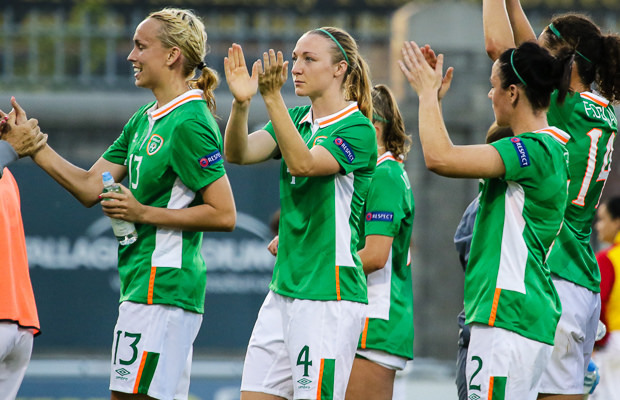
Stephanie Roche, Louise Quinn and Sophie Perry applaud fans following a 9-0 win over Montenegro at Tallaght Stadium in 2016. Credit: Laszlo Geczo

(Yeh that did say NINE nil)

But as the magnificent David Moyes showed, the women are still ok with a bit of manly banter and “special” treatment. Guilty of treating a female reporter exactly how he would a man, but with the added qualifier of “even though you’re a woman…”, poor ol Moyesie has taken a hell of a beating himself. He’s not the most enlightened man but jaysus compared to what goes on in football and life outside football, this is not the platform for a gender conflict. Paul Ince’s casual use of “darlin'” is worse in my view. Moyes would never slap Vicki Sparks or any woman, or man for that matter. Ince however represents a real patronising side to the Proper Football Man club. Awful stuff all round. Not a great few weeks for footballing gender equality on either side of the Irish sea.

Elsewhere, Mourinho has kept up his unbearable comic villain routine going quite well through this period. The worst unbeaten run in living memory has United wallowing in 6th place with 9 games to go – the sort of statistic that would have Moyes and LvG flat on their arses in the dole queue. In Mourinho’s case though, it’s all someone else’s fault. Luke Shaw, Linesmen, the lack of a Video Ref. Christ, imagine there was a woman in the dug out now!!! Football does not need a successful Mourinho, but a failing Mourinho is an absolute nightmare to witness. The sooner he pisses off the better. (As I type, Mkhitaryan has put them 2 up at Sunderland. They’re up to 5th now!!).

Liverpool have been a nightmare to follow. Up and down like freaking yo-yos, the draw to Bournemouth the latest down, only days after a fine up against Everton and that mouthy Dutch clown they have in charge. No Mané for the rest of the season will probably see us limp into next season’s Champions League. But a good win against Stoke at the weekend has perhaps given us Reds more reasons for optimism than before.

Thankfully us dual fans can seek solace in the domestic game, but as a fan of Shamrock Rovers, even this cannot help. The noble aim of giving youth a chance is not paying dividends. Rovers have lost 5 and won 3 of their first 8 games. They will settle and improve but there are many better teams in the league this year and the gap to leaders Cork is 15 points. In April.

Cork City though must be applauded for such an impressive start. I don’t know my Irish football records that well but 8 straight wins to start must be up there with the best of them. It’s between them and Dundalk again already. Fans of Pats must be in a similar mind to Hoops as they now sit second from bottom, but there’s a long way to go in a league where anyone can beat anyone.

So as the League here settles down into some sort of pattern and as we face into the business end of the English season, there’s plenty of nonsense to keep us distracted from all the other trials and tribulations of life. I’ll do my best to keep writing as much as possible and, as always, thanks for reading.

YoG no. 1 learning the ropes:

Thomas


YoG No. 22 – George Hamilton

georgehamiltonmar15_large

“It’s one of those nights”. With these words, spoken in that wonderfully familiar voice in Lille as the final whistle blew on Ireland’s dramatic victory over Italy last summer, George Hamilton evoked an entire national footballing history. And as he reamed off the names of the cities where those nights had previously happened, you remembered that through it all, there has been one constant; one reliable; one unifying element; one which has become a defining part of Irish football history itself. The voice of the commentator.

He should be more celebrated. There are the odd articles here and there, the brilliant Danger Here which gave new life to a 1988 panicked outburst, and of course the flag that has his most famous quote, but this man should have a statue erected on the west stand podium at Lansdowne Road. Every single magnificent Irish football moment has been described to the millions by George Hamilton. His voice simply cannot be separated from the moments below. A twelfth man for those watching at home, no doubt.

No attempts are made by Hamilton to hide his allegiance, an allegiance which seems to have developed despite his Belfast Methodist background. My memory of the Italia 90 home qualifiers is of commanding Irish performances which eventually led to a breakthrough goal all of which were accompanied by an almost perfunctory “and there it is…” as if it was only a matter of time before the goal was found; we could all breathe a sigh of relief – George included; and Ireland would win. Which we did in every home game of that campaign. He also famously roared “Oh nooo… disaster” when Mexico went 2 up in USA 94. No impartiality required. He knows his audience and there weren’t many Mexicans living in RTE land in those days.

George Hamilton was cemented in Irish national culture in those years. As football took the sporting and cultural centre stage for the first time since Independence, George, along with Dunphy, Giles and the equally masterful and incomparable Bill O’Herlihy transcended the subject matter and became part of the family. Sometimes he would do your head in, but you would miss him if he wasn’t there. And Ireland did. The infamous Jimmy Magee curse first reared its head in Italia 90, when the veteran was drafted in for the prestige quarter-final against the hosts. And then again four years later when the Dutch did for us in Orlando.

8826196

But he has his angry side as well. One of my favourite moments from his commentary came from that infamous day in 1995 when Ireland succumbed to Austria at home 3-1.This was the day after the Harry’s Challenge debacle and is regarded as the beginning of the end for Jack Charlton. Our batter filled lads managed to take the lead fairly late on – 65 minutes – through Ray Houghton, but 3 goals in 10 minutes as the Irish team wobbled around the pitch was enough for a good few fans to head off to the pub or to the DART and buses to beat the traffic with more than 5 minutes left on the clock. The team was fucked and there was no hope of a fightback. George responded to this disgrace by jumping on his high horse berating these “fairweather fans” who dared walk out on this team in its hour of need. It was proper righteous stuff. He was probably right based on the team’s reputation, but perhaps had he known their nutritional habits the night before, he’d have fecked off to the Beggars Bush himself for a scoop once Toni Polster had knocked in number 3.

His love of the farcical was also in evidence last summer when he delivered one of the most comical pieces of commentary in his distinguished career by choosing to sympathise with the English nation after their Icelandic collapse by aping Bjørge Lillelien at full time. Yeh he’s the Norwegian commentator from 1981 when they beat England 1-0. It’s difficult to tell the difference between the tribute and the original. Kind of. But the point is that he did it. He couldn’t have planned it in advance – maybe he had built it up for a while before the final whistle as England huffed and puffed aimlessly, which is even better because the man knows what’s ridiculous and what’s not. Yet having thought about it he purposely chose the ridiculous option and gave us a classic commentary moment. Hear it and the original at 2:43 here.Fantastic. And rightly lauded by the Second Captain’s crew at the time!

Hamilton is also famous for his absolute dedication to the pronunciation of players names.Whether they are your more straightforward French or Spanish ones or those from deepest old Eastern Europe, George will get it absolutely spot on. None of this English nonsense of just saying what you see. No.George does his research. Which he probably sees as just doing his job. It’s the other clowns who let the fraternity down.

His breadth of ability also sees him hosting a classical music show ‘The Hamilton Scores’ on weekend mornings on Lyric FM. We should also remember that he had emergency heart surgery back in 2011 and returned to the day jobs pretty soon after. He may be a most dedicated commentator, but I would imagine he is a man of perspective and wide-ranging interests.

000bc568-707

I know he has his moments and can sometimes pontificate when he sees things that get on his wick. But he’s usually right about these things – play acting; pernickity refereeing etc. but for many of us, it is impossible to imagine the glory days of the Charlton era without hearing Hamilton’s voice and I hope the same will be said in the future of Euro 2016 and a few more moments to come. At 65 years of age, there probably aren’t too many tournaments left before retirement, so we should listen carefully for those commentary nuggets that only come with such knowledge and experience in case one day soon they are replaced by an inferior product. If he had done Italia 90 and that alone, he would be a national treasure for that one phrase uttered as O’Leary stepped forward. But he has done far, far more in many, many sports and in music. And I never even mentioned Know Your Sport!!!

To quote his colleague Jimmy Magee from one of his finest pieces – “Different class!”


YoG No. 21 – 2016 Review

206231_54_news_hub_175848_656x500

It’s says something about a year in which the national team beat Italy in a tournament and got out of its group into the second round that the abiding memory of 2016 is of that man above waltzing across the continent, as Dundalk brought unprecedented success to the domestic game and made a lot of people in Ireland finally sit up and take notice. While I never reached the fever pitch of Lille while watching Dundalk – I’m a Rovers fan  – the feeling of pride was even more powerful. Dundalk was pure, true made-in-Ireland football success. It was about a border town pummelled by recession finding in its club a voice and an expression of solidarity and of community. It was everything the GAA claims only it can give (on the local scale only of course) writ large across the continent. It must have been magic to be a Dundalk football person these last few months.

But 2016 wasn’t all about the Lilywhites. Football went through a lot this year in Ireland and the UK. The start of 2016 was dominated by Leicester City and their preposterous run to the English league title. They were phenomenal however. Us Liverpool fans had this confirmed in spectacular fashion in February:

But as we all know, while Leicester deserved the title, it was a freak. A massive, massive freak that may never happen again for another 100 years. Every big team was muck last season (Spurs aren’t a big team. Cop on!). Leicester took advantage brilliantly, where the like of Spurs and the entire rest of them did not. Normal service has resumed due to a combination of the big clubs getting their shit together and Leicester quite rightly focussing all their energy on Champions League progress, having been largely found out in England. If the season ended tomorrow, Leicester fans should be happy enough, but they could get past Sevilla in the last 16 and then it’s truly in the lap of the gods. Theirs is a wonderful story for 2016 , but it means nothing for football. The Premier League is as lopsided now as ever, as dominated by big club oligarchs and capitalists as ever, as greedy and as voracious as ever, and as captivating and brilliant as ever. And we continue to lap it up.

Given the dearth of big-club success across the water (I think United won the FA Cup maybe?) and that the domestic campaign was only starting, I think it’s fair to say that the minds of all Irishmen and women were on matters international for the first 6 months of the year. Euro 2016 would see the Republic of Ireland and Northern Ireland share the spotlight on the international stage for the first time. Northern Ireland’s first tournament in 30 years would be a memorable one. Led by a great Irish football man Michael O’Neill – a man whose footprints Stephen Kenny followed this year before digging his heels in to make his own even greater mark – our neighbours were never there for just a party. They meant business and they put in some creditable performances, losing in the group by the odd goal to Germany and Poland (most would do worse), while an excellent 2-0 victory over Ukraine in the 2nd game was enough to see them through. They were eventually undone by a Welsh team on fire, but again only the odd goal separated them from the eventual semi-finalists. They also gave Europe this (via Wigan).

I had enough to say about England and their toxic national football team’s poxy showing in France back in June. Not long after, the new manager Sam Allardyce was undone in the most clumsy hamfisted manner imaginable. England have been in a dreadful mess. On the pitch they had squeaked past Slovakia in their first qualifier, in Sam’s only competitive game, while off the pitch they were thrust into yet another period of soul-searching and questioning. Only a few months after the last one. Gareth Southgate is now in charge. They will obviously qualify for Russia. And then do fuck all when they get there. Some things never change.

Unlike across the border in Wales, whose phenomenal tournament – their first in almost 60 years – kinda went unmarked here on yardofgrass. They put in the best performance of the month when they dumped Belgium out in the quarter-finals. Bale was magnificent throughout, but the form of Joe Allen was mighty along with the likes of Ashely Williams, while Hal Robson Kanu gave us this magical memory:

But two teams owned Euro 2016.Not the French, Italians, Germans or Spanish as you’d expect, but champions Portugal and the magnificent Iceland. The Portugeuse finally won the trophy their football over many decades has deserved, with Ronaldo’s generation laying to rest the ghost of Lisbon 2004. This was despite squeaking out of the group with 3 draws. The best player on the planet had brought home a prize for his country, something a certain you-know-who has never done. His almost co-management of the team in the final having gone off early with injury added another great touch of melodrama to the occasion. Any of you reading thinking “yeh but what an etc.” really need to snap out of it. This was Ronaldo’s year, which makes it a great year for football. And a fine, fine footballing nation finally has something to put on its mantlepiece. Ronaldo led his country to something Eusebio, Figo et al never did. There are no caveats necessary.

As for Iceland, where in the name of Odin did that come from. Largely expected to be swept aside in the group stages, instead they marched on ahead of Portugal with 5 points, including a win over the disappointing Austrians. The thunderclap had become established by then as they became everyone’s second team. Unfortunately England awaited, ready to sweep them aside in the 2nd round. I actually missed most of this game, but managed to avoid the result to see the highlights. It was 1-0 to England when I turned it off. As I tuned in later, I could not believe what I was seeing. First the Icelandic goals, and then – as with highlights, you never know what time in the match it is – I saw Joe Hart go up for a corner – we were into injury time. The whistle blew, and the Icelandics had a moment that must’ve felt like a million Stuttgarts. Outrageous. The continent didn’t know whether to laugh at England or cry with joy for Iceland. The latter was far more satisfying. What a dream for this tiny isolated country;  a footballing minnow until very recently, and never likely to bother the last 8 of a tournament. Yet here they were. Despite being undone by a rampant French side 5-2 in the Quarter Finals, Iceland to this day remain the story of Euro 2016.

Euro 2016 finished on the 10th July in Paris. 3 days later, as Icelandic football was still on the ceiling, their domestic champions Fimleikafélag Hafnarfjarðar travelled to a small town on the Irish border for a 1st round Champions League qualifying match. The euphoria from both island’s performances in France only days earlier was still in the air, completely overshadowing this fixture as a few thousand people witnessed a 1-1 draw which caused no ripples across each country, let alone across the continent. A week later on the more northerly island, the game ended 2-2. Irish Champions Dundalk had scraped through to the 2nd qualifying round on away goals. They would face BATE Borisov, a team who had taken 7 points from Roma and Bayer Leverkusen in the group stages the previous season, having dispensed with Dundalk in qualifying. They had absolutely no chance, and duly lost by an albeit creditable 1-0 over there. A week later, however, a thunderclap of the Louth variety went off in Tallaght, and Brady, Hoolahan and the Boys in Green would start to be overshadowed by Horgan, McMillan and the Lilywhites. An imperious 3-0 victory put this Dundalk team on a pedestal alongside the greatest domestic teams in Irish history. They were simply magnificent that night and were through to the final qualifying round.

Legia Warsaw awaited. And in front of over 30,000 people including this writer who was drowned in a summer monsoon on the cycle down the canal to the match, Dundalk went down 2-0 to the Poles. A dodgy penalty and one of those late goals you give away when you’re chasing the game. Dundalk looked done and dusted, despite showing once again that there was very little between them and their far more illustrious opponents. The following week in Warsaw, they once again showed a trait that, alongside their attractive brand of football, would define their campaign – their willingness to go out and try and beat teams. Robbie Benson gave the Lilywhites the lead after 19 minutes with the sort of goal you dream about – a screaming volley from 15 yards out – meaning Dundalk were one goal away from taking these guys to extra time. Legia then were reduced to 10 men on 67 minutes, and at no point over the next 20 minutes did you ever think Dundalk incapable of coming back. Unfortunately they came up against a well organised team with no little ability to close out a game which needed closing out. Warsaw undeservedly pegged back an equaliser and Dundalk were out, down into the Europa League group stages.

Surely at this point they would unravel! But no. They only went and got 4 points from their first 2 games, as Ciaran Kilduff wrote his name into Irish soccer history, first by scoring the equaliser away to AZ Alkmaar to secure the first point for an Irish team in a European group stage, then by getting the winner at home to Maccabi Tel Aviv to secure the first win. Dundalk were off to a flyer. But again surely the gulf in class would show eventually. Not a chance. A double-header against Zenit St. Petersburg saw a single goal between the teams in each game – Dundalk taking the lead in Tallaght and drawing level in St Petersburg. And despite going down by a single goal to Alkmaar in Tallaght, they went into the last round of fixtures with an outside chance of progressing to the knock-out stages. Unfortunately another single goal defeat followed in Israel and Dundalk’s season was finally over.

This run was unprecedented. As a Rovers fan, I remember 2011 well.No points and a few hammerings. The highlight was the 7 or 8 minutes in the lead at White Hart Lane, before losing 3-1. But Dundalk took every game to their opponents. Home and away. The most surprising thing about their performances was that they stopped being surprising. To the extent that I almost expected a home victory by the time Alkmaar came to town. That alone is ridiculous. Others who had not seen them play before were pleasantly surprised by the standard and brand of football played, but plenty of domestic teams know how to knock it around like that. But they were a phenomenal advertisement for the League of Ireland, in particular in the business-like manner of Stephen Kenny and the players – talking of victories and progress, not content to be there; not happy just to take part. In my lifetime there have been great performances at the highest level by the Irish national team on many occasions. Dundalk’s 2016 European run is up there with them all. It’s unlikely they can keep the momentum going as already they have lost 3 key players in Daryl Horgan, Andy Boyle and Ronan Finn – and it was only an away goals victory against an Icelandic team that made it all possible after all – but their success is a lesson for all Irish soccer fans. Get out and support these lads. They’re your neighbours and they are the same lads you might have kicked a ball around with as a kid; and every so often they end up representing you like this in Europe. They deserve better than we give them.

———————————————

Despite the many memories of on-field heroism and against-the-odds triumphs throughout the year, for many thousands of people the greatest football victory of 2016 was secured off the pitch, when 27 years of lies around the Hillsborough disaster were finally shut down for good. The verdict that the victims were unlawfully killed lifted the heaviest burden from the shoulders of survivors and victims families. The final vindication for a lifetime of struggle for so many people. They faced down politicians, police and the entire British justice system in their fight. The scenes on the steps of Liverpool’s St. George’s Hall the day after the verdict were football’s most poignant of the year, as 30,000 people stood in solidarity and then sang that famous song. Football thinks it creates heroes every day. But the heroics of Margaret Aspinall and the campaigners for justice, some of whom did not live to see this day, are simply beyond words.

———————————————

Thanks for reading Yard of Grass throughout 2016. I’ve enjoyed writing it and I hope you’ve enjoyed reading it. Have a great rest of Christmas break and have a Happy New Year and see you all again in 2017. I don’t ask for much for the new year but for Ireland to top the group and for Liverpool and Rovers to win their titles would be nice…


YoG No. 20 – Under-rated Irish – Stephen McPhail

stephen-mcphail-ireland

In the 2nd of this series, I look at another fine Irish midfielder.

Stephen McPhail retired at the end of the domestic season after 3 seasons at Shamrock Rovers.  Once dubbed “the new Liam Brady” by George Graham, he was part of a truly great Leeds United squad that reached the Champions League semi-final under David O’Leary and a key member of the Irish U-18s European Championship winning team with Brian Kerr as manager. He also led a Cardiff team out at Wembley for the 2008 FA Cup Final. His career, however, was blighted with injuries and illnesses. Despite his success, despite his great achievements, and despite the fact that he has been appointed Sporting Director with Rovers and will hopefully have a long, and deserved post-playing career in football, there is a sense  that had a bit more luck shone his way, we would be speaking of him in the same vein as his former teenage teammates Robbie Keane and Damien Duff. Even a glorious end at Rovers would have been nice, but managerial upheavals and the presence of great Dundalk and Cork City sides kept the Hoops well off the big honours in McPhail’s time at the club as a player.

Born in Westminster, London, he was raised in Dublin. His schoolboy career was forged in that great Dublin Academy of Home Farm in the early 1990’s from where he earned a spot in Leeds’ youth system. For those of you too young to remember, Leeds were giants of English football in the 90’s and into the early 00’s. Some of you are probably old enough to remember them as giants in the 1970’s as well. The now much-maligned and perennially unemployed David O’Leary was their manager through this golden period as McPhail made 78 appearances for the first team. O’Leary’s sacking, combined with a massive financial implosion and the subsequent scrambling around for new gaffers and new ways to dig themselves out of their abyss,  meant the glory days were well and truly over for the club, and Stephen left to join Barnsley in 2004 after loan spells at Forest and Millwall. From being an unused substitute in a Champions League semi-final against Valencia to the 3rd tier of English football is quite a drop in a few years, but he went on to rebuild back up to the pinnacle of the game not long after.

After playing a part in Barnsley’s promotion to the Championship in 2006, he left to join Cardiff City. He spent 7 years with the Welsh club and racked up 190 appearances, captaining them on many occasions, including the 2008 FA Cup Final. This honour has fallen to only 2 other Irishmen in recent decades – Ronnie Whelan in 1989 and Roy Keane in 1999, 2004 and 2005 (thanks DannyInvincible on foot.ie). It’s quite an exclusive list to feature on. Unfortunately Cardiff were beaten by Portsmouth that day.

Injuries would interrupt the next few years, followed by a cancer of the lymphoma diagnosis in November 2009. He would be out until the following February, which was a remarkable recovery turnaround and a testament to his character. Over the following years, he was in and out of the side with injuries and illness, including Sjogrens syndrome. Despite this he was given the honour of Clubman of the Year in 2012, but was released by Malky Mackay at the end of the 2012/13 season after only 2 appearances that term. After a brief stint at Sheffield Wednesday, he came home to Shamrock Rovers at the start of 2014. He made 53 appearances for the Hoops, scoring twice.

000d0e1d-800

He has 10 Ireland caps and 1 goal, the last appearance coming in 2004. I don’t understand how he wasn’t capped more often, in particular during his time at Cardiff City. It seems ridiculous that an Irish player can lead a team out at Wembley and not feature for the national team. He was drafted in by Trappatoni in 2008 but never featured. The fact that he was a fine footballer maybe explains that.

I think we can all trust that Stephen will continue to give his all to Shamrock Rovers in his new role and bring home his wealth of experience gained at the highest levels in England. He has had an extremely successful career for which he deserves great credit. And despite the difficulties he’s had to overcome in forging a 20-year playing career, his humility in his statement on his retirement shows he is precisely the type of personality that we need to keep in the Irish game.

His statement ended very simply with the words “Football, thank you for everything”. It’s a sentiment we all understand to some degree, but rarely express. I hope he has many more happy decades in the game.

YoG No.19 – From Global Icon to Local Tragedy – Rashidi Yekini

1336259386rashidi

For those of us in a certain age bracket, the above picture is one of 90’s football’s most iconic images. Rashidi Yekini crying into the net after scoring Nigeria’s first ever goal in a World Cup, in a 3-0 dismissal of eventual semi-finalists Bulgaria. In a tournament that featured Baggio and Maradona, and Ireland beating Italy, this may well be the image that many remember most vividly. In May 2012, the national hero pictured above died aged 48. The circumstances around his death are bizarre and may even be horrific if the real truth ever emerges. For now, there is no real clarity – rumour and intrigue surround this story and may always.

But first, it’s only right to look at this man’s great football career. 37 goals in 58 games for Nigeria; 90 in 114 for Vitoria Setubal in Portugal. At his peak, he was comfortable in the upper echelons of European football, being top scorer in the Portuguese League in 1993-94, as Setubal finished 6th. And, of course, the man who lit the spark as Nigeria made the last 16 of USA 94.

In May 2012, reports state that he died in a traditional Nigerian healing home. Chained to the floor. Screaming. Rumours are that we was kidnapped by family members, against whom he had taken out a restraining order. He was shackled, thrown into the back of a van and brought to this place. He was buried mere hours after his death. No inquest took place and the story was that he had suffered cardiac shock, despite having no record of any difficulties in that regard. The official family line is that he had slowly lost it and they did all they could to help him until eventually he died during an intervention of some sort.

Things are rumoured to have started to turn bad for Yekini when he lost all his savings in an investment with a man named Ibraheem. It seems he transferred all of his wealth to this man in cash before he was gunned down and robbed, by men tipped off that he was going to be carrying a huge amount of money – Yekini’s money. Even this story doesn’t feature in all accounts, but could explain partly the downward spiral he went on. Pathetic stories of him being seen in scruffy clothes; wandering the streets of Ibadan; relieving himself on the side of the road; selling plantains on the street; pepper the various accounts given of his final years.

His family claim he suffered serious mental health problems and that they had tried again and again to intervene. Local police and his friends claim he had a restraining order against his relatives and that his death was preceded by his kidnapping. His friend and barrister Jibril Mohammed is quoted in the Blizzard as saying Yekini had been close to his family. He opened a supermarket for his sister, bought his mother a two-storey building and sponsored his footballing brother to go to Cote d’Ivoire. But things went awry as the family, as is claimed, became obsessed with his money. It seems that Yekini’s eccentricities were over-egged in order to paint a picture of a man teetering on the edge of madness.

His daughter Yemisi tells a different story. He seemed fine when they spoke on the phone – she lived in London. This view of a perfectly sensible man was backed up by Mohammed, who said he had a physician visiting and that his health was fine. Neighbours attested to this view – one of a very generous man who wished to live in peace and a degree of solitude. One who would look for you when he wanted you and who had a fairly steady routine. In May of this year Yemisi and her sister Omoyemi once again requested that an inquest into their father’s death is opened. At a press conference in Lagos, Yemisi had these words to say:

“You don’t know whether he was killed, or he was drugged, or he was ill; there are no answers…”

A man whose joyous face was beamed across the globe and became the defining image of a World Cup died with no proof of illness and no death certificate, buried immediately under concrete. And with a strange concoction of intrigue surrounding him, bound up in the private realm of the family and Nigerian social structures and customs. He obviously deserves far more than this. From his family and from Nigeria as a country and their football association. And his daughters deserve this closure as well.

Further reading:

Rashidi Yekini’s children want inquest 4 years after father’s death

Untold story of Rashidi Yekini’s last days

The Sad End of Rashidi Yekini

Subscribe to The Blizzard!


YoG No. 18 – Belfast Celtic

231125861-88581eae-209f-49f2-9f03-3dd64dc8c3a9

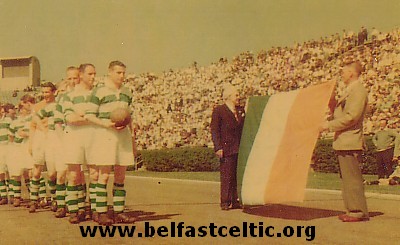
The grand old team and a fundamental part of Irish football history, their story is one worthy of keeping alive, particularly in these days where folklore is written by rival tv stations, agents and advertisers. The people at the Belfast Celtic Society are doing their utmost in this very endeavour with a website which may be the most complete and comprehensive history of any football club anywhere. Reading more about this club and the affection in which it is still held has made this the most daunting of any post I’ve written! While dozens of Irish clubs have been in and out of business, Cork Hibs and Drumcondra being among the best known, it’s Celtic’s story which is most interesting and dramatic, suffused as it is with the political upheaval and violent sectarianism that shaped this island in the early 20th Century.

The story of Belfast Celtic is also the story of Ireland and Northern Ireland. A footballing microcosm of the troubles past and the troubles which followed their disappearance from League football in 1949. And from what I’ve gathered in researching this article, a club; a name; a family; and a way of life which is still held dear by many, many people. There’s a real passion evident in the esteem in which this club is held, and the nagging feeling that their absence may be a much bigger hole in Irish football than many may think.

Formed in 1891 they went on to play their home games at Celtic Park on the Donegall Road in West Belfast, they  won the Irish League fourteen times and the Irish Cup eight times. Celtic Park, like its Glasgow namesake, is still called Paradise, even though it has been paved over for a fairly non-descript out-of-town shopping centre since.

paradise

You would imagine that a team with that name, in that city, through that period, would have been defined purely by one side of the divide and that side only. Belfast Celtic, however, showed no preference whatsoever for Catholic players and this ethos is carried on by the Belfast Celtic Society who state that “The Belfast Celtic Society is an inclusive, non-sectarian, anti-racist organisation in the spirit of the Belfast Celtic Football and Athletic Club. Membership of the Society is open to individuals irrespective of age, gender, ethnic identity, nationality, sexual orientation, race, religion or political opinion.” Their support was indeed Catholic but many of their players were Protestant. Sectarian hiring policies were for others.

paradise-frontdoor

It’s no surprise to learn that the club modelled itself on their Glasgow counterparts, with the name and nickname of their home ground, as well as the green and white hooped jerseys. Not surprising either would be the fact that these colours transferred directly down to Shamrock Rovers, who first wore the Hoops around 1926, changing from the green and white vertical stripes. Belfast Celtic also provided the opposition for the opening game at Milltown in 1926, bringing 4,000 supporters to swell the attendance to 18,000. Celtic won 2-1 to claim the unofficial title of All-Ireland Champions.

While their story ultimately ended in sadness, Celtic were an innovative club. According to this Irish Echo piece, they were the first Irish Club to play on European soil, when they travelled to Czechoslovakia in 1912. Future 1916 rebel, and Minister for Justice, Defence and Posts & Telegraphs, as well as President of the FAI, Oscar Traynor was the goalkeeper on this tour.

But it was the nature of the club’s demise that has caused the sadness that seems to permeate the writing and the memories to this day. This club is commemorated in as much as it is celebrated, because they were beaten out of competition by violence not by sport. Having left the league temporarily in 1920 as the island fell further into warfare, their participation was permanently and savagely terminated on Boxing Day 1948, when Linfield fans poured over the barriers and attacked Celtic players after a 1-1 draw. Protestant  Celtic player Jimmy Jones had his leg broken when he was chased or pushed over a wall. The RUC just looked on. Jones had annoyed the Linfield fans first by leaving them to join Celtic, then on the night in question he was held responsible, by no more than the PA announcer, for causing injury to Linfield’s Bob Bryson. The club had had enough.

While they dropped out of the Irish League then, they would go on to have one last, and historically significant, tour when they headed Stateside in May 1949 – thus becoming the first Irish team to cross the Atlantic. They played 10 matches including an incredible 2-0 victory over Scotland on May 29th. The Scots were Home International Champions – probably the best team in the world as far as the British and Irish press were concerned at the time, who had dubbed them the “wonder team of 1949”. The game was watched by 15,000 spectators at the Triboro stadium in New York. It’s not possible today to find a comparison to that result. A good club side would never come up against a great international side and actually compete with each other, plus these days the clubs are better in many cases. It is rightly regarded, however, as one of the finest performances by a club side ever.

flagcolortxt

And so that was the end of the Belfast Celtic story. They have events to this day and there was a UTV documentary done in 1989 commemorating 40 years since the club’s greatest achievement and ultimate demise. The significance of their loss was perhaps not as keenly felt in its immediate aftermath, in that attendances at matches north and south remained healthy. But I do wonder as both leagues on the island continue to struggle to get attention in their native lands, and possibly with a view towards an All-Ireland league and national team one day (it’ll never go away. Accept that.), if the presence of a true footballing force for unity in Northern Ireland – more recent efforts by the IFA notwithstanding – could make a major contribution to that end.

I’ll leave with some words from society’s page, which neatly sums up the story as follows:

“The city of Belfast never recovered from its loss and neither did Irish football. The formation in 2003 of the Belfast Celtic Society is living proof that the Grand Old Team is not forgotten. We hope that these pages will be a forum for those interested in the history of the club and an inspiration to those who are currently campaigning for the  reformation of Ireland’s greatest ever football team.”


YoG No. 17 – Bohs 3 – 2 Rangers. Great Days and Nights in Ireland

bohemiandublin1024px-rangers_fc-svg

Following on from the first post in this series, which aims to highlight how good the football played on this island by our teams can be, and following Dundalk’s slaying of BATE Borisov and ascent into the play-off stages of the Champions League, this sweet victory for the Northsiders stands out for many reasons. I’m too young to remember this at the time, but it’s been an integral part of Irish football folklore for over 3 decades. Bohs beat Rangers, beat them well, and took that lead to Ibrox, where they went out only 4-3 on aggregate. This was back in the days when the Scottish League was good. When it was competitive. And when Scotland qualified for every World Cup. Long before relegation and Sevco threatened to make a century of half of Glasgow’s football history irrelevant, Rangers were a credible force even in Europe. While Bohs have had their ups and downs since this game, in 1984 as these days generally, they were a part-time team in a mainly part-time league. Their successes and falls from grace in the intervening periods, while fairly spectacular, were nowhere near the disgrace that Rangers became. And that’s coming from a Rovers fan. (Glasshouses etc….)

And then, as now, there was no way in hell a team whose fans flew Union Jacks and can be found in large numbers in the most hostile parts of Northern Ireland, would be able to play a match in peace in Dublin. I suppose the main difference from now for me, as you’ll see in the footage below, is how ill-equipped An Garda Síochána were to deal with the violence from both sides. When you see how tooled-up they get for run-of-the-mill Dublin derbies, I can’t imagine them showing up for a game like this today with a wee truncheon, a shield and a soft hat.

Despite the very-well intentioned preparations of Bohemians, including putting in brand new fences to pen Rangers fans in away from the home fans, there was some trouble at half-time which carried on during the game and into the streets of Phibsborough afterwards. Sectarian chanting before hand had turned to flag-burning, pitch invasions, and some fighting. It was inevitable. This RTE Today Tonight piece details all of this. I suppose one thing that certainly has not changed since 1984 is that the Irish media will piss all over success in the League of Ireland by focussing on the negative. Look how little attention is given to the fact that a mainly-ignored semi-professional outfit from Dublin with falling attendances had got one over on a massive British club playing in a league with which so many Irish were obsessed. (I accept that this wasn’t a sports show, but did they give it its due elsewhere?)


Anyway, there was a match as well. “Rocky 2, Gino 1, Orange Bastards On The Run!!!!”, I’ve been told by a Bohs fan was the chant of the evening. Rangers led twice in the game, thanks to Question of Sport arse Ally McCoist and Dave McPherson. Twice David “Rocky O’Brien” hauled the Gypsies back level. But the game was settled by an appropriately spectacular strike from Gino Lawless on 50 minutes.

I can only imagine the reaction on the terraces. Guttural and tribal come to mind. Violent and nasty also. Despite all of the focus of the media on the off-pitch shenanigans however, the game will be remembered as one of Irish football’s great performances. Certainly were it to happen today it would be a massive event. Personally I’d rather see an Irish team do Celtic in but that’s just petty!

And by the way, if you think the Gardaí could relax after that game, Linfield were due in Milltown the following week. Fortunately their fans were not given tickets and only 200 showed up, in peace. Unfortunately a few dozen Rovers fans gave the cops a bit of work to do, but the Hoops lost on away goals after a 1-1 draw. Glasgow Rangers and Linfield in Dublin in the space of 7 days though, jaysus.

I’d like to end by giving the highest, albeit belated, praise possible to Dundalk for their performance last week. More often Irish teams squeak through the odd big European tie, salvage draws, or win one leg which goes down in history and get battered in the other which becomes a footnote. This was very different. Dundalk outplayed BATE Borisov. They outclassed them. They outdid them in every way and deserved the 3-0 win on the night and the 2 goal win overall. I don’t know if they’ll have it in them to beat Legia Warsaw. Pat’s epitomised what I’ve just described against the same opposition in 2014 where a more than creditable 1-1 away draw was followed up by a 5-0 hammering at home. Dundalk are a better team now though than Pat’s then. It would be such an incredible thing for Irish soccer were they to get through. If that doesn’t wake up the nation’s football community to the potential of the football played in Ireland by our teams in our own communities, it’s a lost cause. I’ll be in the Aviva that evening and I hope the rest of you are too.

(PS Only a Rovers fan could end a post on Bohemians talking about 3 other clubs eh…)


YoG No. 16 – England

516ar8johol

The England national football team is a toxic entity. No matter who the manager is, no matter who is on the pitch, the whole damn thing is poisonous. This has never been so starkly evident than in the past 4 weeks. From top to bottom, from the FA boardroom to the police cells of Marseille; from the highest paid players on the planet to the lowest vermin tabloid sports hacks, the whole culture of the English national football team needs to be torn asunder and rebuilt. They limped home from France in embarrassment, their epic failure to become  a punchline for generations. All involved should be ashamed, including their fans (not just the misbehaving ones) and including the English press. In the shadows of a mindless referendum on EU membership, a mindless football culture fell apart. What is most interesting this time is that there is no scapegoat. It’s time for England to look in one place only for the explanation – the mirror. But I wager few, if any, will do that, instead looking to a multitude of scapegoats. Each one, however, can be absolved in turn.

They will look to the technical ability of the players and their coaching – how they have less coaches per capita than some of the European giants. But these players show ability week in week out in the Premier League. Eric Dier does not become shite when he swaps the white of Spurs for the white of England. They are not bad players. Nor are the England based Welsh semi-finalists.

Another age-old bogeyman is the lack of a winter break. There is no question about it but that a winter break is required for many reasons, but England’s inability to perform even half-decent over 4 games cannot be blamed on this. Again, most of the Welsh team play in England and it never affected them in getting to the semi-final. At that stage the exertions over the previous few weeks may have gotten to them, and only then against a better side. But Ireland managed to out-perform England as well, even with suspicions being raised about our lads’ fitness by the end of our tournament. Where Ireland dug deep to beat Italy, England had nothing to respond to Iceland – and don’t even begin to try to explain that Iceland’s first XI would be better than Italy’s second XI; where Ireland took the game to France and looked comfortable for long periods 1-0 ahead only to be undone by some bloody good play, defensive lapses and a red card, England crumbled after taking the lead against Iceland and did nothing against Russia or Slovakia. Did nothing! Yet all of the Irish players play in England, with the exception of Robbie Keane. There was no need for Robbie Brady to have a winter break in order to break his balls to get himself onto Wes Hoolahan’s cross, nor was a January respite required for Wes to show the balls needed to get straight back into the Italians having just missed a sitter. Nah. A winter break will give England-based players some much-needed rest (unless of course they are dragged all over the globe to raise money for the oligarch owners) but it won’t win them tournaments.

Then there’s the manager. Or managers. Mercer, Revie, Greenwood, Robson, Taylor, Venables, Hoddle, Keegan, Erikson, McLaren, Capello, Hodgson. All failures at the England job since Alf Ramsey’s World Cup victory in 1966 at Wembley. Their last trophy was won in black and white. Two semi-finals and fuck all else since. Epic failure during the 1970s and under Taylor and McLaren where they even failed to qualify. It’s not all their faults. They’ve tried them all in recent years yo-yoing from needing a foreigner to inject something new to needing an Englishman to inject something old. All have failed. It’s not the manager.

england-world-cup-final-1966

What has really come out in recent weeks, however, is the pure poison emanating from the English media. The use by that vile Murdoch publication of that vile picture and caption of Wayne Rooney’s son was perhaps that notorious rag’s lowest point in sports coverage in recent years. It was disgusting, absolutely disgusting. And those responsible for that abusive front page should be ashamed of themselves. I bet they are not. I bet they are bloody thrilled with themselves.

Former detergent salesman Danny Baker is another example of this OTT bullshit – faux outrage click-bait scumbaggery of the highest order. Does this character really think that the best thing to do in order to build a footballing empire to rival Germany, Italy and even Wales!!! is to repeatedly call your players “worms” and a “fucking disgrace”. Christ almighty!

So when you see England internationals on the pitch shitting themselves and underperforming, it’s not because they are useless and overpaid bastards. It might however be explained by the fact that they’re worried that some middle-aged often overweight men might decide to put their crying child on the news-stands across the nation the next day or tweet that they are all worms. If the English media are in any way reflective of the English people, then they have exactly the team they fucking deserve. But we know they are not and we know they deserve far far better. It would seem, however, that the tabloid hacks shoulder a massive amount of blame for England’s 5 trophyless decades and need to have a serious look at themselves. But, as their coverage of Paul Gascoigne in recent days shows, they won’t. Another football genius, possibly the last true English football genius, hounded by the English media. Leave him in peace for the love of God.

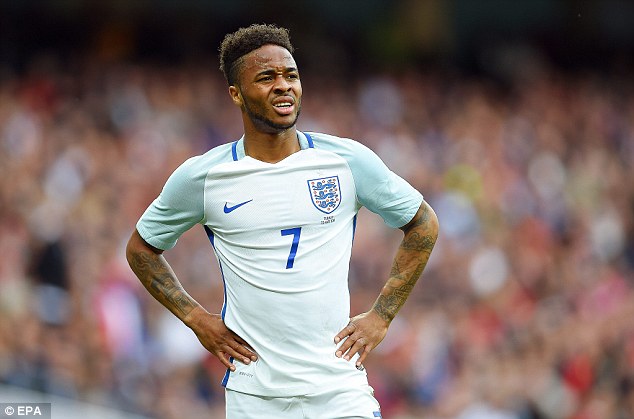
One of the media’s favourite hobby-horses is of course the money players get paid. They even lie and make up stuff to ‘prove’ how out of touch these millionaires are, such as the one a few weeks back about Raheem Sterlings gold-encrusted sink in his latest mansion. Of course, the house in question was bought by Raheem for his mother. Yet some odious cretin and his editor put the misleading bullshit headline into their rag, with the truth buried in later paragraphs.

348099c400000578-0-image-a-33_1464559441462

They do have a point here I guess. Average to poor Premier League players are paid an awful lot of money. This must affect their hunger and desire no? You could see how little success meant to other footballing millionaires like Cristiano Ronaldo and Gareth Bale, right? Or Antoine Griezmann? Or any player from any successful national team of the past 15 years. Remember that great team of German paupers who won the last World Cup? Or the Spanish team that were all on minimum wage who won 3 out of 3 tournaments? Nah lads it’s not the money that makes them complacent, it’s that fucking media again telling them they are “worldies” or “top, top” players when they’ve barely fucking played half a season. Year after year after year, English children (because remember that’s what they are when they break though) are told that they are among the very best in the world at football, despite having achieved nothing. Sterling is another great example. He has yet to win a major trophy yet had already been built up as an English  messiah while at Liverpool and is now in the process of being cruelly torn apart.

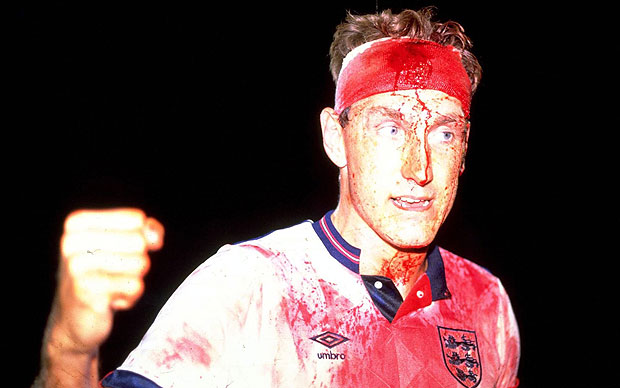
The final bogeyman, and a new one at that, is lack of leadership. If only England had a real lionheart barking out the orders, with a Butcherload of blood all over their head and jersey, wouldn’t they be great. This is of course absolute and total nonsense. John Terry, Steven Gerrard, Bryan Robson, Terry Butcher etc. etc. etc. all great leaders who have never lifted a major international trophy. While they could absolutely benefit from having a John Terry instead of a Chris Smalling now, it’s not the answer.

terry_butcher_2662091a

So what is?

The answer is beyond football, in my view. It lies in English culture, and is something that seeps into Irish culture as well. It’s a lack of education. I don’t mean University Degrees or PhDs, or even GCSEs or Leaving Certs. I just mean knowing how to behave and how to think. It doesn’t seem to affect Irish soccer at the international level, but it sometimes does in the domestic game and can seep into GAA on rare occasions. It’s the lack of objective critical analysis and a default to the cheap and tacky within all of us. A mob mentality. Banter and groupthink trumping real thought about the game. A Soccer AM world view (below). Proper Football Men. The ongoing sneer that has been directed at Arsene Wenger from some quarters for 20 years, which was turned on Rafa Benitez for a while too. It’s 8 pints of cheap lager and a bag of chips. It’s X-factor and it’s Britain’s Got Talent. It infects the Irish too. Educated players are given nicknames. Graeme Le Saux was labelled a homosexual because he went to college and read the Guardian. What the hell has that got to do with England losing to Iceland you ask? It has EVERYTHING to do with it.

maxresdefault

There is no thought in that team. No one seems to know what to do and when to do it. Clueless. And it’s not just up to a football coach to teach that. It’s a social thing. Teachers in schools teach that as well. Parents teach it. England is always on the hunt for Roy Race. He’s a comic character. Gerrard never did it for England. Neither did Captain Marvel Bryan Robson either as he left the international stage trophyless and without reaching a final. Football may be about fairytales at times, but 99% of the time football is about ability and out-thinking as well as out-muscling your opponent. England cannot do that anymore, and if we’re honest, haven’t ever really done it in my lifetime.

John Nicholson of Football365 got in there ahead of me (I’m part-time and started this post several days ago!!) when examining England’s performances and he is spot on in many ways. But it still does not account for England’s failings alone. It’s something about that jersey and the pressure combined with the intellectual mediocrity that makes it impossible. Wales and Northern Ireland exceeded expectations in Euro 2016 with groups of England-based players. Ireland pretty much met expectations with England-based players. It’s not just English, British or Irish culture alone that’s the problem. It’s the culture around this team specifically. Our lads escape England to play for their countries. As do the Welsh. But the Premier League bubble wraps itself around the English team and the bullshit and hype goes on.

The England team has for well over a decade now been crippled by hype, anti-intellectualism and a poisonous media. Even Irish fans are bored of their failings. It has to change.

Good luck to Sam Allardyce if he gets the job. If he fails, so what. It’s just the above to blame again. If he succeeds, well he obviously learned everything he knows in Limerick…


YoG No. 15 – Ireland at Euro 2016

000c6fd1-800

Sin é. All over. Including the shouting. Normal life resumes. The tournament goes on without Ireland and the big boys will fight on to Paris in a few weeks. Dry your eyes out, go back to work and those other second-rate hobbies, have a cup of tea and relax because it’ll be a while before you get those feelings of euphoria and heartbreak in your life again. What a fortnight though. It seems like months since Wes Hoolahan had us on our feet with that beautifully crafted goal against Sweden. It’s been just over two weeks. Two weeks not unlike the 2 year campaign that led us to France, containing polar opposite lows and highs with very little in-between. There was no average game in this tournament. We were the better team by some distance in 2 1/2 out of 4 games; and nowhere near our opponents in the other 1 1/2. No in-between. And perhaps that’s how it will be remembered.

I read somewhere a few months back that this Ireland team would make the 2012 team look terrible; like impostors; pretend internationals. In a way, the performances in France achieved that, but moreover, they confirmed that Trappatoni and Tardelli were a pair of hacks when it came to this job. Even accounting for the fact that a number of players such as Hendrick and Randolph have emerged more recently, the absence of Coleman, Hoolahan et al and the lack of game-time given to others over the Trap years now looks like gross incompetence on the part of the Italians. Ireland 2016, in essence, made absolute shit of Ireland 2012.

It’s too soon to rehash the stories of how each game unfolded in the manner of previous posts (Euro 88Italia 90USA 94, and Japan and Korea 2002), as we’ve just seen them and read all about them so I’ll approach this one a bit differently.

The build-up to the tournament was subdued. The sting of Poland was still felt and we knew this was yet another difficult group, in a tournament format that required other results in other groups to fall kindly. We ‘knew’ we had to beat Sweden however. Experts, of the paid media and barstool variety, all agreed.

So it was off to the Swan on Aungier Street at 4pm on Monday 13th June, a great Dublin pub. Annual leave and ‘flexi’ had been arranged to suit the fixtures. Tuesday would be a day off because you never know, and it’s always better to be safe. Amazingly, we arrived to 4 empty stools under the TV at the bar. It would be rammed by 4:45 however. We were the lucky ones. Then Wes scored that wonderful, wonderful goal and we were on our feet. The difference in this game to other games we’ve taken the lead in recently (Scotland, Germany, even Georgia), was that we felt we could hold this one. We were playing very well, with little threat coming from Sweden, and the most panic in the Irish defence was in fact, self-inflicted with Ciaran Clark doing his best to beat Randolph. He eventually succeeded after the only peek we had of Zlatan all day.

ireland-sweden-wes-hoolahan-euro-2016_3483461

2 points dropped. Not quite doom and gloom, but not far off. Tougher tests lay ahead. Positives emerged all over the park, but none so clear as the performance of Jeff Hendrick. The Dubliner had shown great quality at times in the qualification campaign, but in this match he took a giant leap forward, controlling the game, creating, and coming close to scoring with a rocket off the Swedish crossbar.

Belgium. Saturday afternoon. Mulligan’s of Poolbeg Street. Another one of the best pubs in Dublin, but not too hectic for the match, which was fine as the Irish team weren’t too hectic either. Battered by a better side who were intent on showing their quality after their disappointing and very poor defeat to Italy in the first game. We had a definite penalty refused at 0-0 – see picture below. Had we scored then, god knows what would’ve happened, but defensive lapses and naivety combined with lethal marksmanship done for us. This was a disaster. Not only were we stuck on 1 point, but our goal difference coupled with the results that would come about in the other groups meant nothing but a victory against Italy would do.

thomas-vermaelen-belgium-shane-long-ireland-toby-alderweireld-belgium-18062016_1vx12r40jvc3r1l29l407hpd7b

I booked my flight to Charleroi months ago, with tickets secured through those allocated to FAI season ticket holders. I had a feeling about Italy. Knowing that, no matter what, this match was likely to be decisive due to the format of the tournament, I put all my money on it. As I walked into Lille City Centre with my mate Bryan (he of the Polish police assault in 2012), we found a roundabout with a few bars around it already being colonised by the Green Army’s advance party. Every passing minute the crowd grew and the traffic gave way. Footballs bounced around and as usual the locals wandered around with a wry smile which said they loved it, but will be happy enough to have their city back by Friday. We left this location about 6 hours later. Sunburnt and hopeful. But we never in our wildest of imaginations could have predicted the drama ahead.

Getting to the stadium was not the easiest. As an aside, one of the greatest decisions in Irish sport was surely the maintenance of Lansdowne Road as our national stadium within walking distance of the city centre. Imagine having to trek to fucking Abbotstown for all those games and imagine not having every pub in Dublin 4 and 2 and many more so accessible before and after. I’ll take the diminished north stand and the 50,000 capacity any day over the alternative. History and location are important.

Anyway, Stade Pierre Mauroy is not central. It sits close to the University of Lille’s campus on a fairly low capacity driverless tram line. Security was bloody slow, but you can’t really complain about that. Once inside the ground however, there was a special buzz. By 10 minutes in we were all thinking that Ireland looked assured; confident; and belonging at that level. Even if it was an under-strength Italy, the 11 in blue would give any team a game. As many have explained before and since, unlike the white of England, the Azzurri brings out the best in Italian footballers and they don’t bring bad players to tournaments. We had chances and they had chances. But we would have the moment…

robbie-brady-republic-of-ireland_3488820

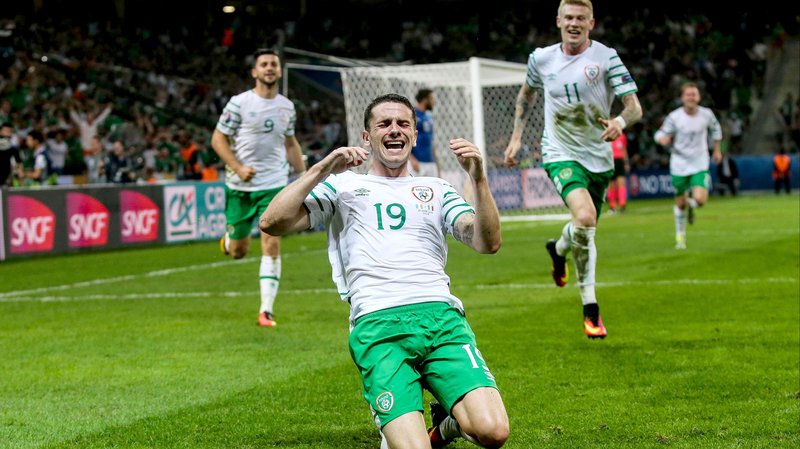
It’s incredible how 5 minutes can wash away almost 15 years. It wasn’t just Robbie Brady in my mind as I jumped around the stadium, hugging strangers, screaming as we went 1-0 up. It was all the near-misses and football disasters beforehand – the 2 weeks in Poland; Thierry Henry; Cyprus away; Staunton as manager; Brian Kerr and Israel and Switzerland. It was all the nonsense comparing the footballers to the rugby team; the “you wouldn’t get that in the GAA” brigade; all of the years that Irish football was ridiculed and made a national punchline because for a decade and a half we punched at or below our weight for a fucking change. Could tonight in this stadium be one of those great nights? What about the 12 year old kid beside me in the stadium with his parents who was bawling his eyes out after the goal, bringing me right back to my own formative Italia 90 experience. Could he be denied this night?

I spent the next 5 minutes hunched over the seat in front. Could I vomit? Possibly. Was my head splitting from the beer and indoor humidity? Yes indeed. Can I feel my left arm? Yes (thankfully) Will it ever end??? God will it ever fucking end?

Then it did. It finally ended. And the place, already in the midst of a volcanic event, erupted even further. I have never in my life experienced anything quite like this. Everything listed above rushing through my head and heart. The crowd in absolute rapture. Grown men all over the place crying. Women and children too. No-one knew where to turn so we all just turned to whoever. Hugging, singing, cheering. Our lads, our Boys in Green had beaten Italy. Their place in national history secured. We still talk about Houghton, Whelan, Sheedy, Quinn and O’Leary. Now it’s going to be Robbie Brady. No one will forget that moment. We had finally surpassed expectations again. For the first time in a long, long time. We were out of the group. Into the knockout stages of a tournament for the first time in 14 years. The players came over for the congratulations. The Fields of Athenry belted out endlessly in the stadium, before one-by-one we left, texts flying back and forth between Lille and home. We knew we had seen something truly special. And another generation had their night!

The tram ride back was a sweaty stinking ordeal, but all worthwhile for the moment when we emerged from the underground into the concourse of Gare de Lille Flandres station. Hundreds of fans were standing around the escalators as they came up to ground level but the acoustics of the cavernous station building made it sound like thousands. Again it was The Fields of Athenry, endlessly. It was an incredible moment. To be welcomed into the station by that crowd, then to join in for half an hour and watch the rest of the supporters stare around at this sight was unforgettable. Forget the last pint lads. Just soak it in. Thursday was sweet. Thunder and lightning all morning followed by glorious sunshine all day long. In the evening we headed back to Charleroi and to Dublin, privileged with the knowledge that the host nation awaited on Sunday.

And in Lyon it would end. For me, it was the Sugar Club on Leeson Street which is a bloody marvellous place to watch a big match with it’s cinema layout and massive screen. We had a dream start and a pretty phenomenal hour of Irish football, undone by 10 minutes of French quality; some Irish naivety; and a centre-half doing what he had to do and getting himself sent off. 2-1 it ended. We could have equalised. We had a go, but there were no complaints. The better team won fairly and we would be on our way home.

image

There’s been plenty already said and written and there’ll be plenty more to be said and written about the Irish performance in Euro 2016. We’ve heard daftness on a regular basis from Eamon Dunphy, a man I’ve always respected in many ways, but in the last fortnight he has well and truly exposed himself as a bluffer and, in his own words, a cod. Each line-up announcement was greeted like a blasphemous text; each mistake or conceded goal as an excuse to peddle another one of his hobby-horses. McCarthy, Clark and Shane Duffy were all scapegoated and treated fairly disgracefully by this clown, who has now decided John O’Shea is some sort of Irish Fabio Cannavaro for fucks’s sake. Eamon, you can inform the viewers as to how and why a goal was conceded but you don’t have to hang a player every fucking time and claim the alternative would not have conceded the goal. We’ve had plenty of shite defensive performances with O’Shea in there. Dunphy, like his knackered hobby-horses, needs to be put out to pasture. He has become nothing but click-bait for the national broadcaster and has plummeted in my humble estimation.

On the other side, and to be positive,  the phenomenal Second Captains have proven to be among the very best in sports broadcasting on these islands once again. A new hour of material every day of the Euros, an hour of quality, insight and humour. Highlights include Ken Early’s refusal to review the Ireland Belgium game, instead taking up about 10 precious minutes of airtime reviewing the game that should have happened where the “Jean Claude Van-Damming” of Shane Long led to a penalty and we won as Belgium, under pressure and falling apart, could not muster up an equaliser. Quality stuff, as was his wonderful story of getting back from an England game on the train. Sounds mundane but it was nothing of the sort. Add in the rest of the lads, the world class guests, and we have a clear, outright winner when it comes to the Irish sports media. We waited in a department store – quite a posh one – in Lille so we could use their wifi to download the post-Italy podcast to listen to on the drive back to Charleroi. It took a while and pushed us into the next hour of car park charges but it was well worth it.

So I’d like to end with the one most important outcome of these Euros for Ireland. Above all else it was a time when the Irish people fell back in love with the Boys in Green. A time for new heroes, at long last. We had a taste against Germany, but all of the problems and issues for the national team ebbed away with, let’s upgrade it to 3, memorable performances in France, including rattling the host nation in front of 55,000 of their fans. That was the first time we had ever led in a knock-out tournament game in our history. In all the folklore of the Charlton years with all those world-class players, we had never taken the game to anyone like that and led. And held on for so long. These lads were the ones that did that. This group with this management team have created some of the best football memories in Irish history in the last 2 years, just when you thought you would never see their likes again. We owe them big and we will let them know next time the old ground in Dublin 4 opens up. Here’s to the next World Cup campaign and let’s make qualification seem normal again, and let’s make performing well at the tournament normal again. Wales, Serbia and Austria await. My season ticket will be sent out soon. And the whole bloody palaver starts all over again….

Merci.

0002c3dc-642